
🔍 Read the full analysis: How 10 Best Mesh Wi-Fi Systems Can Help Cover Your Home In 2027 on ThorstenMeyerAI.com

Get business pricing on office and shipping supplies
- Business-only prices and quantity discounts
- Tax-exempt purchasing
- Multiple users, one account, clear invoices
TL;DR
The source compares 10 mesh Wi-Fi systems for different homes and needs, ranking the TP-Link Deco X55 as a balanced Wi-Fi 6 starting point. It also considers tri-band and Wi-Fi 7 options, but offers no independent test results, current prices or verified 2027 availability.
A buyer comparison from ThorstenMeyerAI.com, the original analysis, ranks 10 mesh Wi-Fi systems for different home layouts and network needs, placing the TP-Link Deco X55 first as a balanced Wi-Fi 6 three-node option. The comparison also points readers toward tri-band and Wi-Fi 7 models for homes that can use their added capacity, while cautioning that placement, walls and internet speed can limit results regardless of the system chosen.
The comparison weighs Wi-Fi generation, number of bands, potential wireless backhaul capacity, kit size and setup approach, factors also covered in guides to mesh WiFi systems for maximum coverage. Its top-ranked Deco X55 is presented as a general-purpose choice that avoids requiring buyers to pay for Wi-Fi 7. The source describes the Deco XE75 as a fit for people seeking a dedicated 6 GHz band and the Orbi 770 as a more capable Wi-Fi 7 option, similar to systems featured in this guide to Wi-Fi 7 mesh systems for home offices.
The remaining named systems include the Deco 7 Pro, Deco 7 BE5000, Deco S4 and Eero 6+. The source characterizes the Deco 7 Pro as a performance-focused Wi-Fi 7 choice, the BE5000 as a simpler dual-band Wi-Fi 7 entry point, and the older Wi-Fi 5 Deco S4 as a potential fit for modest needs. Eero 6+ is described as an option for buyers who value guided setup. The supplied material does not identify all 10 products or provide a complete product-by-product test table.
Its central qualification is that specifications do not guarantee whole-home coverage. Wireless backhaul can constrain traffic between nodes, while wired Ethernet links may offer a steadier connection where cabling is practical. A system’s advertised coverage is a planning estimate: walls, floors, interference and node placement can change real-world performance.
The 10 picks
- 1
 NETGEAR Orbi 770 Series WiFi 7 Mesh System, 3-PackView on Amazon →
- 2
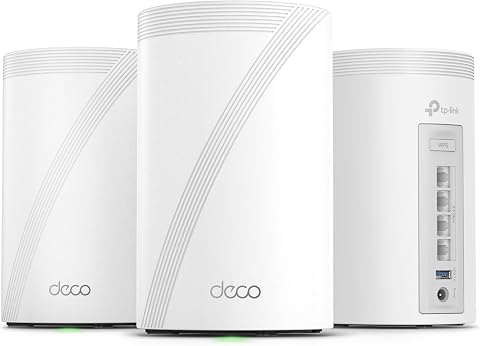 TP-Link Deco 7 Pro BE10000 Tri-Band Wi-Fi 7 Whole-Home Mesh System, 3-PackView on Amazon →
- 3
 Amazon eero 6+ Wi-Fi 6 Mesh System, 3-PackView on Amazon →
- 4
 NETGEAR Orbi 370 Series WiFi 7 Mesh System for Home (RBE373) – Wireless Route…View on Amazon →
- 5
 TP-Link Deco 7 BE5000 Dual-Band Wi-Fi 7 Mesh SystemView on Amazon →
- 6
 TP-Link Deco XE75 AXE5400 Tri-Band Wi-Fi 6E Mesh System, 3-PackView on Amazon →
- 7
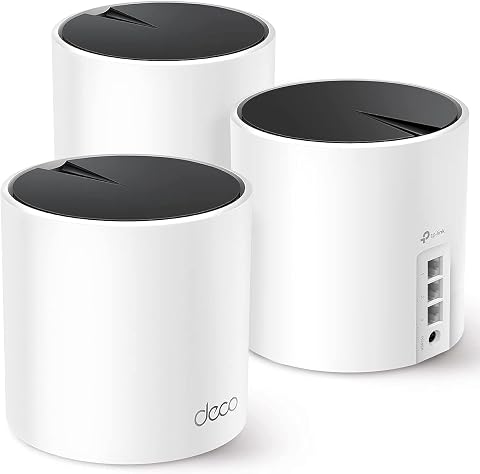 TP-Link Deco X55 AX3000 Wi-Fi 6 Mesh System, 3-PackView on Amazon →
- 8
 TP-Link Deco S4 AC1900 Mesh Wi-Fi System, 3-PackView on Amazon →
- 9
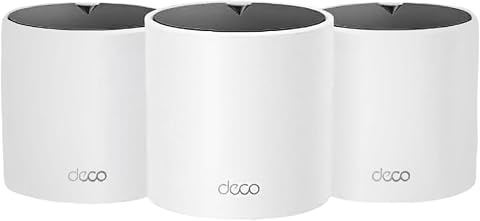 TP-Link Deco X15 AX1500 Dual-Band Wi-Fi 6 Mesh System, 3-PackView on Amazon →
- 10
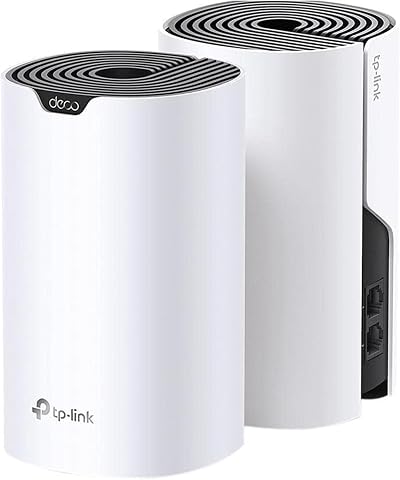 TP-Link Deco S4 Whole Home Mesh WiFi System (2-Pack)View on Amazon →
How Backhaul Shapes Home Coverage
The comparison matters because mesh buyers can easily mistake newer Wi-Fi standards or larger coverage figures for a fix to every dead zone. In practice, the source says the system must fit the home’s layout, devices and broadband connection. A premium Wi-Fi 7 kit may add little for a household whose devices cannot use its features or whose internet plan is the bottleneck.
Backhaul is another practical dividing line. Tri-band models such as the Deco XE75 and Deco 7 Pro add radio capacity that may help when nodes communicate wirelessly, but the benefit depends on conditions and system design. For homes that can connect nodes by Ethernet, wired backhaul may address the same constraint more directly. Choosing based on where nodes can actually be placed may matter more than selecting the highest headline speed.
Kit size also affects value. A two-pack can be adequate in a compact home, while multiple floors, dense walls or long corridors may call for more flexible placement. More nodes are not automatically better if they are poorly positioned or too close together.
Products Worth Considering

Dell UltraSharp U2724DE 27-Inch WQHD IPS Black Monitor

Samsung 32-Inch Movingstyle Essential 4K UHD Smart Monitor with Adjustable Rolling Stand

Canon SELPHY CP1500 Wireless Compact Photo Printer Bundle with RP-108 Ink and Paper Set, White
As an affiliate, we earn on qualifying purchases.
The Comparison’s Buying Criteria
The source says it ranked systems around everyday coverage decisions rather than the newest wireless standard alone. Its criteria include Wi-Fi generation and band configuration, wireless backhaul potential, kit size, setup and management, and fit for a typical household. It favors balanced capability, with the Deco X55 leading as a three-pack Wi-Fi 6 choice and higher-tier systems intended for buyers able to use their added capacity.
The comparison advises checking the Wi-Fi capabilities of phones, laptops and smart-home equipment before paying for a newer standard. It also recommends planning node locations and checking Ethernet ports for devices such as televisions, consoles, desktop computers and network storage. These are general selection considerations in the source, not results from disclosed laboratory testing.
“The Deco X55 is the most balanced starting point.”
— ThorstenMeyerAI.com comparison
Prices, Tests and 2027 Availability
The supplied source does not give prices, independent speed measurements or a full list of all 10 products. It also does not establish whether each model will remain available, receive updates or keep the same price in 2027. Its rankings and product descriptions should be read as the source’s buying assessment, not as independently verified comparative test results.
Actual performance in a particular home remains uncertain without details about building materials, interference, broadband speed, client devices and node placement. The material does not quantify how much improvement a buyer should expect from any model or provide a common coverage test under controlled conditions.
Check Models Against Your Home
Before buying, readers should confirm current model specifications and prices, then map the rooms where coverage is needed. Check device compatibility, the number and location of Ethernet ports, and whether wired links between nodes are possible. Compare the result with the broadband plan and the home’s layout rather than relying on a coverage estimate alone.
Any final 2027 recommendation will depend on current availability and comparable testing, neither of which is provided in the source material. Buyers should revisit the shortlist as those details become clear and select a system whose features match their actual network constraints.
Key Questions
Which mesh system does the comparison rank first?
The source ranks the TP-Link Deco X55 first, describing its Wi-Fi 6 platform and three-node kit as a balanced general-purpose starting point. That is the source’s assessment, not a disclosed independent test result.
Is Wi-Fi 7 the best choice for every home?
No. The comparison says Wi-Fi 7 may suit homes with compatible devices, fast broadband or longer-term upgrade plans, but the benefit depends on the full connection path. A Wi-Fi 6 system may be a better fit when household devices cannot use newer features.
Do tri-band systems always improve coverage?
No. The Deco XE75 and Deco 7 Pro are cited as tri-band examples that may offer more capacity for wireless backhaul. Results still depend on node placement and conditions, and Ethernet backhaul may be a more direct option where wiring is available.
How many mesh nodes does a home need?
That depends on the layout, walls and floors, not just square footage. The source says a two-pack such as the Deco S4 may suit a compact home, while divided or larger spaces may need more placement flexibility. Coverage claims are estimates rather than guarantees.
Does the source provide confirmed 2027 prices or test results?
No. The supplied comparison does not include current prices, independent speed tests or confirmation of 2027 availability for every model. Buyers should verify those details before making a purchase.
Source: ThorstenMeyerAI.com