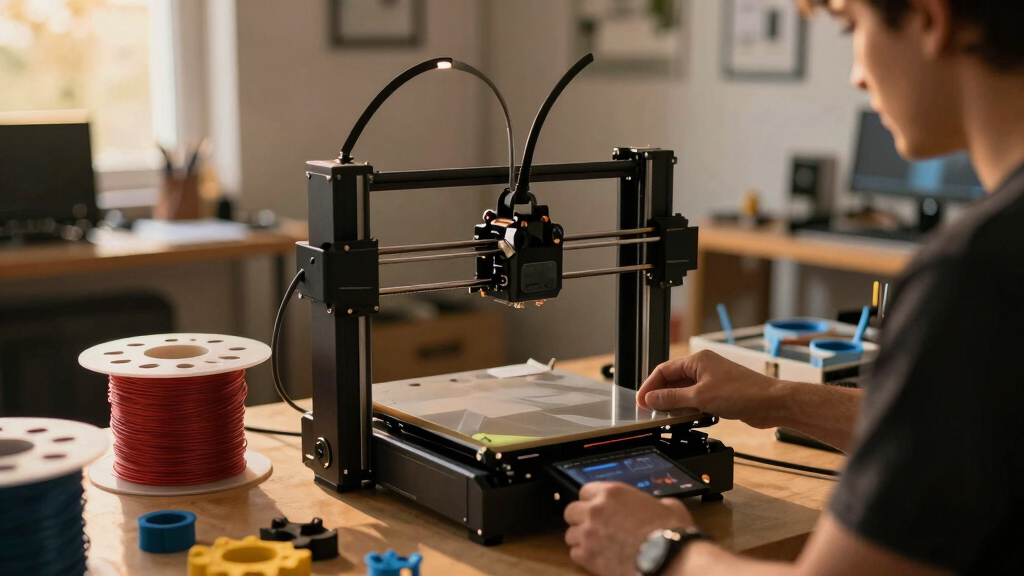
For makers seeking rapid, high-quality 3D printing, high speed 3D printers can dramatically cut production times while maintaining precision. The Creality K2 SE stands out as the best overall choice, combining impressive speeds with reliable performance. For those prioritizing ultra-fast printing, the FLASHFORGE Adventurer 5M delivers speeds up to 600mm/s, ideal for large or time-sensitive projects. However, higher speeds often come with tradeoffs in print quality or equipment complexity. Keep reading for a detailed comparison that helps you find the perfect balance between speed, quality, and usability.
Key Takeaways
- Speed varies significantly among top models, with some reaching 600mm/s, but ultra-fast speeds may compromise detail or reliability.
- Auto-leveling and easy filament management are common features in high-speed printers, reducing setup time and user frustration.
- Build volume differences are notable; larger sizes support bigger projects but may affect print stability at extreme speeds.
- High-temperature extruders (up to 300°C) are standard, enabling use of advanced filaments like carbon fiber composites.
- Price ranges widely, with premium models offering advanced features like AI cameras and multi-color printing, but not always necessary for core speed needs.





More Details on Our Top Picks
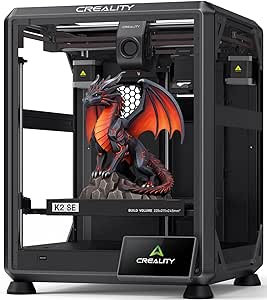
Creality K2 SE 3D Printer, 500mm/s High-Speed Printing, Support Multi Color 3D Printing Needs CFS, Solid Metal Build, Auto Leveling, Direct Drive Extruder, Quick-Swap Nozzle, 220×215×245mm Print Size
The Creality K2 SE stands out for delivering a remarkable combination of speed, stability, and expandability, making it the most versatile choice among fast printers like the FLASHFORGE AD5M. Its lightweight CoreXY system enables up to 500mm/s printing speed with active vibration damping and input shaping, ensuring high-quality results even at rapid speeds. The solid metal frame offers excellent rigidity, reducing frame flex during high-acceleration moves, which is a common issue with less robust frames like in the Ender 3 V3 SE. The fully automatic bed leveling and filament run-out sensors simplify operation for beginners, while the support for a multi-color system (via CFS) allows advanced users to grow their workflows. Tradeoffs include a slightly smaller build volume compared to larger models and a learning curve for multi-material upgrades, but overall, this printer balances speed, precision, and user-friendliness effectively.
Pros:- Exceptional 500mm/s printing speed with active vibration damping
- Solid metal frame ensures high precision and stability
- Automatic bed leveling and filament sensors simplify operation
- Supports multi-color printing with optional CFS upgrade
Cons:- Limited build volume compared to some larger printers
- Multi-material upgrade requires additional investment and setup
- Requires some tuning for optimal PETG and high-temp filaments
Best for: Makers who want a fast, reliable, and expandable machine capable of multi-material printing without complex setup.
Not ideal for: Hobbyists seeking large build volumes or those on a tight budget for basic single-material prints.
- Max Speed:500mm/s
- Build Volume:220×215×245mm
- Frame Material:Solid Metal
- Extruder Type:Direct Drive
- Auto Leveling:Yes
- Support for Multi-color:Yes (via CFS)
Bottom line: This printer is best suited for makers who need speed, stability, and future expansion without sacrificing print quality.
FLASHFORGE Adventurer 5M 3D Printer, 600mm/s Max High-Speed FDM 3D Printers with Auto Leveling, 280°C Direct Extruder with 3S Detachable Nozzle, Core XY All Metal Structure, Print Size 220x220x220mm
Compared with the Creality K2 SE, the FLASHFORGE Adventurer 5M emphasizes ease of use and high-speed operation, making it an excellent choice for beginners and educational settings. Its Core XY structure achieves speeds up to 600mm/s with automatic leveling that requires no manual adjustments, reducing setup time to under 10 minutes. The all-metal frame provides good stability, but its slightly smaller print volume of 220x220x220mm may limit larger projects. The 280°C hotend supports a variety of filaments, including some high-temp or composite options, and the detachable nozzles make maintenance straightforward. While it lacks extensive expandability like multi-color support out-of-the-box, its plug-and-play operation, app control, and quick setup make it ideal for users new to 3D printing or those who prioritize speed and simplicity over complex workflows.
Pros:- Blazing fast speeds up to 600mm/s with active vibration control
- One-tap auto leveling for quick setup and consistent first layers
- Quiet operation with effective cooling and minimal noise
- Plug-and-play design with app control for easy operation
Cons:- Limited build volume restricts larger models
- Basic feature set without multi-color or multi-material support included
- Requires reliable Wi-Fi for full app features, which might be a concern in some environments
Best for: Home users, educators, and beginners seeking a fast, straightforward, and reliable printer with minimal setup.
Not ideal for: Experienced makers or professionals needing large build volumes or multi-material capabilities from day one.
- Max Speed:600mm/s
- Build Volume:220×220×220mm
- Frame Material:All Metal
- Hotend Temperature:280°C
- Auto Leveling:Yes
- Connectivity:Wi-Fi, App Control
Bottom line: This machine is perfect for newcomers who want rapid, hassle-free printing with minimal fuss and setup time.
AOSEED 3D Printer for Kids, AI-Powered Fully Assembled 3D Printer with Up to 400mm/s Speed, Auto Leveling, 1500+ Models & 16+ Modules, Includes 8 PLA Filaments for Home and School Use, X-MAKER JOY AI+
The AOSEED X-MAKER JOY AI+ prioritizes safety, simplicity, and creative engagement, making it ideal for children and educational environments, unlike the more technical Creality K2 SE. Its fully enclosed design and one-tap operation allow kids to start prints easily, supported by AI-powered features like voice prompts and model generation, which eliminate the need for complex design skills. The printer supports over 1,500 built-in models and offers a library of themed modules, encouraging endless creativity. Its 400mm/s peak speed is impressive but geared toward small, quick projects rather than large or detailed models. While it lacks multi-color hardware support, the real-time monitoring via built-in camera and app sharing make it a fun, safe, and engaging device for young makers and families exploring 3D printing for the first time.
Pros:- One-tap, app-controlled operation for simple start-up
- Built-in AI features for model creation and guidance
- Real-time camera monitoring and sharing for family engagement
- Includes 8 PLA filaments and extensive model library
Cons:- Limited to small projects due to 220mm cube size
- No support for multi-color or multi-material hardware upgrades
- Peak speed may compromise detail in larger or complex models
Best for: Parents, teachers, and kids who want a safe, easy-to-use machine that fosters creativity and learning without technical complexity.
Not ideal for: Advanced hobbyists or professionals needing large build volumes or multi-material capabilities from a single machine.
- Peak Speed:400mm/s
- Build Volume:220x220x220mm
- Filament Support:8 PLA rolls included
- Auto Leveling:Yes
- Camera:Built-in
- Connectivity:Wi-Fi, App
Bottom line: This printer is ideal for introducing children to 3D printing through a safe, intuitive, and highly creative platform.
FLASHFORGE AD5M, CoreXY 600mm/s High-Speed Printer with 1-Click Auto Leveling, High-Temp Direct Drive Extruder, 3s Quick-Swap Nozzle, 220×220×220mm Build Volume
The FLASHFORGE AD5M emphasizes industrial-level speed and high-temperature capability, making it a strong competitor to the Creality K2 SE for professional or rapid prototyping environments. Its Core XY structure achieves speeds up to 600mm/s with rapid auto-leveling, supporting high-temp materials like PET-CF and ASA, which the Creality K2 SE might struggle with without upgrades. The 220×220×220mm build volume balances compactness with sufficient space for functional prototypes. Its powerful extruder and quick-change nozzles facilitate fast material changes, ideal for iterative design. While it lacks multi-color support out of the box, the open-source firmware and remote management elevate its professional appeal. This model suits engineers and makers needing speed, versatility, and high-temp support for demanding applications.
Pros:- Ultra-high speed up to 600mm/s with active vibration control
- Supports high-temp materials like PET-CF and ASA
- Automatic leveling and quick-nozzle swaps for efficiency
- Open-source firmware for customization
Cons:- Limited build volume for large models
- No native multi-color hardware support
- Higher complexity for initial setup and tuning
Best for: Engineers, rapid prototypers, and professional makers requiring fast turnaround and high-temp material compatibility.
Not ideal for: Hobbyists or casual users prioritizing large build sizes or multi-color workflows without additional investment.
- Max Speed:600mm/s
- Build Volume:220×220×220mm
- Hotend Temp:up to 300°C
- Extruder:Direct Drive
- Leveling:Auto
- Connectivity:Remote, USB
Bottom line: This printer is best suited for professionals and advanced users who need rapid, high-temp printing with minimal downtime.
Creality K1C 3D Printer, 600mm/s High-Speed Auto Leveling Clog-Free Robust Direct Extruder K1 SE Upgraded 3D Printer with AI Camera 300°C Printing Silent Mode Support Carbon Fiber Filaments
The Creality K1C offers the highest speed in this lineup at 600mm/s, plus advanced features like a clog-free direct extruder and an AI camera for real-time monitoring, making it the best choice for heavy-duty production and high-performance applications. Its enclosed chamber and hotend support up to 300°C enable printing with abrasive and high-temp materials like carbon fiber composites, a step above the more general-purpose Creality K2 SE. The auto calibration and dynamic balancing reduce vibrations, helping to minimize ringing even at high speeds. The silent mode and air purification system make it suitable for professional environments where noise and fumes are concerns. While the size and complexity may be overkill for hobby use, this model excels for industrial prototypes and demanding projects requiring speed, stability, and high-temp support.
Pros:- Exceptional 600mm/s printing speed with active vibration management
- Supports up to 300°C for advanced material compatibility
- Clog-free, robust direct extruder with quick-change nozzles
- AI camera for real-time monitoring and remote control
Cons:- Smaller build volume limits large or multi-part projects
- Higher price point and complexity for casual users
- Requires some technical knowledge for optimal setup
Best for: Manufacturers, engineers, and professionals seeking fast, reliable, and high-temp capable 3D printing in a compact form.
Not ideal for: Casual hobbyists or small-scale home users without high-temp material needs or large build volume requirements.
- Max Speed:600mm/s
- Build Volume:220×220×220mm
- Hotend Temp:up to 300°C
- Extruder Type:Clog-Free Direct Drive
- Camera:AI Monitoring
- Noise Level:Silent Mode
Bottom line: This machine is ideal for high-volume, high-performance production environments needing speed, stability, and material versatility.
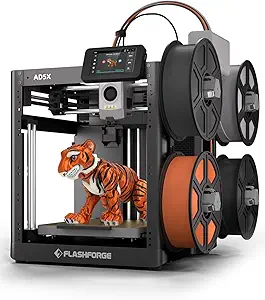
FLASHFORGE AD5X Multi-Color 3D Printer, CoreXY 600mm/s High-Speed, 1-Click Auto Leveling, 300°C Direct Drive Extruder, 220x220x220mm Build Volume, Ideal for Precision and Efficiency
This FLASHFORGE AD5X stands out for its extraordinary speed—up to 600mm/s—and multi-color capabilities, making it ideal for makers who prioritize rapid, vibrant output. Compared with the Creality Ender 3 V3 SE, it offers significantly faster print speeds and seamless multi-color printing, though at a higher complexity and cost. The CoreXY structure enhances stability during high-speed operation, reducing vibrations that could compromise detail. The support for four nozzles with different sizes provides creative flexibility, especially for detailed miniatures or large prototypes. The automatic filament management minimizes downtime, boosting productivity. However, this level of speed and multi-color operation demands a more robust setup and can be overwhelming for beginners. The large build volume and versatile nozzle options make it suitable for professional prototyping or artistic projects, but its complexity and price make it less ideal for casual hobbyists. Overall, this printer is best for makers who need fast, colorful prototypes and are comfortable managing advanced features.
Pros:- Exceptional high-speed printing capability up to 600mm/s
- Supports up to 4 colors simultaneously for vibrant multi-color prints
- Robust CoreXY structure enhances stability at high speeds
- Versatile nozzle sizes for detailed or rapid large prints
Cons:- Steep learning curve due to advanced multi-color and speed features
- Higher price point and more complex setup compared to simpler models
- Requires a stable, vibration-free surface for optimal results
Best for: Experienced makers and small workshops needing rapid, multi-color prototyping
Not ideal for: Beginners or hobbyists seeking a simple, plug-and-play experience
- Max Speed:600mm/s
- Build Volume:220x220x220mm
- Nozzle Compatibility:4 sizes, 0.25mm to 0.8mm
- Extruder Temp:300°C
- Auto Leveling:Yes, 1-Click
- Connectivity:WiFi, remote control via app
Bottom line: This pick is perfect for makers who need speed and color versatility and can handle the machine’s complexity.
ELEGOO Centauri Carbon 3D Printer, CoreXY 500mm/s High Speed Printing with Auto Calibration, 320°C Nozzle and Built-in Camera, Ready to Print Out of the Box, 256x256x256mm Printing Size
This ELEGOO Centauri Carbon excels in ease of use and reliable high-speed performance, making it ideal for newcomers and makers seeking quick, quality results. Unlike the FLASHFORGE AD5X, which offers multi-color printing, the Centauri focuses on streamlined, fast printing of single or advanced filament types with minimal setup. Its auto-calibration and fully assembled design remove common setup hurdles, enabling immediate printing. The robust die-cast aluminum frame and vibration compensation ensure consistent quality even at 500mm/s speeds, perfect for production or educational settings. The high-temp hotend supports specialized filaments like carbon fiber-reinforced materials, broadening its application scope. Though it lacks multi-color capability, its user-friendly interface and built-in camera make it highly accessible for beginners. It’s a smart choice for those who want fast, dependable printing with minimal fuss, but less so for multi-color projects or complex multi-material work.
Pros:- Pre-assembled and fully calibrated for immediate use
- Supports high-temp materials up to 320°C for advanced filaments
- Built-in camera for real-time monitoring
- Vibration compensation for consistent quality at high speeds
Cons:- Limited to single or advanced filament types, no multi-color support
- Build volume smaller than some competitors at 256x256x256mm
- Lacks multi-nozzle options for detailed multi-color projects
Best for: Beginners or educational labs seeking quick, dependable high-speed printing
Not ideal for: Advanced artists or professionals needing multi-color or multi-material capabilities
- Max Speed:500mm/s
- Build Volume:256x256x256mm
- Nozzle Temp:320°C
- Auto Calibration:Yes
- Camera:Built-in
- Connectivity:WiFi
Bottom line: This printer is ideal for beginners and educational environments that value speed, reliability, and ease of use over multi-color complexity.
FLASHFORGE Adventurer 5M 3D Printer, 600mm/s Max High-Speed FDM 3D Printers with Fully Auto Leveling, 280°C Direct Extruder with Quick Detachable Nozzle, Effective Cooling, Core XY Structure
The FLASHFORGE Adventurer 5M is designed for rapid, reliable printing at home or in classrooms, offering speeds up to 600mm/s. Compared with the ELEGOO Centauri Carbon, which emphasizes beginner-friendliness and stability, the 5M is built for speed and efficiency, supporting a wide range of filaments thanks to its 280°C extruder. Its auto-leveling and dual-sided PEI platform simplify setup, making it suitable for users who want quick results without extensive tuning. The Core XY design enhances stability during fast printing, and the effective cooling fan improves detail resolution. While it might not match the multi-color capabilities of the AD5X, it offers a good balance of speed, versatility, and ease for educational or casual use. Its intuitive touchscreen interface and remote app control make it accessible for non-technical users, though advanced multi-material or multi-color projects are less straightforward.
Pros:- Maximum speed of 600mm/s for rapid prototyping
- Auto-leveling with dual PEI platforms for easy setup
- Supports various filament types including PETG and ABS
- Effective cooling for better detail resolution
Cons:- Limited to single or basic multi-filament materials, no multi-color support
- No multi-nozzle system for complex multi-color prints
- Build volume slightly smaller at 220x220x220mm
Best for: Home users and educators needing quick, versatile prints with minimal setup
Not ideal for: Professional artists requiring multi-color or multi-material complex printing
- Max Speed:600mm/s
- Build Volume:220x220x220mm
- Nozzle Temp:280°C
- Auto Leveling:Yes
- Filament Support:PLA, PETG, ABS
- Connectivity:WiFi, app control
Bottom line: This printer offers a compelling option for fast, reliable home and educational printing, with straightforward operation.
Creality Ender 3 V3 SE 3D Printer, 250mm/s Faster Print Speed CR Touch Auto Leveling Sprite Direct Extruder Dual Z-Axis Auto Filament Loading Ender 3 Upgrade 3D Printer Print Size 8.66×8.66×9.84 inch
The Creality Ender 3 V3 SE offers a substantial upgrade over older models, with a maximum printing speed of 250mm/s, making it suitable for makers who want faster results without sacrificing reliability. Its Sprite dual-geared extruder ensures smooth filament feeding, compatible with a range of materials like PLA, TPU, and PETG. The CR Touch auto leveling simplifies bed calibration, saving time and reducing errors, especially compared to manual leveling of older Ender models. The dual Z-axis lead screws improve stability on tall prints, enhancing accuracy. Its straightforward assembly and user-friendly interface make it appealing for hobbyists ready to move beyond entry-level printers. However, while faster than traditional Ender 3s, it still falls short of the ultra-high speeds of the AD5X or Adventurer 5M, and the print volume remains modest at 8.66×8.66×9.84 inches. It’s an excellent upgrade for those seeking a quick, reliable, and affordable step up.
Pros:- Faster printing speeds up to 250mm/s
- CR Touch auto leveling for quick setup
- Reliable Sprite dual-geared extruder supports various filaments
- Dual Z-axis ensures stability and accuracy
Cons:- Limited build volume compared to higher-end models
- No multi-color or multi-material support
- Speed still below 600mm/s of high-end printers
Best for: Enthusiast hobbyists wanting faster, reliable prints with easy setup
Not ideal for: Professional or artistic projects requiring multi-color/multimaterial complex printing
- Max Speed:250mm/s
- Build Volume:8.66×8.66×9.84 inches
- Auto Leveling:CR Touch
- Extruder:Sprite dual-geared
- Z-Axis:Dual
- Filament Compatibility:PLA, TPU, PETG
Bottom line: This upgrade balances speed, reliability, and affordability, making it ideal for hobbyists ready for quicker prints.
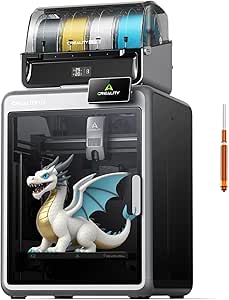
Creality K2 Combo 3D Printer, Multicolor Printing with CFS, High-Speed 600mm/s, Smart Auto Leveling, Quiet Printing, 300°C Nozzle, Dual AI Camera, Direct Drive Extruder, Build Volume 260x260x260mm
The Creality K2 Combo excels in delivering multi-material, multicolor prints thanks to its expandable CFS unit capable of handling up to 16 colors, making it ideal for artists and prototypers. Compared with the FLASHFORGE AD5M, which offers similar high speeds and auto leveling, the K2 stands out for its intelligent filament system that keeps materials dry and ready, reducing downtime. The impressive 600mm/s print speed paired with 20,000mm/s² acceleration pushes the boundaries of rapid prototyping, though this speed can sometimes compromise filament control if not managed carefully. Its ultra-quiet operation and smart AI camera for failure detection provide a user-friendly experience, but the size (260x260x260mm) requires adequate workspace and could be bulky for compact setups. The direct drive extruder handles a variety of filaments up to 300°C, broadening creative possibilities. Setting up is straightforward, with automatic leveling and guided calibration, making it suitable for both beginners and experienced makers. The onboard Wi-Fi and large storage facilitate seamless remote control, though the complexity of multicolor options may overwhelm new users.
Pros:- Exceptional 16-color multicolor printing with expandable CFS unit
- Blazing fast 600mm/s print speed for rapid prototyping
- Smart auto filament handling and drying system to minimize failures
- Quiet operation and AI camera for failure detection
Cons:- Large build volume may require substantial workspace
- High speed can lead to filament control challenges if not carefully managed
- Complex multicolor setup may be intimidating for beginners
Best for: Makers and artists who want vibrant, multi-material prints at high speeds with minimal fuss and advanced monitoring features.
Not ideal for: Small-scale hobbyists with limited space or users primarily working with simple single-color projects without the need for multi-material capabilities.
- Build Volume:260x260x260mm
- Max Speed:600mm/s
- Acceleration:20,000mm/s²
- Nozzle Temperature:300°C
- Filament Support:Multiple, with RFID auto-identification
- Auto Leveling:Yes
- Connectivity:Wi-Fi, local storage
- Frame Material:Aerospace-grade aluminum
- Camera:Dual AI monitoring
Bottom line: This printer is best suited for makers seeking high-speed, vibrant multi-material prints with advanced automation and monitoring features.
FLASHFORGE Adventurer 5M 3D Printer with Fully Auto Leveling, Max 600mm/s High Speed Printing, 280°C Direct Extruder with 3S Detachable Nozzle, CoreXY All Metal Structure, Print Size 220x220x220mm
The FLASHFORGE Adventurer 5M delivers rapid, consistent prints thanks to its CoreXY architecture capable of reaching 600mm/s, making it a prime choice for quick turnaround projects. Unlike the Creality K2, which offers multicolor capabilities, the AD5M focuses on speed and simplicity, making it ideal for users who prioritize throughput over color variety. Its 280°C direct extruder with a quick 3-second warm-up ensures fast start-up times, and the fully automatic leveling system means less manual calibration—perfect for busy makers or educational environments. The dual nozzles and vibration compensation help maintain top print quality at high speeds, though the smaller 220x220x220mm build volume may limit larger projects. The detachable nozzle and support for multiple nozzle sizes improve versatility, but the high speed can sometimes lead to print artifacts if not tuned properly. It’s a straightforward, high-performance option for those needing dependable speed and ease of use.
Pros:- Blazing 600mm/s travel speed for rapid prototyping
- Fast 3-second nozzle heating with high-temperature capability
- Fully automatic bed leveling for hassle-free setup
- Detachable nozzles with support for various sizes
Cons:- Limited build volume of 220x220x220mm
- No multicolor or multi-material capabilities
- High speed may cause artifacts if not meticulously tuned
Best for: Prototypers and educators who need fast, reliable prints with minimal setup and maintenance, especially for smaller parts.
Not ideal for: Artists requiring multicolor or multi-material printing, or users with larger build volume needs.
- Build Volume:220x220x220mm
- Max Speed:600mm/s
- Nozzle Temperature:280°C
- Nozzle Change Time:3 seconds
- Frame Structure:CoreXY all-metal
- Auto Leveling:Yes
- Extruder Type:Direct drive
- Connectivity:Wi-Fi, USB
- Print Size:220x220x220mm
Bottom line: This printer suits users who need quick, high-quality prototypes with minimal setup and are working on smaller projects.

How We Picked
The selection process focused on performance metrics such as maximum printing speeds, reliability at high speeds, and print quality consistency. Usability features like auto-leveling, filament handling, and user interface were also key for maker-friendly operation. Build quality and durability were considered, especially for prolonged high-speed use. We prioritized models that balance speed with practical features, avoiding overly complex setups that could hinder everyday use. The ranking reflects a combination of speed capabilities, feature set, value for price, and overall user-friendliness for makers in 2026.Factors to Consider When Choosing High Speed 3D Printer For Makers
Choosing a high speed 3D printer involves balancing multiple factors that affect print quality, reliability, and ease of use. While faster speeds can dramatically reduce project times, they often introduce challenges like reduced detail or increased maintenance. The following factors help clarify what to prioritize based on your specific needs and environment.Printing Speed and Accuracy
Speed is a primary consideration, but it should not come at the expense of print quality. Some printers excel at maintaining detail even at high speeds, thanks to advanced motion control and sturdy construction. Consider your project requirements—if you need rapid prototypes, prioritize models that combine speed with stability, but be wary of models that sacrifice detail for raw speed. The best options strike a balance, delivering high throughput without significant quality loss.
Build Size and Stability
Large build volumes enable bigger projects but can introduce stability issues at higher speeds. Look for models with reinforced frames, rigid axes, and effective vibration damping. Smaller printers tend to maintain accuracy more reliably at extreme speeds, making them better suited for detailed parts or tight tolerances. Think about the size of your typical projects and whether rapid turnaround outweighs the need for larger print capacity.
Ease of Use and Maintenance
Auto-leveling, quick filament loading, and simple interfaces reduce setup and troubleshooting time—especially important for high-speed printing, where delays can be costly. High-end models often include features like auto-nozzle cleaning or remote monitoring, which help sustain optimal performance. Remember, the faster the printer runs, the more critical routine maintenance becomes to prevent print failures and ensure consistent quality.
Filament Compatibility and Extruder Capabilities
High-speed printers often support advanced filaments like carbon fiber composites or high-temperature materials, which require robust extruders capable of handling abrasive or hot materials. Check maximum nozzle temperatures and extruder durability; a quick-swap nozzle feature can also save time during multi-material or multi-color prints. However, high-temperature extruders tend to be more complex and costly, so consider your material needs carefully.
Price and Value
Prices for high-speed 3D printers vary widely, reflecting features like multi-color printing, AI cameras, or larger build volumes. While premium models often offer better stability and additional features, they may not be necessary for all makers. Focus on models that deliver the core speed and reliability you need without overpaying for extras you won’t use. Balance your budget against the benefits of faster print times and improved usability.
Frequently Asked Questions
Can high speed 3D printers maintain quality at top speeds?
Many high-speed 3D printers are designed to balance speed with quality, but there are limits. Generally, as print speed increases, some detail or surface finish may degrade unless the machine features advanced motion control and vibration damping. The best models use precise hardware and software optimizations to keep quality acceptable, but it’s important to set realistic expectations and test your specific filament and project types.
Are high-speed 3D printers more prone to failures or maintenance issues?
Speed can increase wear on components like extruders and belts, requiring more frequent maintenance. High-speed printers often operate under higher mechanical stress, which can lead to issues if not properly maintained. Choosing a model with robust build quality and easy access for maintenance can mitigate these risks, but regular upkeep is essential to keep high speeds consistent and reliable.
What is the typical build volume for high speed 3D printers?
Build volume varies considerably, from compact sizes around 200mm to larger formats exceeding 260mm. Generally, larger sizes may reduce stability at high speeds, so if you prioritize speed over size, smaller models with reinforced frames are preferable. For bigger projects, look for models with proven rigidity and vibration control to ensure consistent quality at maximum speeds.
Is it worth paying extra for features like multi-color or multi-material printing?
Features like multi-color or multi-material capabilities add versatility but also increase complexity and cost. If your projects demand multi-color prototypes, then these features justify the extra investment. However, for purely speed-focused applications or simple prototypes, a single-material, straightforward machine may suffice. Evaluate whether the added features improve your workflow or create unnecessary complications.
How important is software compatibility for high speed 3D printing?
Software plays a critical role in achieving high speeds reliably. Compatibility with slicing software that optimizes motion control, supports custom speed profiles, and provides real-time monitoring can make a significant difference. Choosing printers with manufacturer-recommended software or open-source options with active updates can help you fine-tune performance and troubleshoot issues more effectively.
Conclusion
For makers new to high speed 3D printing, the Creality K2 SE offers a reliable balance of speed, quality, and ease of use, making it an excellent starting point. Those who need rapid prototyping with minimal fuss should consider the FLASHFORGE Adventurer 5M for its impressive speeds and user-friendly features. If budget is less of a concern and advanced features are desired, the FLASHFORGE AD5X provides multi-color capability and high-temperature extrusion for complex projects. Beginners should prioritize models with auto-leveling and straightforward interfaces, while experienced makers aiming for maximum throughput might opt for premium options like the Creality K2 Combo. Carefully matching your project size, material needs, and budget will ensure the best fit for your high speed 3D printing journey in 2026.