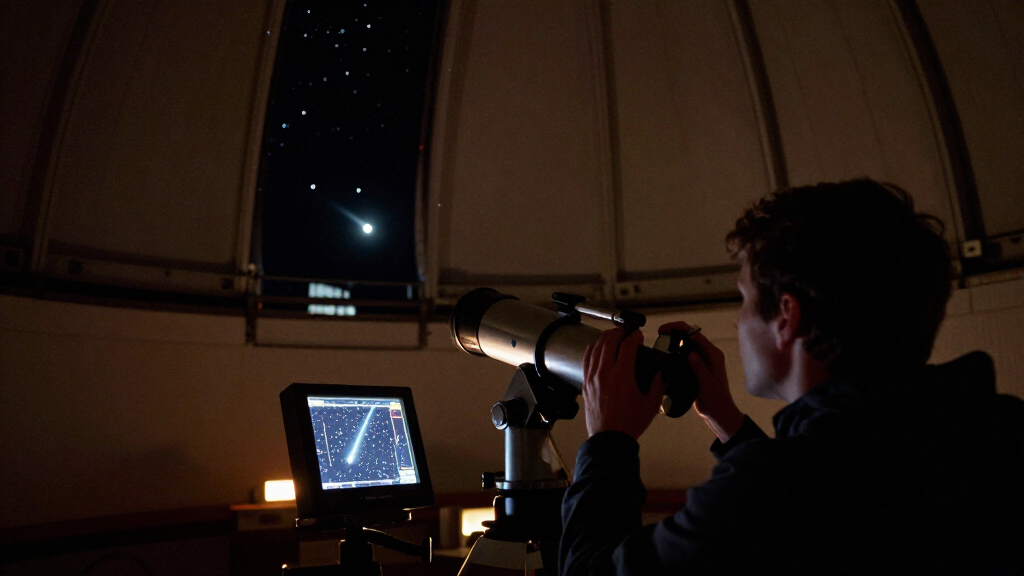

🔍 Read the full analysis: What Makes The Light Feel Suspended In “OORT — Comet Vigil For P/2043 K1 Vesper”? on ThorstenMeyerAI.com

Get business pricing on office and shipping supplies
- Business-only prices and quantity discounts
- Tax-exempt purchasing
- Multiple users, one account, clear invoices
TL;DR
OORT — Comet Vigil for P/2043 K1 Vesper is an AI-built web artwork centered on a fictional comet and observatory. Its star trails accumulate with time spent on the page, while a scrolling diagram and a simulated shutter turn waiting into the work’s main interaction.
OORT — Comet Vigil for P/2043 K1 Vesper is an AI-built online artwork, as described in the original analysis, that makes time spent viewing it visible through star trails that lengthen as a visitor stays. The exhibition imagines an observatory keeping watch on a fictional comet, using a persistent canvas, scrolling orbital diagram and simulated shutter to turn the act of waiting into its central subject.
The work’s signature effect is a field of stars drawn as curved trails on a dark canvas. According to the project description, the trails grow with elapsed time and return to their earlier state when a visitor comes back on the same device. A repeatable seed keeps that device’s sky consistent, while local storage preserves elapsed time. The page’s metaphor is direct: a visit becomes a kind of long exposure, rather than a pause before the main content.
A second instrument ties scrolling to the comet’s imagined journey. An inline SVG moves the body through a fictional orbit, with an ion tail pointing away from the sun and a dust tail bending along the orbit. Both respond to the same progress value, keeping the depicted geometry, distance and year coordinated. A range control adjusts a defocused view and its associated brightness estimate.
Visitors can also hold a control to open a simulated shutter. The site records a timestamp, but does not present the interaction as a sighting: the comet remains unseen and in transit within the fiction. The source describes the artwork as AI-built and the observatory and comet as fictional; it also links to a live room and a design guide explaining the visual and technical choices.
FABLE/175 · Room 170 · An imagined observatory
What Makes the Light Feel Suspended in OORT?
In OORT — Comet Vigil for P/2043 K1 Vesper, star trails grow as a visitor stays. Scrolling follows a fictional orbit; a held shutter marks a moment of attention. Waiting becomes the artwork’s central subject.
“The page makes duration part of the artwork.”
Project description · ThorstenMeyerAI.com
AI-built web artwork · fictional comet · persistent sky · simulated observation
01 / The mechanism
A visit becomes a long exposure
The signature effect is a field of curved star trails on a dark canvas. Their gradual growth gives elapsed viewing time a visible form.
Canvas / accumulation
Light that keeps gathering
As time passes, trails lengthen. A short visit and a longer vigil leave different visual records.
Memory / same device
A sky with continuity
The description says a repeatable seed keeps the sky consistent and local storage preserves elapsed time when a visitor returns.
Shutter / timestamp
Attention, not discovery
Holding a control opens a simulated shutter and records a timestamp. The comet remains unseen and in transit within the fiction.
02 / The interaction
How waiting becomes visible
Browser features carry the premise: canvas drawing, local storage, scrolling and SVG geometry make the observatory feel like an instrument that remembers.
- 01
Arrive
A repeatable seed sets a recognizable sky on the device.
- 02
Stay
Elapsed time accumulates as longer star trails on the canvas.
- 03
Follow
Scrolling advances the comet through an imagined orbital diagram.
- 04
Mark
A held shutter records a timestamp as a trace of attention.
The inline SVG coordinates the comet’s position, distance and year. The ion tail points away from the sun; the dust tail bends along the orbit.
03 / Reading the instrument
What the interface suggests
The art direction borrows the language of a dark-adapted observatory: measurements, field notes and controls frame an invented world.
Visual signals
Display typography gives headings and measurements an instrument-like quality; monospaced coordinates and field notes evoke a logbook.
Inside the fiction
The imagined community watches P/2043 K1 Vesper over decades. Invented amateur logs, frost on an eyepiece and a purported last sighting in 1608 belong to the artwork’s worldbuilding. They are not evidence about a real comet or historical observation.
P/2043 K1 Vesper, its orbit and observing history are fictional. The shutter interaction is not an astronomical observation.
04 / What is documented
Artwork, design study, open questions
The showcase and design guide describe the concept and production choices. They do not independently verify every live behavior or stated target.
Is the comet real?
No. The project describes P/2043 K1 Vesper and its observatory as fictional.
Does the page remember visits?
The description says elapsed time is stored locally and the sky resumes on the same device. Cross-device and browser limits are not specified.
Are performance and accessibility results reported?
The brief lists responsive design, reduced-motion support and pausing animation in hidden tabs as goals. The supplied account gives no measured performance or audit results.
What does the shutter record?
A timestamp for a simulated shutter moment: a mark of attention, not a claimed sighting.
How Waiting Becomes Visible
OORT’s central idea is that duration is an input. The trails change because the visitor stays, and the recorded shutter moment marks attention rather than discovery. That choice gives the interactions a role beyond decoration: they make the imagined vigil legible without pretending that a real astronomical observation has taken place.
The project also shows how browser features can carry an artistic premise. Canvas drawing, local storage, scrolling and SVG geometry are used to make the fictional observatory feel like an instrument that remembers a visitor. The effect depends on continuity: leaving and returning on the same device matters, while a brief visit produces a different visual record from a longer one.
For readers interested in AI-built web work, OORT is presented as both an exhibition and a technical study. Its design guide describes the interaction logic and visual direction, making the piece relevant not only as an artwork but as an example of how a website can give elapsed time and attention a visible form.
Products Worth Considering

Logitech MX Master 4 for Mac Wireless Ergonomic Mouse, White Silver

Logitech MX Mechanical Wireless Illuminated Keyboard, Clicky Switches

Dell UltraSharp U2724DE 27-Inch WQHD IPS Black Monitor
As an affiliate, we earn on qualifying purchases.
Inside the Fictional Observatory
The project is listed as room 170 of 175 in the FABLE/175 exhibition series. Its premise is a community watching the fictional comet P/2043 K1 Vesper over decades. The source material describes invented amateur logs, a long wait, frost on an eyepiece and a purported last sighting in 1608 as elements of the brief’s worldbuilding; these are not evidence about a real comet or historical observations.
The page’s art direction draws on a dark-adapted observatory: deep black provides the background, cyan marks the ion tail and readings, and red-orange indicates instructions and actions. Pale, dust-toned text is used for longer passages. Display typography gives headings and measurements an instrument-like quality, while monospaced coordinates and field notes make the text resemble a logbook.
The supplied brief describes a three-pass production process: an initial build and self-critique, an external critique and fixes, then an art-direction review. It also specifies responsive layouts, reduced-motion support and pausing animation when a browser tab is hidden. The source outlines these requirements and the design process, but does not independently document testing results for every screen size or performance target.
“The page makes duration part of the artwork instead of treating it as time spent before the content.”
— ThorstenMeyerAI.com project description
What the Description Does Not Verify
The source identifies P/2043 K1 Vesper as fictional, so its orbital details, dates and observing history belong to the artwork’s invented setting. The material does not provide independent verification of the live site’s current behavior, the exact data stored by the page, or how long a visitor’s exposure persists across browsers or devices. It says the sky resumes on the same device, but does not specify the limits of that persistence.
The design brief sets performance, accessibility and responsive-display goals, including reduced-motion handling and pausing animation in hidden tabs. The supplied account does not include measured frame rates, accessibility audit results or screenshots confirming those targets. It also does not report visitor numbers or evaluations of how viewers respond to the experience.
Explore the Live Room
The project directs readers to the live OORT room and an accompanying design guide with build notes. Visitors can observe how the trails change, test the scrolling diagram and use the simulated shutter; the result is an interaction with a fictional observatory, not an astronomical forecast or observation. The source also points readers to the broader FABLE/175 hub. No further release, event or development date is specified.
Key Questions
Is P/2043 K1 Vesper a real comet?
No. The project describes P/2043 K1 Vesper as fictional, and the observatory and its observing history are part of the artwork’s imagined setting.
Why do the star trails seem to hang in place?
The canvas draws curved star trails that lengthen as time passes. Their gradual growth makes the visitor’s time on the page visible rather than showing a static star field.
Does the page remember a visit?
The project description says a repeatable seed keeps the sky consistent on the same device and local storage preserves elapsed time. It does not specify how that record behaves across different devices or browsers.
What does the shutter interaction record?
Holding the control opens a simulated shutter and records a timestamp. It represents a moment of attention; the site does not claim that the fictional comet has been seen.
How does scrolling affect the comet?
Scrolling advances an inline SVG through an imagined orbit. The ion tail points away from the sun, while the dust tail curves along the orbit; both change with the same progress value.
Source: ThorstenMeyerAI.com