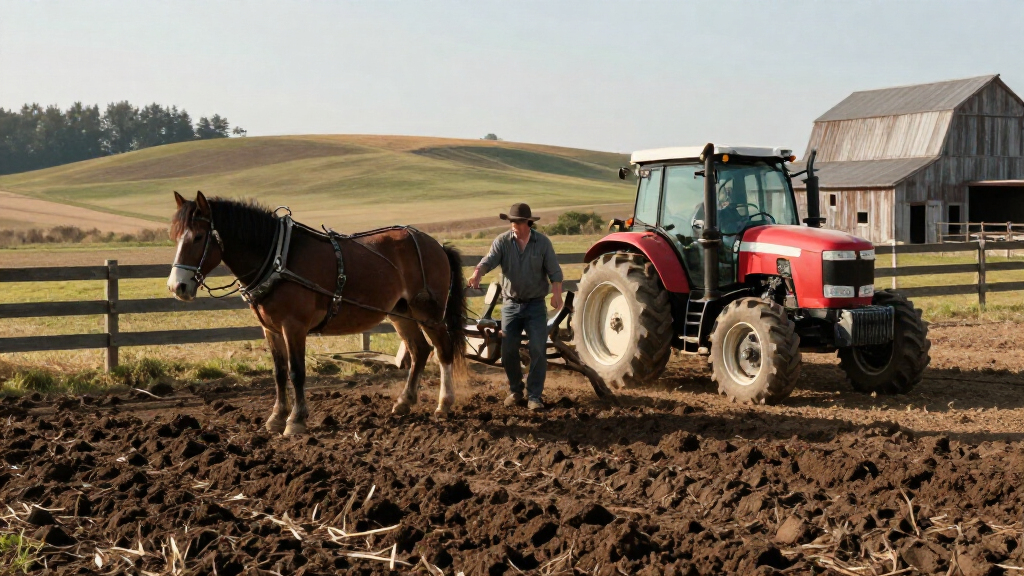
🔍 Read the full analysis: Did Tractors Make Working Animals Obsolete? on ThorstenMeyerAI.com

Get business pricing on office and shipping supplies
- Business-only prices and quantity discounts
- Tax-exempt purchasing
- Multiple users, one account, clear invoices
TL;DR
U.S. farm horses and mules peaked at 26.7 million in 1918, then declined to 3.1 million by 1960 as tractors and other machines spread. The change sharply reduced demand for working animals and farm labor, but it did not make all workers unnecessary: employment shifted as the wider economy grew. The horse story is a historical comparison, not proof of what automation will do to people today.
A November 4, 2026, report by ThorstenMeyerAI.com recounts how tractors and other farm machinery displaced most working horses and mules in the United States: their combined farm population fell from 26.7 million in 1918 to 3.1 million in 1960. The change transformed farm work and freed land once used to grow animal feed, but the report cautions that the history is an analogy—not a forecast—when considering what automation may mean for human workers.
U.S. historical statistics cited in the report show that horses alone reached a peak of 21.4 million in 1915. Mules continued to increase afterward, bringing the combined total to 26.7 million on January 1, 1918. In 1915, about 93 million acres of harvested cropland—more than a quarter of the total—grew feed for horses and mules. That figure remained about 90 million acres in 1920.
Tractors spread rapidly over the following decades. The report puts the number on U.S. farms at about 1,000 in 1910, 246,000 in 1920, and 4.69 million in 1960. Around 1955, tractors outnumbered horses and mules for the first time. By 1960, the working-animal count had fallen to 3.1 million, nearly 90% below its 1918 peak. The report says farmers generally did not retrain or replace the animals; instead, they stopped breeding replacements as the existing population aged.
Mechanization extended beyond tractors. Combine harvesters, corn pickers, balers and milking machines changed farm production, alongside fertilizer and improved seed. The Department of Agriculture estimated that one farm worker supplied 47.1 people in 1970, compared with 7.1 in 1910. The 1970 figure includes people abroad supplied through exports, according to the series cited in the report.
How Mechanization Reshaped Farm Work
The shift was not only about replacing an animal with a machine. Tractors reduced the need to grow feed and supplied farms with a different kind of power: unlike horses, they required fuel when operating rather than food every day. The acreage once devoted to animal feed could be used for crops for people or for sale. The report estimates that feed acreage fell from 93 million acres in 1915 to about 5 million in 1960.
Farm employment also contracted. U.S. farm employment peaked at 13.6 million in 1916 and stood at 4.5 million in 1970, while the country’s overall labor force doubled, the report says. It describes new jobs as emerging in cities, meaning that the change involved migration as well as technology. The record does not show that workers could simply stay in place and take equivalent jobs; it points to a wider economic adjustment whose costs and benefits were unevenly distributed.
That history is relevant to current debates about automation because it shows that a major technology can eliminate demand for one kind of work while changing production and the wider labor market. It does not establish that the same outcomes will follow for people today. The skills, institutions, choices and social rights involved are different, and the report presents the comparison as a question to examine rather than a law of economic change.
Products Worth Considering

Canon PIXMA TR160 Wireless Portable Color Inkjet Printer

Canon PIXMA PRO-200S Wireless Professional Inkjet Photo Printer

Logitech MX Brio Ultra HD 4K Webcam, Graphite
As an affiliate, we earn on qualifying purchases.
From Fordson to Farm Automation
Gasoline tractors were available before World War I, but early models were heavy, costly and better suited to large farms. The report says Ford launched the Fordson in 1917; the Henry Ford museum describes it as the first mass-produced, inexpensive lightweight tractor designed to meet small farmers’ needs. The 100,000th Fordson left the assembly line on February 21, 1920.
According to the historical series cited in the report, tractor numbers rose from 246,000 in 1920 to 920,000 in 1930, 1.57 million in 1940 and 3.39 million in 1950. Combine harvesters grew from about 4,000 in 1920 to more than one million in 1960. The report notes that the tractor counts are census figures with somewhat different dates, and that from 1951 the Department of Agriculture counted horses and mules together.
The article also places the U.S. experience alongside mechanization in China, Germany and Japan, and mentions modern autonomous machinery. It says John Deere introduced a 16-camera autonomy kit in February 2025 for tillage on selected large tractors. It also reports that China said about 74% of ploughing, sowing and harvesting was mechanized in 2023. These examples are not evidence that autonomous equipment can perform every farm task.
Where the Horse Analogy Falls Short
The historical figures establish a large decline in U.S. farm horses and mules alongside the rise of tractors, but they do not by themselves show exactly how each affected worker fared or how much of the employment decline came from any single machine. The report links the change to mechanization and a broader shift of jobs to cities; it does not provide a full account of wages, working conditions or the experiences of individual farm communities.
Nor does the historical record settle what current automation will do to human employment. The cited autonomous tractor system is limited to tillage on selected large tractors, and the report does not give figures on its adoption, costs or employment effects. China’s 74% mechanization figure is attributed to the Chinese government and concerns ploughing, sowing and harvesting in 2023; the report does not specify the measurement method or provide a comparable figure for other countries.
The source outlines comparisons with China, Germany and Japan but supplies limited country-by-country detail in the material available here. It is therefore unclear how closely their timelines or effects matched the U.S. case. The horse analogy can prompt questions about displacement and adaptation, but it cannot predict the scale, speed or distribution of future job changes.
The Next Test for Farm Robots
The historical account’s next question is whether modern autonomous equipment will spread beyond narrow tasks such as tillage on selected large tractors. The supplied material does not announce a new deployment, policy decision or labor-market forecast, and it gives no timetable for broader use. Adoption, task range and effects on farm employment remain to be established.
For readers comparing the past with current automation, the relevant measures are not machine counts alone. Future reporting would need to track which tasks equipment can perform, how widely farms adopt it, what happens to labor demand and where affected workers find new work. The historical episode offers evidence of a major agricultural transformation, but what happens next with autonomous machinery remains open.
Key Questions
When did tractors outnumber horses and mules on U.S. farms?
According to the historical figures cited by ThorstenMeyerAI.com, tractors outnumbered horses and mules around 1955: 4.35 million tractors compared with 4.31 million working animals.
How many horses and mules worked on U.S. farms at the peak?
The combined count reached 26.7 million on January 1, 1918, including 21.2 million horses and 5.5 million mules, according to the report’s cited historical statistics.
Did tractors alone cause farm employment to fall?
The report connects declining farm employment with mechanization and a wider shift toward city jobs, but the figures provided do not isolate the contribution of tractors from other changes in agriculture and the economy.
Does the decline of working horses predict what AI will do to jobs?
No. The report treats the horse story as an analogy, not a law or a forecast. Human workers have different rights and social roles, and the history alone cannot establish how current automation will affect jobs.
Can today’s autonomous tractors do every farm task?
The source describes a John Deere 16-camera autonomy kit for tillage on selected large tractors. It does not establish that autonomous tractors can perform every agricultural task.
Source: ThorstenMeyerAI.com