🔍 Read the full analysis: 14 AI Workflow Automation Tools For Teams To Consider In 2027 on ThorstenMeyerAI.com

Get business pricing on office and shipping supplies
- Business-only prices and quantity discounts
- Tax-exempt purchasing
- Multiple users, one account, clear invoices
TL;DR
ThorstenMeyerAI.com presents 14 AI workflow automation options for teams, grouped around no-code use, developer control and enterprise needs. The material is a buyer’s guide, not a report of a new product launch; it does not provide a complete, independently verified list of product features, prices or 2027 availability.
ThorstenMeyerAI.com’s guide to AI workflow automation advises teams to choose according to their technical capacity and operational goals, rather than treating every platform as interchangeable. It contrasts no-code resources for business users with developer-focused approaches and enterprise tools, while warning that ease of use can come at the expense of flexibility as workflows grow more complex.
The guide identifies The No-Code AI Automation Playbook as its best overall option for business users seeking to automate without coding, describing it as a bridge between Zapier, Make and n8n, as explored in other AI workflow automation tools. It recommends n8n AI Automation for developers who want more control and Python integration. These are the source’s assessments, not independently verified rankings or product tests presented in the material supplied.
Other named resources include Agentic Coding with Claude Code, Agentic AI for DevOps and AI-Powered Automation for Small Business. The guide says the first two reflect a move from simple task sequences toward agents that can make decisions, while the small-business resource emphasizes starting with relatively simple, high-impact tasks.
For organizations already using Microsoft products, the guide positions Microsoft Power Automate as a natural enterprise choice, alongside considerations of AI automation network security. It also names Zapier and Make as accessible platforms and n8n as an option for greater technical control. The source says it evaluated practical instructions and accessibility by user type, but the provided material does not identify all 14 options or give a full scoring table.
The 14 picks
- 1
 Agentic AI for DevOps Engineers: Building Autonomous CI/CD, Infrastructure, a…View on Amazon →
- 2
 Workflow Automation with Microsoft Power AutomateView on Amazon →
- 3
 Claude AI for Smart Automation: No-Code Strategies to Build Intelligent Workf…View on Amazon →
- 4
 The No-BS Guide to AI Agents & Automation: Build AI Workflows, Automate Your…View on Amazon →
- 5
 AI Agents: From Theory to Operations — A Practical Guide to Business Automati…View on Amazon →
- 6
 50 AI Workflows for Engineers: From Debugging to System Design, Code Review &…View on Amazon →
- 7
 AI-Powered Automation and Workflows for Small Business OwnersView on Amazon →
- 8
 Practical Autonomous Workflow Automation: Build AI Agents and Automate Real-W…View on Amazon →
- 9
 Hands-On AI Workflow Automation: A Beginner-Friendly Roadmap to Eliminating R…View on Amazon →
- 10
 The No-Code AI Automation Playbook: Build Practical AI Workflows with Zapier,…View on Amazon →
- 11
 AI for Everyday Automation: 7 AI Workflows to Save Hours at Work Every WeekView on Amazon →
- 12
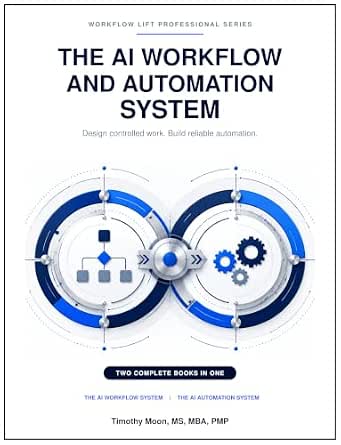 AI Workflow and Automation System – Workflow Lift Professional SeriesView on Amazon →
- 13
 n8n AI Automation: Build Smarter Workflows, Agents, and Intelligent Systems w…View on Amazon →
- 14
 Agentic Coding with Claude Code (5-in-1): A Practical Developer’s Handbook fo…View on Amazon →
Matching Automation to Team Skills
The choice affects whether a workflow is adopted, maintained and affordable as usage grows. No-code tools can help teams connect routine processes without waiting for engineering support, but complex branching may become difficult to manage. Code-first systems give developers more freedom, with a corresponding need for programming knowledge and ongoing upkeep.
The guide also draws attention to practical risks beyond setup: integration reliability, security, error handling and cost at higher volumes. Teams moving sensitive information between services need to check data practices and compliance claims. Those operating at scale should test projected costs and the durability of required connectors before committing.
Products Worth Considering

Canon PIXMA TR160 Wireless Portable Color Inkjet Printer

Apple Mac mini Desktop Computer with M5 Pro Chip (2026)

Logitech MX Creative Console with 9 Customizable Keys, Graphite
As an affiliate, we earn on qualifying purchases.
How the Guide Sorts Its Picks
The material groups its recommendations by intended user rather than presenting one tool as suitable for every organization. Its tiers include no-code playbooks for business owners, developer-oriented resources for engineers and enterprise guidance for complex environments. That structure reflects a central tradeoff: simpler interfaces can speed up initial setup, while more customizable systems may better fit complicated workflows.
The source says it prioritized resources that turn AI concepts into working processes, as well as their accessibility to different technical audiences. It cautions that users should assess actual coding ability, check whether platforms support necessary APIs and connectors, and compare hosting and pricing models. The supplied text does not include a publication date, complete list of 14 entries, or independent performance data.
“The main tradeoff in this category is simplicity versus scalability.”
— ThorstenMeyerAI.com guide
Details Missing From the List
The source material provided here does not name all 14 options, explain how each was scored, or supply comparative pricing, security certifications or performance results. The article therefore cannot establish that one platform is objectively best, nor confirm that every named product or resource will remain available in 2027.
Claims about features, integrations and suitability are attributed to the guide. Teams should confirm current product documentation, connector support, data handling, compliance terms and costs directly with vendors. The source also does not specify which workflows were tested or provide evidence from users.
Checks Before Choosing a Platform
Before adopting a system, teams can map one recurring process, identify the applications and data involved, and test the workflow with realistic error cases. They should compare the effort required to maintain it, confirm access controls and data-retention terms, and estimate costs at higher usage levels. Connector testing and a small pilot can reveal limitations before a wider rollout.
For the guide’s 2027 framing to be actionable, readers will need the complete list and current product details. The source material does not state when those details will be updated, so availability, pricing and capabilities should be checked at the time of purchase.
Key Questions
What is the main recommendation in the guide?
The guide calls The No-Code AI Automation Playbook its best overall choice for business users who want to automate without coding. That is the source’s judgment, not an independently established ranking.
Which option does it point developers toward?
It recommends n8n AI Automation for developers seeking granular control and Python integration, while noting that code-first approaches require more technical skill.
Does the source list and compare all 14 options?
The supplied source material names several resources and platforms, but it does not include the complete set of 14 or a full comparison table. The full list and its supporting evidence are not available here.
What should a team verify before adopting an automation tool?
Check required integrations, API support, security and data-handling terms, maintenance needs, and projected costs. A pilot using a real workflow can help expose issues before deployment at scale.
Source: ThorstenMeyerAI.com