
📊 Full opportunity report: AI Changelog Digest For Open-source Maintainers on IdeaNavigator AI — validation score, market gap, and execution plan.
TL;DR
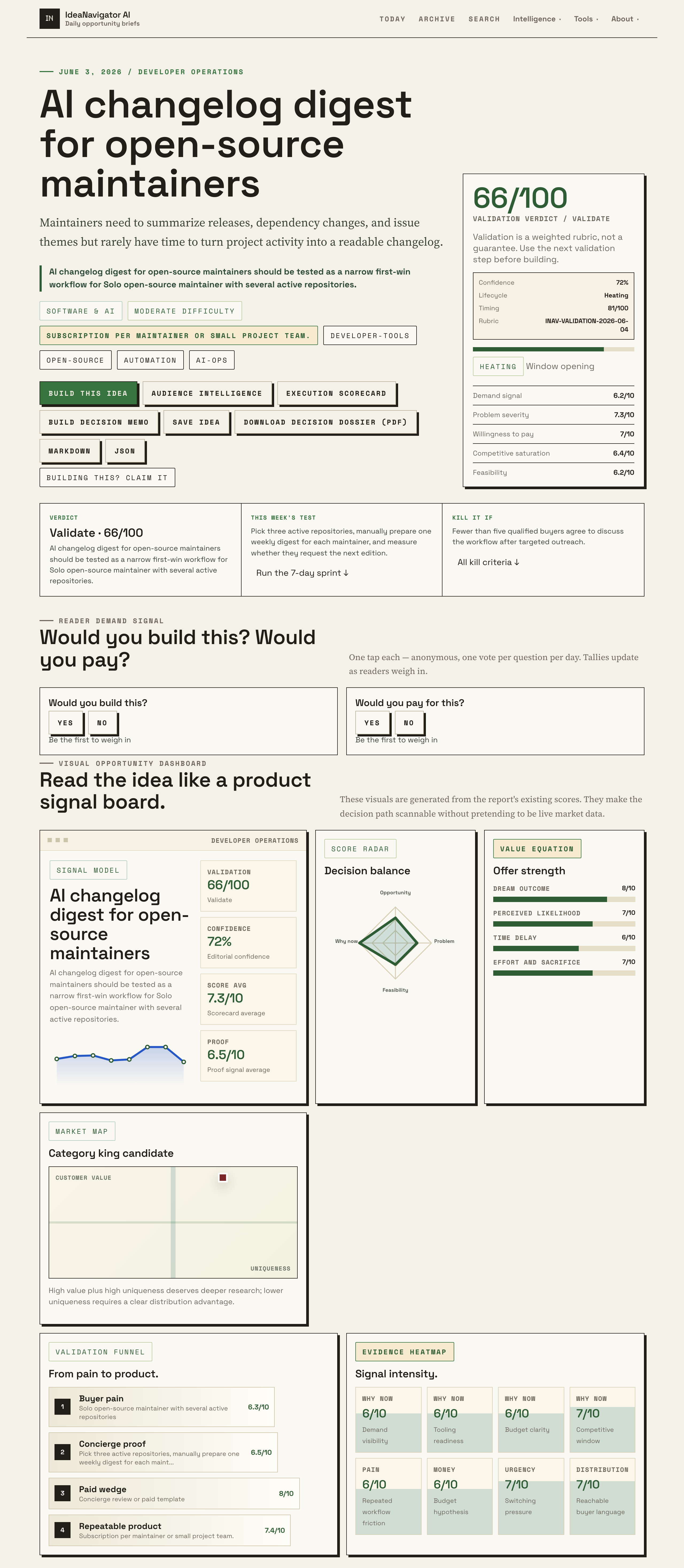
A prototype AI changelog digest for solo open-source maintainers is being tested, aiming to automate release summaries and issue themes. The tool could simplify project management for maintainers with multiple repositories.
IdeaNavigator AI is testing a new AI-driven workflow designed to generate weekly changelog digests for solo open-source maintainers managing multiple repositories. This development aims to address the common challenge of summarizing release updates, dependency changes, and issue themes without requiring a full developer-relations team, potentially streamlining project management for individual maintainers.
The proposed AI changelog digest system reads data from a maintainer’s repositories, including recent releases, merged pull requests, and top issues, then drafts a concise, readable summary for distribution via email or other channels. The initial test involves selecting three active repositories, with the goal of measuring whether maintainers request subsequent editions after reviewing the first digest. The concept leverages existing repository metadata, release feeds, and AI summarization technology to automate what is typically a manual, time-consuming process.
This initiative is part of a broader effort to develop practical tools for developer operations, with revenue models based on subscription fees per maintainer or small project teams. The MVP (minimum viable product) focuses on a narrow, high-value workflow that can be validated through real-world testing, offering a potential solution for solo maintainers overwhelmed by project activity.
Potential Impact on Solo Open-Source Maintainers
This development could significantly reduce the workload for individual open-source maintainers, enabling them to stay better informed about project activity without dedicating extensive time to manual updates. Automating changelog summaries may improve communication with users and contributors, enhance project transparency, and support more efficient project management. If successful, it could also inspire further AI-driven tools tailored for small-scale open-source projects, filling a gap in current developer operations tools.
software development changelog management tool
As an affiliate, we earn on qualifying purchases.
As an affiliate, we earn on qualifying purchases.
Growing Need for Automated Project Summaries
Maintainers of open-source projects often juggle multiple repositories and struggle to keep release notes, dependency updates, and issue themes organized and communicated effectively. Traditionally, this has involved manual effort, which can be time-consuming and prone to oversight. Recent advances in AI summarization and the availability of rich repository metadata make automated digest generation feasible. The idea of an AI-powered weekly digest has been proposed as a practical solution to this ongoing challenge, especially for solo maintainers without dedicated teams.
This initiative builds on existing trends toward automation in developer operations, with some early prototypes and experiments emerging in the open-source community. The current testing phase by IdeaNavigator AI aims to validate the concept’s practicality and value before broader adoption.
“The concept leverages existing repository metadata and AI summarization to automate manual update processes, promising to save maintainers significant time.”
— an anonymous researcher
Uncertainties About Adoption and Effectiveness
It is not yet clear how many maintainers will adopt the AI digest tool or how effective it will be in practice. The success depends on factors such as the accuracy of summarization, user interface design, and actual time savings. Additionally, the scalability of the system across diverse project types remains untested, and long-term user engagement is still uncertain.
Next Steps for Validation and Broader Deployment
IdeaNavigator AI plans to complete initial testing with the selected repositories, gather feedback from maintainers, and refine the digest generation process. If the prototype proves valuable, the team will expand testing to more projects and consider integrating additional features such as dependency change alerts and issue trend analysis. Broader deployment will depend on user demand and demonstrated effectiveness in reducing manual effort.
Key Questions
How will the AI generate the changelog summaries?
The system analyzes repository data, including releases, pull requests, and issues, then uses AI algorithms to create concise summaries of recent activity.
Is this tool intended for all open-source projects?
The initial focus is on solo maintainers managing several repositories, with plans to adapt based on user feedback and success metrics.
What are the potential limitations of this AI digest system?
Limitations include accuracy of summaries, handling complex project activity, and ensuring the digest remains relevant and timely for maintainers.
When will the system be available for wider use?
Wider deployment depends on the success of the current testing phase, with no specific release date announced yet.
How can maintainers participate in testing?
Maintainers interested in participating should contact IdeaNavigator AI or follow updates on their platform for opportunities to join early testing programs.
Source: IdeaNavigator AI