
📊 Full opportunity report: How Vendors Can Track Parental Consent For Youth Services on IdeaNavigator AI — validation score, market gap, and execution plan.

Get business pricing on office and shipping supplies
- Business-only prices and quantity discounts
- Tax-exempt purchasing
- Multiple users, one account, clear invoices
TL;DR
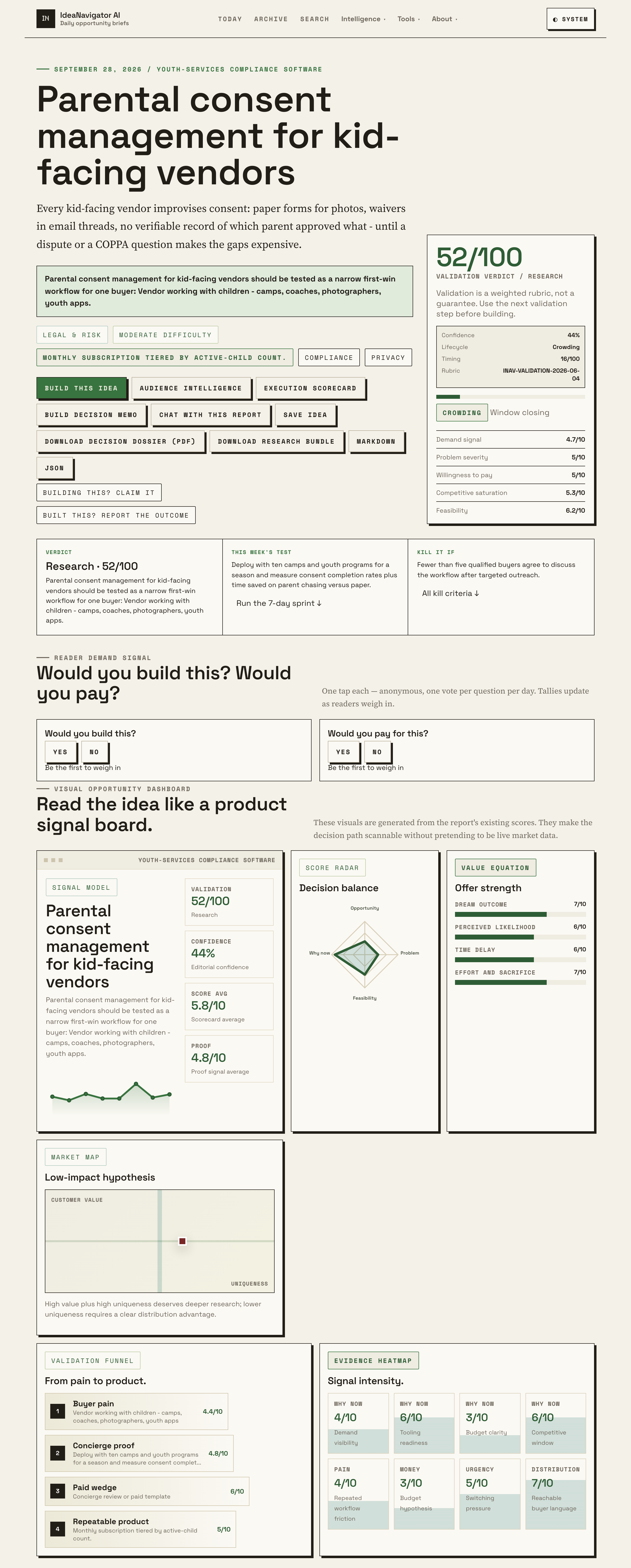
IdeaNavigator AI proposes testing a phone-based parental consent service with camps and youth programs. The concept includes per-child records, expiry tracking and audit exports, but no pilot results or evidence of adoption are provided.
IdeaNavigator AI has proposed a parental consent management service for vendors working with children, including camps, coaches, photographers and youth apps. The proposal calls for a pilot with ten camps and youth programs, but does not report that a product has been built, a pilot has begun or customers have signed up.
The proposed service would let parents complete vendor-branded consent forms on their phones. The suggested forms cover photo use, data collection, medical information and liability. The idea is to give each vendor a consistent way to record what a parent approved for a particular child, rather than relying on paper forms or scattered email threads.
Suggested product features include identity checks matched to the risk level, a per-child consent ledger, expiry tracking and an option to export records for an audit. The proposal does not specify how identity checks would work, which kinds of consent would require stronger verification or how long records would be kept.
The proposed business model is a monthly subscription tiered by active-child count. To test whether the service is useful, IdeaNavigator AI suggests deploying it with ten camps and youth programs for a season and measuring form completion and staff time spent following up with parents. No pricing, completion targets or pilot findings are provided.
A Record for Each Child
For a camp or coach, a reliable record could make it easier to confirm whether a parent authorized a specific activity, photo or use of a child’s data. Centralized, searchable approvals could also reduce the administrative work of chasing missing forms, though that benefit has not yet been measured for this proposal.
The idea addresses a practical problem for small organizations that may use different paperwork and processes across programs. If the suggested pilot shows that parents complete forms and staff save time, vendors could have a reason to pay for a dedicated system. If not, the proposed subscription model and product scope would need reassessment.
Consent records would not, by themselves, settle whether a particular use is lawful or whether an organization has met every applicable requirement. Their value would depend on accurate records, clear consent language and processes that match the organization’s obligations.
From Paper Forms to Ledgers
The proposal describes vendors using paper forms, email waivers and improvised records to collect approval for photos, data use, medical matters and liability. It argues that those approaches can leave vendors unable to verify which parent approved which use. That is the problem statement behind the product concept; the proposal supplies no survey or incident data showing how often these gaps occur.
It also points to changing children’s privacy rules and parent challenges to photo or data use as reasons vendors may want more defensible records. However, it does not identify specific laws, enforcement actions or jurisdictions. The proposed tool’s compliance value would depend on the requirements that apply to each vendor and the way each consent request is designed.
Pilot Evidence Is Still Missing
No product launch or pilot is confirmed. The proposal gives no vendor commitments, prototype details, price points or evidence that parents would adopt phone-based forms. It also does not report baseline completion rates or staff time spent on follow-ups, so any future time savings would need a defined comparison.
Other open questions include how the service would verify a parent’s identity, protect children’s personal and medical information, handle custody or guardian disputes, and manage consent changes or withdrawals. The proposal does not describe data storage, retention periods, security controls or how the system would address differing legal requirements.
A Ten-Program Season Test
The next proposed step is a season-long trial with ten camps and youth programs. A useful evaluation would record consent completion rates and staff time spent following up, as IdeaNavigator AI suggests. The proposal gives no start date, participant list, success threshold or plan for publishing results.
Until a pilot is reported, vendors considering the concept have no disclosed evidence about adoption, operating costs or measured savings. Any later announcement would need to clarify which consent workflows were tested, how records were verified and what happened to the children’s data.
Source: IdeaNavigator AI
Key Questions
Is a parental consent platform already available?
The proposal does not confirm a product launch or identify an available service. It outlines a product concept for vendors working with children.
Which organizations is the proposed service for?
It names camps, coaches, photographers and youth apps as potential users. The suggested pilot would involve ten camps and youth programs.
What would the platform track?
The suggested features include per-child consent records, expiry tracking and audit exports, covering permissions such as photo use, data collection, medical information and liability.
Has the proposed pilot shown that the service saves time?
No results are reported. The proposal suggests measuring completion rates and staff time spent following up with parents during a season-long trial.
Source: IdeaNavigator AI
Fall Picks
fall essentials
As an affiliate, we earn on qualifying purchases.