
📊 Full opportunity report: Postpartum Recovery Advice For Your Kind Of Delivery on IdeaNavigator AI — validation score, market gap, and execution plan.

Get business pricing on office and shipping supplies
- Business-only prices and quantity discounts
- Tax-exempt purchasing
- Multiple users, one account, clear invoices
TL;DR
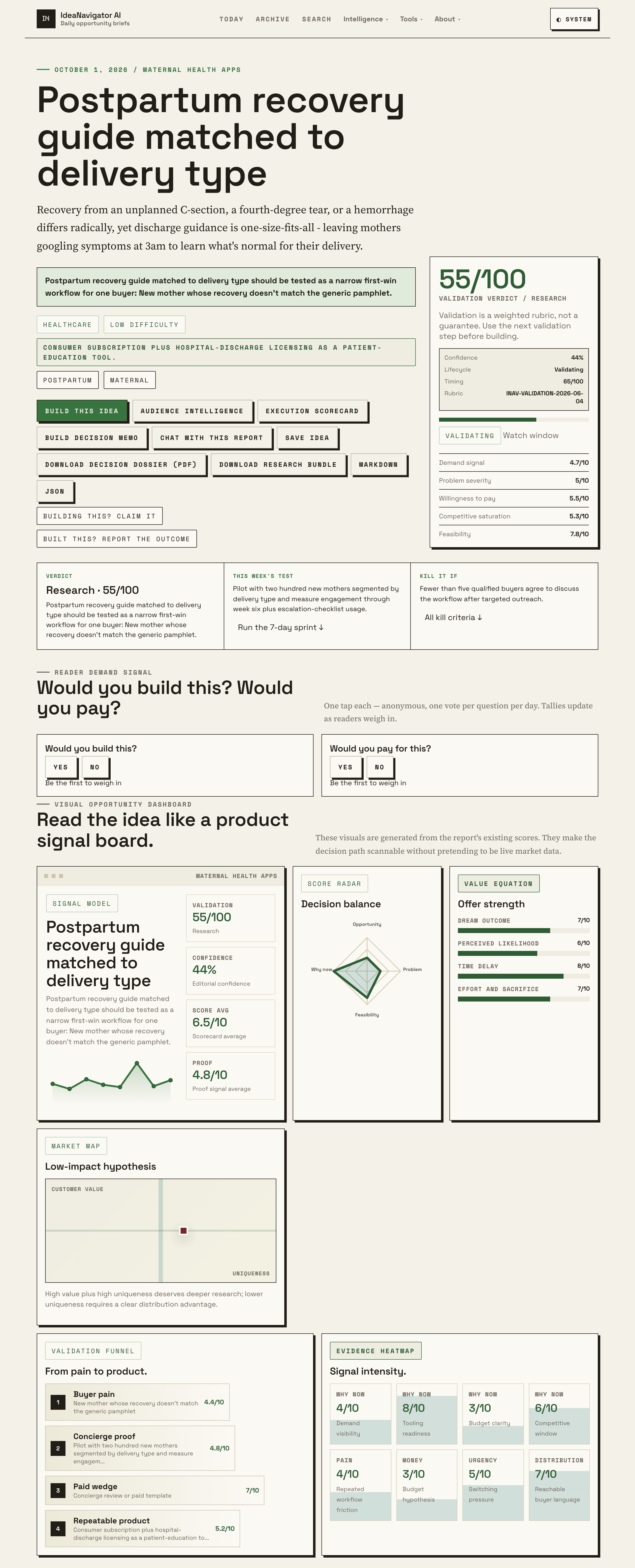
IdeaNavigator AI has outlined a proposed postpartum recovery guide that would tailor week-by-week information to a mother’s delivery details and complications. The concept includes warning-sign checklists and preparation for the six-week visit, but it is a product proposal, not a launched service or tested clinical intervention.
IdeaNavigator AI has outlined a proposed postpartum recovery guide that would adapt information to a mother’s delivery type, interventions, complications and feeding choices. The concept responds to a stated gap between varied recovery experiences and discharge guidance described as one-size-fits-all; no launch, clinical validation or hospital partnership is reported.
The proposed guide would begin with an intake covering mode of delivery, interventions and complications, as well as feeding. It would then provide week-by-week recovery expectations tailored to that profile, along with warning-sign checklists and summaries to help users prepare for the six-week postpartum visit. The material does not specify who would write or clinically review the advice, how often it would be updated, or how it would handle information that falls outside a user’s intake responses.
The idea is aimed at mothers whose recovery may not fit a generic pamphlet, including people recovering from an unplanned C-section, a fourth-degree tear or a hemorrhage. These are examples in the proposal, not evidence that the product has been developed for or evaluated with those groups. The proposal says differences in recovery can leave mothers searching online for information about symptoms, including late at night, but provides no survey data or patient interviews documenting how often that happens.
For validation, the proposal suggests a pilot with 200 new mothers segmented by delivery type. It would measure engagement through week six and use of escalation checklists. No pilot results, recruitment plan, safety measures or definition of successful engagement are provided. The proposed business model combines a consumer subscription with licensing to hospitals as a patient-education tool; neither a price nor a licensing agreement is reported.
Guidance That Reflects Delivery Differences
The proposal focuses on a practical question for postpartum care: whether recovery information can better reflect what happened during an individual birth. A person recovering from surgery or a serious tear may have different needs and warning signs from someone with an uncomplicated vaginal delivery. A guide organized around those differences could make it easier to find relevant information and prepare questions for a follow-up appointment.
That potential depends on the quality and limits of the guidance. A checklist could help users recognize when to seek care, but a digital guide cannot establish a diagnosis or confirm that a symptom is safe to monitor. The concept does not describe how it would distinguish routine recovery from urgent symptoms, direct users to emergency services, or account for individual medical advice. Those details matter to patients and hospitals considering an education tool.
The commercial plan also makes the proposal consequential beyond individual users. If hospitals licensed the guide, it could become part of discharge education; if consumers subscribed, access and cost would shape who uses it. At present, these are suggested routes to market. There is no evidence in the available description that hospitals have adopted the idea or that mothers would pay for it.
postpartum recovery guide for C-section
As an affiliate, we earn on qualifying purchases.
As an affiliate, we earn on qualifying purchases.
A Proposed Response to Follow-Up Needs
The proposal says postpartum care is receiving clinical attention and that newer guidelines call for individualized follow-up. It does not identify the guidelines, their issuing bodies, publication dates or specific recommendations, so the claim cannot be tied here to a particular policy change. The product rationale is that care may call for individual follow-up while educational materials remain organized around delivery as a single event.
The concept narrows its intended first audience to a new mother whose recovery does not match a generic pamphlet. Its suggested workflow links birth details to information delivered over the first six weeks, rather than treating the discharge document as the only point of contact. The six-week visit is the stated reference point for the proposed preparation summaries; the material does not say whether users would receive clinician contact before that appointment.
Maternal health apps are the market named in the proposal. The description does not compare existing products, identify competitors or establish how common delivery-specific guidance already is. It therefore sets out a potential product opportunity, rather than demonstrating that the market lacks all tailored resources or that this approach would improve health outcomes.
Clinical Review and Pilot Evidence
No evidence of a completed product or trial is included in the description. It remains unclear whether the proposed 200-person pilot has been approved, funded or scheduled, and there are no findings on engagement, checklist use, patient safety or clinical outcomes. The suggested sample size is a plan, not a reported result.
The proposal also leaves open how recovery guidance would be checked by clinicians, tailored for different medical histories, and kept current. It does not state which symptoms would trigger an escalation recommendation, what action the checklist would advise, or how the guide would respond if a user reported a potentially urgent problem. Its reference to individualized follow-up guidelines is not detailed enough to establish which recommendations the product would follow.
It is also unknown whether consumers or hospitals have expressed interest, what a subscription would cost, or how licensing would work. The stated problem of mothers searching online for answers is part of the product rationale; no figures are provided for how many mothers experience that problem or whether a tailored guide would reduce it.
Testing the Six-Week Guide
The next step set out in the proposal is a pilot involving 200 new mothers grouped by delivery type. The suggested measures are engagement through six weeks and use of escalation checklists. A report on recruitment, participant consent, clinician oversight, safety procedures and results would be needed to show what the test established; none is included in the available description.
If the concept proceeds, its developers would also need to clarify how the intake maps to specific guidance, who reviews that guidance, and how patients are directed to care when symptoms may be urgent. Hospital licensing and a consumer subscription are proposed business models, but the description does not name a partner, launch date or price. For now, the development is a product proposal whose usefulness and safety remain to be evaluated.
Source: IdeaNavigator AI
Key Questions
Has the postpartum guide launched?
No launch is reported. The available description presents a product concept and proposed validation pilot, without a release date or confirmation that the guide has been built.
What information would the guide use?
The proposed intake would capture delivery mode, interventions, complications and feeding. The concept says those details would shape week-by-week expectations, warning-sign checklists and preparation for the six-week visit.
Has the guide been clinically tested?
No clinical testing or pilot results are reported. The proposal suggests a 200-mother pilot measuring engagement through week six and escalation-checklist use.
Would the guide replace a clinician’s advice?
The proposal describes a patient-education tool, but does not specify how it would relate to medical care. It provides no basis for treating the guide as a substitute for advice from a clinician or urgent care when symptoms require attention.
Source: IdeaNavigator AI
Halloween Picks
halloween
As an affiliate, we earn on qualifying purchases.