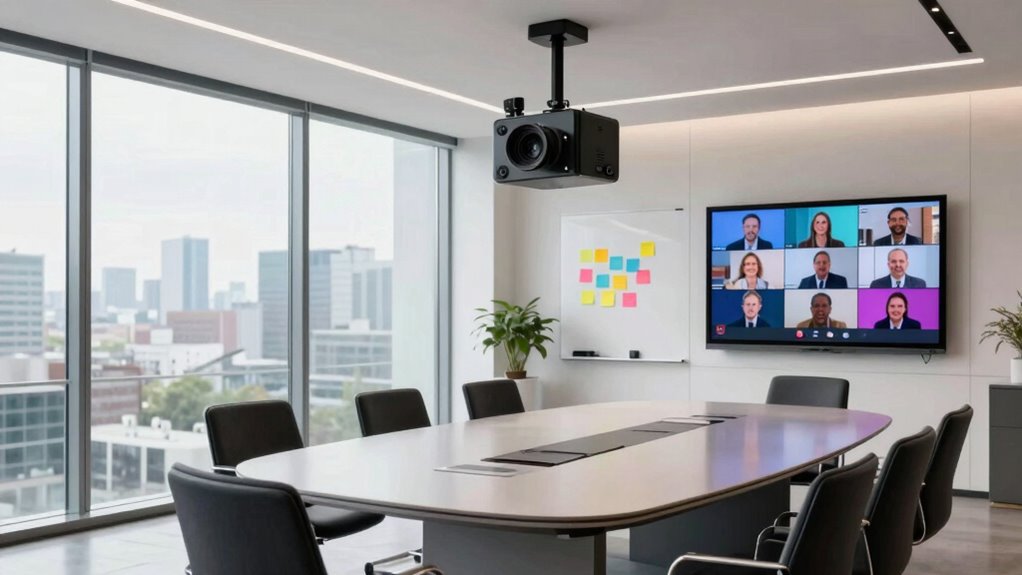
To choose the best conference room camera for your small team, focus on features like high resolution, autofocus, wide-angle lenses, and good low-light performance for clear video. Easy setup, remote control, and seamless integration with platforms and smart devices make meetings smoother. Don’t forget to take into account audio quality with noise reduction and echo cancellation. Balancing cost, maintenance, and scalability ensures long-term usability. Keep exploring to find the perfect fit that will boost your team’s collaboration.

Get business pricing on office and shipping supplies
- Business-only prices and quantity discounts
- Tax-exempt purchasing
- Multiple users, one account, clear invoices
Key Takeaways
- Prioritize high-resolution cameras with autofocus and wide-angle lenses for clear, comprehensive video in small meeting spaces.
- Choose models with user-friendly setup, remote/app controls, and pan/tilt/zoom features for flexible framing.
- Ensure compatibility with popular conferencing platforms and seamless integration with existing smart systems.
- Opt for cameras with high-quality audio, noise reduction, and echo cancellation to enhance communication clarity.
- Consider cost, maintenance, and scalability to find budget-friendly solutions suitable for ongoing team growth.

Choosing a conference room camera is essential for small teams that want clear, reliable communication during meetings. When you’re collaborating remotely, your video conferencing setup impacts how well your team interacts, shares ideas, and stays aligned. The key is to find a camera that offers the right features to support your team’s needs without overcomplicating your setup. Focus on camera features that enhance video quality, such as high resolution, autofocus, and wide-angle lenses, so everyone appears sharp and visible regardless of where they sit in the room. A camera with good low-light performance ensures everyone is visible even in less-than-ideal lighting conditions, making your meetings more productive.
In choosing a conference room camera, you should take into account how well it integrates with your existing systems and the ease of use. Some cameras come with plug-and-play setups, which save you time and reduce frustration during installation. Others might offer more advanced features like pan, tilt, and zoom capabilities, allowing you to focus on the speaker or capture the entire room with ease. These features are especially useful if your team varies in size or if you frequently switch between different meeting styles, from one-on-one discussions to larger group presentations. The right camera should allow you to easily control these functions, either via remote or through an app, so you don’t have to fumble with complicated settings during an important call. Additionally, selecting a camera with easy setup can significantly streamline the initial installation process.
Furthermore, considering the compatibility with your existing video conferencing platforms can ensure smoother operation with minimal technical issues. Clear audio is just as important as video quality in video conferencing, so look for cameras that include built-in microphones or are compatible with external audio devices. Some cameras even feature noise reduction and echo cancellation, ensuring voices come through crisp and clear, reducing misunderstandings. Additionally, think about the camera’s physical design—compact, discreet models can blend seamlessly into your meeting space without causing distractions. When selecting a camera, paying attention to video resolution can greatly improve overall clarity, especially in smaller rooms with limited space. Keeping the cost and long-term maintenance requirements in mind can also help you select a solution that fits your budget and future needs.
A further consideration is the ease of integration with other smart home or office automation devices, which can enhance your overall conference room experience. Ultimately, your goal is to choose a conference room camera that balances performance with simplicity. You want a device that enhances your team’s communication without adding unnecessary complexity. By prioritizing essential camera features such as high-resolution video, flexible control options, and audio compatibility, you set your team up for more engaging and productive meetings. Small teams thrive when they can communicate seamlessly, and the right camera is a key tool to make that happen, turning every virtual meeting into a clear, smooth, collaborative experience.
Products Worth Considering

Canon SELPHY CP1500 Compact Photo Printer Bundle with Two KP-108IN Ink and Paper Sets, Black

Vari Ergo Electric Standing Desk, 54×26, Light Wood/White

Logitech MX Ergo S Advanced Wireless Trackball Mouse USB-C – Graphite
As an affiliate, we earn on qualifying purchases.
Frequently Asked Questions
How Do Camera Field of View Options Affect Small Team Meetings?
Choosing the right camera angle and field of view directly impacts your meeting coverage. A wider field of view captures more of the room, ensuring everyone’s image is visible, which fosters engagement. Narrow angles focus on specific areas, ideal for presentations. Adjusting the camera’s field of view helps you tailor meeting coverage, making small team discussions more inclusive and productive, without missing important interactions or details.
Can These Cameras Integrate With Existing Team Collaboration Software?
Think of your conference camera as a universal translator in a busy market; it bridges communication gaps seamlessly. Most modern conference room cameras are designed for easy video conferencing integration, ensuring camera compatibility with popular collaboration software like Zoom, Microsoft Teams, and Slack. You’ll find many models that can sync effortlessly, making your meetings smoother and more efficient without technical hiccups, just like a translator that speaks everyone’s language.
What Are the Power Source Options for Small Conference Room Cameras?
You have several power source options for small conference room cameras. Many models offer wireless connectivity, allowing you to operate them without messy cords, and some are battery powered, giving you flexibility in placement. Battery-powered options are especially convenient if you want to avoid wiring or if the room lacks power outlets. Choose a camera with the power source that best fits your setup, ensuring seamless integration into your meeting environment.
Are There Privacy Features Available on These Conference Cameras?
Yes, many conference room cameras come with privacy features. You can control privacy settings to disable cameras or microphones when needed, ensuring your team’s conversations stay secure. Additionally, data encryption protects transmitted video and audio, preventing unauthorized access. These features give you peace of mind, knowing your meetings are private, and your data remains secure while you focus on collaboration.
How Do Camera Resolutions Impact Meeting Video Quality?
In the age of dial-up, poor resolutions felt like watching a blurry telegraph. Today, higher camera resolutions improve meeting video quality by capturing clearer images and finer details. Keep in mind, video compression and lighting conditions also influence quality—poor lighting can make high-res videos look grainy, and compression may cause pixelation. So, choosing a camera with higher resolution guarantees sharper visuals, even in less-than-ideal lighting.
Conclusion
Choosing the right conference room camera empowers your small team to communicate clearly, collaborate seamlessly, and grow confidently. It’s about more than just technology — it’s about connection, clarity, and confidence. When you select a camera that fits your needs, you foster better ideas, stronger relationships, and a more productive environment. Ultimately, the right camera isn’t just an investment in equipment; it’s an investment in your team’s success, today and tomorrow.