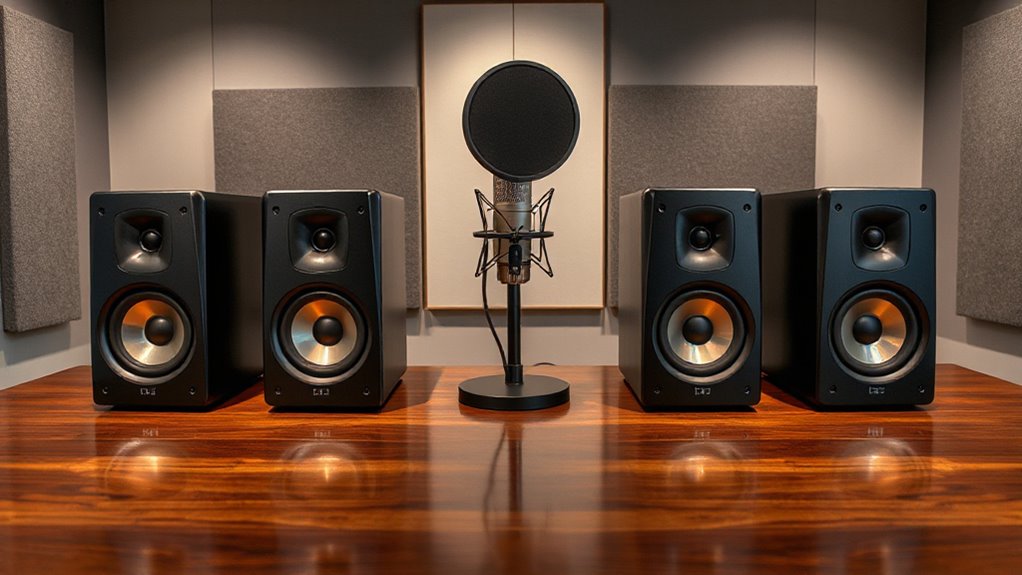

When selecting studio monitor speakers for podcast production, clarity and accuracy are essential. The PreSonus Eris Studio 5 stands out for its balanced sound and affordability, making it a solid overall choice. The Mackie CR8BT offers excellent versatility with Bluetooth connectivity, ideal for flexible setups. However, buyers face tradeoffs between size, sound fidelity, and budget, with larger speakers typically providing better bass but requiring more space. Keep reading for a detailed breakdown of these options to match your specific needs and setup.

Get business pricing on office and shipping supplies
- Business-only prices and quantity discounts
- Tax-exempt purchasing
- Multiple users, one account, clear invoices
Key Takeaways
- Larger monitors generally deliver better bass response, but need more space and power.
- Bluetooth connectivity adds convenience but may introduce slight latency or compromise sound purity.
- Balanced sound profiles are crucial for accurate podcast editing, favoring models like the PreSonus Eris series.
- Compact monitors are suitable for limited spaces but often sacrifice low-end depth.
- Price often correlates with build quality and sound fidelity, but some budget options still offer excellent value.
| PreSonus Eris Studio 5 5.25-inch 2-Way Active Studio Monitors with EBM Waveguide |  | Best Overall for Podcast Production | Driver Size: 5.25 inches | Frequency Response: 48 Hz to 20 kHz | Power: 80W | VIEW ON AMAZON | See Our Full Breakdown |
| Mackie CR5BT 5.25″ Creative Reference Powered Studio Monitors with Bluetooth |  | Best for Versatile Use and Casual Podcasting | Driver Size: 5.25 inches | Connectivity: TRS, RCA, 3.5mm, Bluetooth | Tweeter: Silk dome | VIEW ON AMAZON | See Our Full Breakdown |
| M-AUDIO BX4 4.5-inch Wired Studio Monitors Pair |  | Best Compact Monitors for Limited Spaces | Size: 4.5 inches | Type: Wired studio monitors | Connectivity: 1/4-inch, 1/8-inch, RCA | VIEW ON AMAZON | See Our Full Breakdown |
| PreSonus Eris E4.5 2-Way 4.5-Inch Near Field Studio Monitor (Pair) |  | Best for Accurate Studio Monitoring in Small Spaces | Speaker Size: 4.5 inches | Power: 50 Watts | Amplifier Type: Class AB | VIEW ON AMAZON | See Our Full Breakdown |
| Mackie CR8BT 8″ Creative Reference Powered Studio Monitors with Bluetooth, Tone Control, and Location Switch |  | Best for Larger Rooms and Versatile Listening | Size: 8 inches | Connectivity: TRS, RCA, 3.5 mm, Bluetooth | Features: Tone knob, location switch, headphone output | VIEW ON AMAZON | See Our Full Breakdown |
| M-AUDIO BX3 3.5-inch Wired Studio Monitors Pair |  | Best Compact Monitoring for Limited Space | Driver Size: 3.5 inches | Woofer Material: Kevlar | Tweeter Type: Silk Dome | VIEW ON AMAZON | See Our Full Breakdown |
| PreSonus Eris 3.5 Powered Studio Monitors, Pair |  | Best Value for Entry-Level Podcasting | Power: 50W | Woofer: 3.5″ woven-composite | Tweeter: 1″ silk-dome | VIEW ON AMAZON | See Our Full Breakdown |
| PreSonus Eris E7 XT 2-Way Active Studio Monitor |  | Best for Professional-Grade Podcasting and Mixing | Low-frequency driver: 6.55-inch woven composite | High-frequency driver: 1.25-inch silk-dome | Waveguide: EBM waveguide (100˚H x 60˚V) | VIEW ON AMAZON | See Our Full Breakdown |
| PreSonus Eris 3.5 Powered Studio Monitors, Pair |  | Best for Small Desk Setups and Casual Podcasting | Power: 50W | Woofer: 3.5-inch woven-composite | Tweeter: 1-inch silk-dome | VIEW ON AMAZON | See Our Full Breakdown |
| Edifier MR4 Powered Studio Monitors, 4-inch Active Reference Speakers |  | Best for Versatile Connectivity and Casual Production | Speaker Size: 4 inches | Tweeter: 1 inch silk dome | Inputs: 1/4″ TRS, RCA, AUX | VIEW ON AMAZON | See Our Full Breakdown |
| Yamaha HS3 Powered Studio Monitor (Pair) |  | Best Compact and Clear Sound for Small Studios | Type: 2-way bass-reflex powered speaker | Woofer: 3.5 inches | Tweeter: 0.75 inches | VIEW ON AMAZON | See Our Full Breakdown |
| Mackie CR3.5 3.5-inch Creative Reference Powered Studio Monitors | 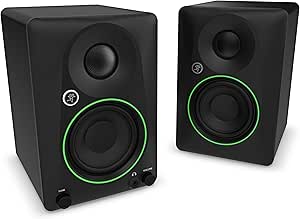 | Most Versatile for Desktop and Casual Use | Speaker Size: 3.5 inches | Tweeter: Silk dome | Woofer: Woven | VIEW ON AMAZON | See Our Full Breakdown |
| studio monitor speakers for podcast production buyer guide | Inputs | Tweeter |
|---|---|---|
| PreSonus Eris Studio 5 5.25-in | XLR, ¼-inch TRS, RCA | — |
| Mackie CR5BT 5.25" Creative Re | — | Silk dome |
| M-AUDIO BX4 4.5-inch Wired Stu | — | — |
| PreSonus Eris E4.5 2-Way 4.5-I | ¼-inch TRS, RCA, ⅛-inch TRS aux | 1-inch silk-dome |
| Mackie CR8BT 8" Creative Refer | — | — |
| M-AUDIO BX3 3.5-inch Wired Stu | 1/4-inch, 1/8-inch, RCA | — |
| PreSonus Eris 3.5 Powered Stud | TRS, RCA, aux | 1" silk-dome |
| PreSonus Eris E7 XT 2-Way Acti | — | — |
| PreSonus Eris 3.5 Powered Stud | TRS, RCA, aux | 1-inch silk-dome |
| Edifier MR4 Powered Studio Mon | 1/4" TRS, RCA, AUX | 1 inch silk dome |
| Yamaha HS3 Powered Studio Moni | XLR/TRS combo, RCA, Stereo Mini | 0.75 inches |
| Mackie CR3.5 3.5-inch Creative | — | Silk dome |
More Details on Our Top Picks
PreSonus Eris Studio 5 5.25-inch 2-Way Active Studio Monitors with EBM Waveguide
The PreSonus Eris Studio 5 stands out for its exceptionally clear high-frequency reproduction and wide stereo imaging, making it ideal for detailed podcast editing where clarity matters most. Compared to the Mackie CR5BT, which offers more versatile connectivity including Bluetooth, the Eris provides more precise tuning controls and protection features, but at a higher price. Its EBM Waveguide enhances sound dispersion, creating a broader listening sweet spot—crucial for collaborative podcast editing. The main tradeoff is the higher cost, which might deter casual or beginner podcasters. This monitor is best suited for serious creators who prioritize sound accuracy over affordability.
Pros:- Exceptional clarity in high frequencies for detailed editing
- Wide stereo imaging with advanced waveguide technology
- Multiple input options for flexible connectivity
- Customizable acoustic tuning controls
Cons:- Higher price point compared to smaller or simpler monitors
- Requires careful setup to optimize sound quality
Best for: Podcast producers who need precise, studio-quality sound for editing and mixing
Not ideal for: Casual podcasters or hobbyists seeking budget-friendly options or Bluetooth convenience
- Driver Size:5.25 inches
- Frequency Response:48 Hz to 20 kHz
- Power:80W
- Max SPL:102 dB
- Inputs:XLR, ¼-inch TRS, RCA
- Waveguide:EBM Waveguide
- Protection Features:RF interference, output-current limiting, over-temperature, transient, subsonic protection
Our verdict“A top choice for professional or serious amateur podcasters who require accurate sound reproduction and versatile controls.”
Mackie CR5BT 5.25″ Creative Reference Powered Studio Monitors with Bluetooth
The Mackie CR5BT offers a compelling balance of studio-quality sound with the convenience of Bluetooth connectivity, making it suitable for multi-purpose use including casual podcasting, gaming, and music. Unlike the PreSonus Eris 5 which emphasizes detailed tuning, the CR5BT focuses on ease of use with adjustable tone controls and a switchable placement mode, catering to those who need quick setup and flexible placement. Its silk dome tweeter and woven woofer deliver crisp highs and deep bass, making it a good choice for listeners who want decent sound without a professional studio environment. The downside is the absence of a subwoofer, limiting low-frequency depth, especially in larger rooms. This monitor set suits podcasters who want decent sound quality with maximum convenience and connectivity options.
Pros:- Versatile connectivity including Bluetooth and multiple wired inputs
- Adjustable tone controls for tailored sound
- Switchable placement for desktop or bookshelf use
- Good overall sound with clear highs and deep bass
Cons:- No included subwoofer for enhanced bass response
- Limited to 5.25-inch woofer size, less suited for large rooms
Best for: Podcasters who value ease of use, Bluetooth streaming, and flexible placement options
Not ideal for: Professional editors or those seeking the most precise sound for critical mixing
- Driver Size:5.25 inches
- Connectivity:TRS, RCA, 3.5mm, Bluetooth
- Tweeter:Silk dome
- Woofer:Woven
- Features:Tone knob, location switch, headphone output
Our verdict“An excellent choice for casual podcasters who want flexible setup and wireless connectivity without sacrificing much audio quality.”
M-AUDIO BX4 4.5-inch Wired Studio Monitors Pair
The M-AUDIO BX4 offers a compact, wired solution with studio-grade sound in a small footprint, making it ideal for desktop setups where space is limited. Compared with the PreSonus Eris E4.5, the BX4’s smaller size makes it more portable and easier to integrate into tight spaces, but it may sacrifice some low-end fullness. Its Kevlar woofers and silk dome tweeters produce punchy bass and clear highs, suitable for editing, streaming, or gaming. The main tradeoff is the need for wired connection, which limits mobility, and some users may find the setup process less straightforward. This model is best for those who need quality sound in a confined area and are comfortable with wired connections.
Pros:- Compact size ideal for small desks
- Studio-grade sound with punchy bass and clear highs
- Versatile input options including RCA and ¼-inch
- Includes cables, software, and foam feet for easy setup
Cons:- Requires wired connection, limiting portability
- May be over-spec for casual listening or very large rooms
Best for: Desktop-focused content creators or gamers with limited space who want studio-quality sound
Not ideal for: Podcasters who prefer wireless or need larger monitors for bigger rooms
- Size:4.5 inches
- Type:Wired studio monitors
- Connectivity:1/4-inch, 1/8-inch, RCA
- Included Components:Passive and active speakers, cables, foam feet, software
Our verdict“A solid, space-saving choice for desktop creators seeking high-quality sound without the bulk of larger monitors.”
PreSonus Eris E4.5 2-Way 4.5-Inch Near Field Studio Monitor (Pair)
The PreSonus Eris E4.5 provides highly accurate sound reproduction, making it well-suited for detailed editing and mixing in small rooms. Its 50W dual amplification and room tuning controls help tailor the sound to specific environments, surpassing basic monitors like the Yamaha HS3 in versatility. However, it’s less capable of delivering deep bass without an external subwoofer, which adds complexity and cost. Its compact size and balanced sound make it a favorite among podcasters who need reliable, studio-grade audio. The main compromise is the potential need for additional bass support in larger spaces. This monitor is ideal for those prioritizing accuracy over bass extension, especially in controlled environments.
Pros:- Highly accurate and balanced sound for professional editing
- Versatile connectivity including balanced inputs
- Room tuning controls for customized sound
- Compact design fits small spaces easily
Cons:- Requires external subwoofer for extended bass
- Power saver mode may turn off speakers unexpectedly
Best for: Podcasters and content creators who prioritize accurate sound reproduction in small rooms
Not ideal for: Large-room producers or casual listeners who don’t want to add external subwoofers
- Speaker Size:4.5 inches
- Power:50 Watts
- Amplifier Type:Class AB
- Tweeter:1-inch silk-dome
- Inputs:¼-inch TRS, RCA, ⅛-inch TRS aux
- Low-Frequency Extension:Optional Eris Sub 8BT
Our verdict“A reliable, accurate monitor choice for podcasters focused on editing precision within limited space.”
Mackie CR8BT 8″ Creative Reference Powered Studio Monitors with Bluetooth, Tone Control, and Location Switch
The Mackie CR8BT features an 8-inch woven woofer and powerful 100W amplification, making it suitable for larger rooms or those who want more bass presence. Its built-in tone control and Bluetooth add convenience and flexibility, especially compared to smaller monitors like the PreSonus Eris 4.5. While it offers excellent sound quality with clear highs and deep lows, it shares the drawback of not including a subwoofer, which could limit bass performance in bigger spaces. Its larger size and added features make it a better fit for users who need more volume and bass, but it may be overkill for small, confined spaces. This monitor is perfect for bigger rooms or casual producers who want a mix of convenience and substantial sound.
Pros:- Large 8-inch woofer with deep bass response
- Versatile inputs including Bluetooth and multiple wired options
- Adjustable tone controls and placement switch
- Powerful 100W amplification for larger spaces
Cons:- No included subwoofer for additional bass depth
- Size may be impractical for small desks or rooms
Best for: Podcasters and content creators working in larger spaces or seeking more bass impact
Not ideal for: Small-room users or those on a tight budget who don’t need the extra size or power
- Size:8 inches
- Connectivity:TRS, RCA, 3.5 mm, Bluetooth
- Features:Tone knob, location switch, headphone output
- Power:100W
- Included Accessories:None
Our verdict“A suitable option for larger rooms or those who want robust sound with flexible controls, but less ideal for tight spaces or budget setups.”
M-AUDIO BX3 3.5-inch Wired Studio Monitors Pair
The M-AUDIO BX3 stands out for its compact size, making it ideal for desktop setups where space is tight. Compared with larger monitors like the PreSonus Eris E7 XT, the BX3 sacrifices some bass depth due to its smaller 3.5-inch drivers, but it offers high-quality studio-grade sound with clear highs and punchy mids. Its customizable EQ controls allow for tailored sound, although the need for external power and setup complexity can be a hurdle for beginners. This pick makes the most sense for podcasters or content creators working on limited desks who prioritize clarity over deep bass. Pros: Compact size, versatile input options, customizable EQ, studio-grade clarity. Cons: Limited bass response, requires external setup, only includes one pair.
Verdict: Best suited for podcasters with small desks needing precise, clear audio in a space-efficient design.- Driver Size:3.5 inches
- Woofer Material:Kevlar
- Tweeter Type:Silk Dome
- Inputs:1/4-inch, 1/8-inch, RCA
- Included Accessories:Passive speaker, active speaker, foam feet, interconnect cables, software
Our verdict“Best Compact Monitoring for Limited Space — a strong pick in this lineup.”
PreSonus Eris 3.5 Powered Studio Monitors, Pair
The PreSonus Eris 3.5 delivers solid studio-quality sound at an accessible price point, making it a strong choice for beginner podcasters and hobbyists. Its 50W amplification and woven-composite 3.5-inch woofer produce clear audio, though the small driver limits deep bass, which can be noticeable compared to larger monitors like the PreSonus Eris E7 XT. The built-in tuning controls help optimize sound for various environments, but the monitors lack wireless connectivity, which could be a drawback for those wanting a clutter-free setup. This model makes the most sense for newcomers seeking reliable sound without a hefty investment. Pros: Affordable, good sound clarity, built-in tuning controls, multiple input options. Cons: Small woofer limits bass, not ideal for large rooms, no wireless features.
Verdict: Ideal for entry-level podcasters who need dependable, clear audio on a budget.- Power:50W
- Woofer:3.5″ woven-composite
- Tweeter:1″ silk-dome
- Frequency Range:80 Hz–20 kHz
- Inputs:TRS, RCA, aux
Our verdict“Best Value for Entry-Level Podcasting — a strong pick in this lineup.”
PreSonus Eris E7 XT 2-Way Active Studio Monitor
The PreSonus Eris E7 XT offers a notable upgrade with its larger 6.55-inch low-frequency driver and wide EBM waveguide, making it better suited for detailed podcast editing and mixing compared to smaller models like the PreSonus Eris 3.5. Its acoustic tuning controls and wide sweet spot facilitate precise calibration in various environments, though its higher price tag can be a barrier for hobbyists. The inclusion of Studio One Prime and Studio Magic software adds value for those wanting an all-in-one production setup. This monitor is ideal for podcasters who demand accuracy and are willing to invest in professional sound. Pros: Wide sweet spot, professional software bundle, detailed sound, customizable controls. Cons: Higher cost, requires space for calibration, more complex setup.
Verdict: Best for serious podcasters and producers seeking studio-level accuracy and calibration features.- Low-frequency driver:6.55-inch woven composite
- High-frequency driver:1.25-inch silk-dome
- Waveguide:EBM waveguide (100˚H x 60˚V)
- Included software:Studio One Prime, Studio Magic
- Features:Level, HPF, LF Trim, HF Trim, Acoustic Space controls
Our verdict“Best for Professional-Grade Podcasting and Mixing — a strong pick in this lineup.”
PreSonus Eris 3.5 Powered Studio Monitors, Pair
The PreSonus Eris 3.5 provides reliable, studio-quality sound in a compact form, making it well-suited for podcasters who record in tight spaces. Its 50W amplification and woven-composite 3.5-inch woofers offer clear, balanced audio, but the small driver size limits deep bass response, which might be noticeable in larger or bass-heavy content. The built-in tuning controls are helpful for customizing sound, though the monitors lack wireless connectivity, reducing convenience. This product is a good fit for podcasters with limited desk space who prioritize clarity over bass depth. Pros: Clear sound, versatile tuning, compact design, solid amplification. Cons: Limited bass, small size for large rooms, no wireless features.
Verdict: Best for podcasters with small desks needing dependable, balanced sound in a minimal footprint.- Power:50W
- Woofer:3.5-inch woven-composite
- Tweeter:1-inch silk-dome
- Frequency Range:80 Hz–20 kHz
- Inputs:TRS, RCA, aux
Our verdict“Best for Small Desk Setups and Casual Podcasting — a strong pick in this lineup.”
Edifier MR4 Powered Studio Monitors, 4-inch Active Reference Speakers
The Edifier MR4 offers a balanced mix of studio accuracy and user-friendly controls, making it suitable for creators who want reliable sound with multiple connectivity options. Its 4-inch composite woofer and 1-inch silk dome provide clear, natural audio, though the slightly larger size compared to the 3.5-inch models adds some depth without overwhelming a small desk. The resonance-reducing MDF enclosure and adjustable sound modes enhance the listening experience, but the absence of wireless features limits convenience for wireless streaming. This monitor is ideal for podcasters who need flexible inputs and straightforward controls without the need for extensive calibration. Pros: Accurate sound, multiple inputs, user-friendly controls, resonance-reducing MDF. Cons: No wireless, limited bass for large spaces, external power needed.
Verdict: Best for podcasters who value flexible connectivity and straightforward operation in a compact, accurate monitor.- Speaker Size:4 inches
- Tweeter:1 inch silk dome
- Inputs:1/4″ TRS, RCA, AUX
- Controls:High and low frequency knobs, volume and sound mode
- Material:MDF wood texture
Our verdict“Best for Versatile Connectivity and Casual Production — a strong pick in this lineup.”
Yamaha HS3 Powered Studio Monitor (Pair)
The Yamaha HS3 stands out for its precise midrange clarity and straightforward connectivity, making it an excellent choice for podcasters in compact spaces. Compared to the Mackie CR3.5, the HS3 offers a more transparent sound profile, especially in the high frequencies, but its smaller 3.5-inch woofer limits deep bass response. The HS3’s room control and high trim adjustments help tailor the sound to different environments, which is beneficial for smaller or acoustically challenging rooms. However, its limited low-end may require an external subwoofer for producers needing more bass punch. This monitor is ideal for those who prioritize accuracy and clarity in a small footprint, but not for users expecting powerful low frequencies or a larger studio setup.
Pros:- Excellent clarity in mid and high frequencies, ideal for voice-centric content
- Multiple input options increase versatility with different audio interfaces
- Includes practical accessories like cables and anti-slip pads
Cons:- Limited low-frequency response due to small woofer size
- Requires external amplifier or audio interface to power the monitor
Best for: Podcasters working in small, acoustically treated rooms who need clear, detailed mid and high frequencies.
Not ideal for: Podcasters needing deep bass or working in larger studio spaces that require more substantial monitoring power.
- Type:2-way bass-reflex powered speaker
- Woofer:3.5 inches
- Tweeter:0.75 inches
- Frequency Response:70 Hz – 22 kHz (-10 dB)
- Output Power:26 W
- Inputs:XLR/TRS combo, RCA, Stereo Mini
Our verdict“The Yamaha HS3 offers precise, transparent sound perfect for small studio podcasters who prioritize clarity over bass depth.”
Mackie CR3.5 3.5-inch Creative Reference Powered Studio Monitors
The Mackie CR3.5 delivers flexible connectivity and adjustable tone control, making it a smart pick for podcasters who also want to use their monitors for gaming or casual listening. Compared with the Yamaha HS3, the CR3.5’s built-in tone knob and location switch provide an extra layer of customization without needing external gear. Its multiple input options (TRS, RCA, 3.5 mm) make it compatible with most devices, providing a plug-and-play experience. However, its 3.5-inch drivers limit deep bass, which may be noticeable if you rely heavily on low-end presence for your podcasting. This monitor suits those who want a compact, multi-purpose speaker for varied applications but isn’t ideal for those seeking studio-grade bass or larger soundstage.
Pros:- Multiple input options accommodate diverse audio sources
- Adjustable tone control allows sound tailoring to environment
- Switchable modes for desktop or bookshelf placement enhances flexibility
- Compact size fits easily into limited spaces
Cons:- Limited low-end response may necessitate a subwoofer for full-range sound
- 3.5-inch driver restricts the depth of bass for bass-heavy content
Best for: Podcasters who need a compact, versatile monitor suitable for desktop use and multi-device connectivity.
Not ideal for: Podcasters requiring deep bass or working in large, acoustically untreated spaces where larger monitors are preferable.
- Speaker Size:3.5 inches
- Tweeter:Silk dome
- Woofer:Woven
- Connectivity:TRS, RCA, 3.5 mm input
- Features:Tone knob, location switch, headphone output
Our verdict“The Mackie CR3.5 is a flexible, space-saving monitor ideal for podcasters who want customizable sound in a small footprint.”

How We Picked
The products in this roundup were evaluated based on sound accuracy, build quality, usability, and value for podcast producers. We prioritized monitors that deliver clear, flat response to ensure listeners get an honest representation of their recordings. Ease of setup and additional features like connectivity options were also considered, especially for those with limited space or budget. The ranking reflects a balance between performance, affordability, and versatility, helping both beginners and experienced podcasters find suitable options.Factors to Consider When Choosing Studio Monitor Speakers For Podcast Production Buyer Guide
Choosing the right studio monitor speakers for podcasting involves understanding several key factors. A monitor’s sound profile, size, connectivity options, and durability all impact your workflow and audio quality. Making the wrong choice can lead to misjudged mixes or unnecessary expense. This section highlights the most important considerations to keep in mind to match your specific setup and goals with the ideal monitors.Sound Quality and Frequency Response
For podcast production, monitors that offer a flat, neutral frequency response are essential. This ensures that what you hear is an accurate representation of your recording without exaggerated bass or treble. Models like the PreSonus Eris series excel here, providing a balanced sound that helps you make precise editing decisions. Avoid monitors with overly colored sound if your goal is to produce transparent, professional-quality audio.
Size and Power Output
The physical size of monitors affects both sound quality and space requirements. Larger speakers, such as the Mackie CR8BT, typically reproduce lower frequencies more convincingly, but they demand more room and power. Smaller monitors like the M-AUDIO BX3 are more space-efficient, though they might lack depth in bass. Consider your room size and whether you need high volume levels, balancing size with your available space and audio needs.
Connectivity and Compatibility
Connectivity options like XLR, TRS, or RCA are standard, but Bluetooth or auxiliary inputs can add convenience, especially for quick playback or secondary devices. However, wireless connections may introduce latency or slight fidelity loss, which can be problematic for critical editing. Choose monitors that match your existing equipment and workflow, weighing convenience against the potential impact on sound quality.
Build Quality and Durability
Since monitors are an investment, durability matters—especially if you move your setup or transport gear. Look for models with sturdy enclosures and quality drivers. Budget options may skimp here, leading to vibrations or distortion over time. Well-built monitors like the Yamaha HS3 tend to offer better long-term reliability, making them a smarter choice for ongoing use.
Budget and Value
While high-end monitors provide superior sound, they come with a higher price tag. Many budget options, such as the PreSonus Eris 3.5, deliver surprisingly accurate audio for their cost, making them suitable for beginners or those on a tight budget. Assess your needs carefully—spending more can improve longevity and performance, but a balanced approach ensures you get the best value without overspending.
Frequently Asked Questions
Do I need powered monitors or passive ones for podcasting?
Powered monitors, which have built-in amplification, are generally more convenient and easier to set up, especially for podcasting. They eliminate the need for external amps or receivers, reducing clutter and complexity. Passive monitors require separate amplification, which can add cost and setup time but may offer more flexibility for larger or more customized systems. For most podcasters, powered monitors like those in this guide provide a straightforward, reliable solution.
How important is room size when choosing studio monitors?
Room size plays a significant role in selecting the right monitors. Smaller spaces benefit from compact speakers like the M-AUDIO BX3, which prevent overwhelming the room and minimize sound reflections. Larger rooms can accommodate bigger monitors such as the Mackie CR8BT, which deliver fuller bass and higher volume levels. Proper placement and acoustic treatment further enhance performance, regardless of room size, ensuring accurate sound reproduction for editing and mixing.
Should I prioritize sound accuracy over features like Bluetooth?
For podcast production, accuracy in sound reproduction should take precedence over added features like Bluetooth, which can introduce latency or slight fidelity compromises. While Bluetooth adds convenience, it’s better suited for casual listening or secondary tasks. For critical editing, wired connections and monitors with flat response curves are essential to ensure your audio decisions are based on true representations of your recordings.
Are more expensive monitors always better for podcasting?
Not necessarily. Higher-priced monitors typically offer improved build quality, flatter response, and better durability, which benefit professional workflows. However, many budget options provide excellent accuracy and value for entry-level or hobbyist podcasters. Your choice should match your production needs and budget—spending more makes sense if you require the highest fidelity or plan to expand your setup, but affordable monitors can still produce professional results at lower costs.
What is the best size monitor for small home studios?
In compact spaces, smaller monitors like the PreSonus Eris 3.5 or M-AUDIO BX3 are ideal. They fit comfortably on desks and deliver accurate sound without overwhelming the room. Larger monitors, such as the Mackie CR8BT, can produce richer bass but may cause room issues or require acoustic treatment. For most small home studios, choosing smaller, well-reviewed monitors helps strike a balance between space constraints and audio quality.
Conclusion
For those seeking the best overall performer, the PreSonus Eris Studio 5 offers a balanced mix of accuracy, affordability, and versatility. Budget-conscious podcasters will find the M-AUDIO BX3 and PreSonus Eris 3.5 excellent values, providing reliable sound without breaking the bank. For users with larger spaces or professional ambitions, the Mackie CR8BT delivers impressive bass and connectivity options, making it a top premium choice. Beginners should prioritize simplicity and affordability, while experienced producers may prefer monitors with flatter response and advanced features. Tailor your selection based on your room size, workflow, and budget to get the best results for your podcasting setup.Fall Picks
fall essentials
As an affiliate, we earn on qualifying purchases.