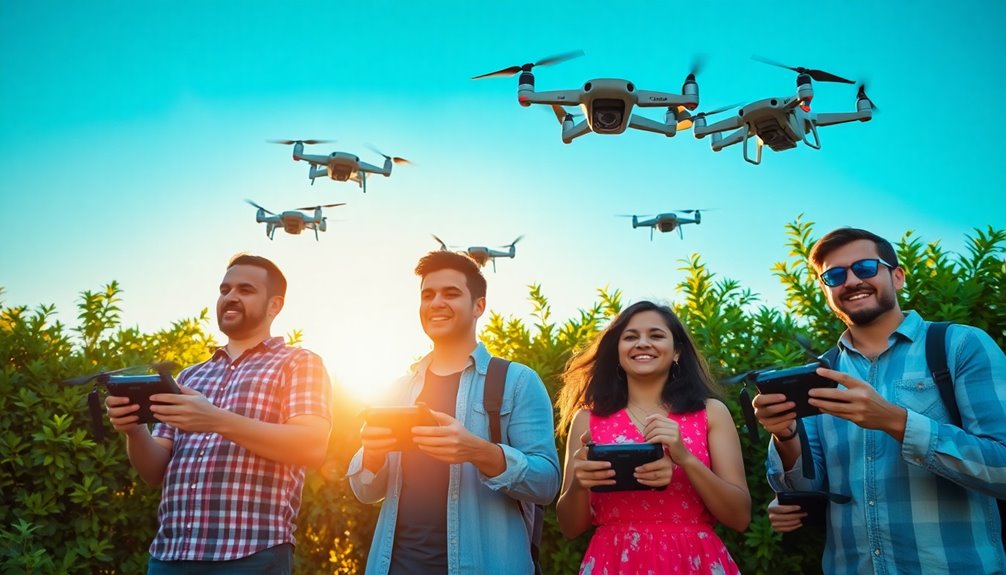

For most first-time flyers, the DJI Mini 4K Drone Combo is the best overall choice in this roundup, pairing a capable 4K camera with two batteries for more practice between charges. The DJI Neo is a simpler, compact option for casual clips, while the Q9s Kids RC Drone favors protected, low-stakes learning over camera quality. The main tradeoff is between beginner-friendly flight support and portability, camera performance, or a lower-complexity setup. Screen controllers can make framing easier, but they do not replace sound flight assistance or careful practice. Read on for how all 15 options differ and which one best fits your first flights.

Get business pricing on office and shipping supplies
- Business-only prices and quantity discounts
- Tax-exempt purchasing
- Multiple users, one account, clear invoices
Key Takeaways
- The DJI Mini 4K Combo stands out as the strongest all-round starter: its 4K camera and two-battery bundle serve both early practice and more serious aerial footage.
- The DJI Neo and Mini 4K fill different beginner needs: Neo favors compact, approachable casual flying, while the Mini 4K offers a more capable camera-drone setup.
- Built-in-screen remotes are a convenience, not a complete beginner system: models such as the G150, PK01, foldable GPS drone, and TD12Pro simplify viewing, but buyers should still check flight aids and control behavior.
- Kids’ practice and aerial photography call for different priorities: the Q9s emphasizes propeller guards and LED lights, while DJI and other 4K models put more emphasis on camera output.
- Feature lists need careful comparison: GPS, return functions, follow-me modes, and brushless motors on models such as the N11 PRO can add capability, but a newcomer should weigh these against setup complexity and support.
| G150 Foldable Drone with 1080P Camera and Screen Controller |  | Best Screen-Controlled Starter | Video resolution: 1080p | Still resolution: 2 MP | Control: Remote controller with built-in screen | VIEW ON AMAZON | See Our Full Breakdown |
| DJI Neo Mini Drone with 4K UHD Camera |  | Best for Phone-Free Casual Flying | Camera resolution: 4K UHD | Weight: 135 g | Control modes: Controller-free, voice control, mobile app, or RC | VIEW ON AMAZON | See Our Full Breakdown |
| DJI Mini 4K Drone Combo with 2 Batteries |  | Best Overall for Learning and Aerial Video | Camera: 4K UHD | Gimbal: 3-axis stabilization | Weight: Under 249 g | VIEW ON AMAZON | See Our Full Breakdown |
| Loiley Foldable Drone with 2K Camera | 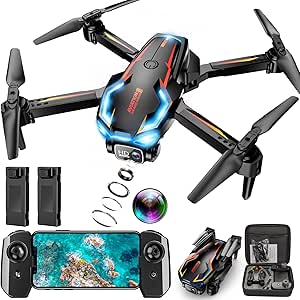 | Best Value for Smartphone Practice | Camera resolution: 2K | Effective still resolution: 2.2 MP | Camera angle: 90-degree adjustable | VIEW ON AMAZON | See Our Full Breakdown |
| PK01 Drone with Camera and Built-in Screen Remote Controller |  | Best for Beginners Who Want On-Controller Video | Camera: 1080p HD with 80-degree adjustable lens | Flight time: Up to 25 minutes with two batteries | Motors: Brushless | VIEW ON AMAZON | See Our Full Breakdown |
| Foldable GPS Drone with 4K Camera and 4.5-Inch Screen Controller |  | Best for Beginners Who Want a Built-In Screen | Camera: 4K UHD; 90° adjustable lens | Controller display: 4.5-inch built-in screen | Motor: Brushless | VIEW ON AMAZON | See Our Full Breakdown |
| Q9s Kids RC Drone with LED Lights, Propeller Guards, and Two Batteries |  | Best First Practice Drone for Kids | Model: Q9s | Type: Remote-controlled quadcopter | Lighting: Blue and green LEDs with three display modes | VIEW ON AMAZON | See Our Full Breakdown |
| Foldable Drone with 1080P HD Camera |  | Best for Straightforward Phone-Based Flying | Camera: 1080p HD video; 12 MP still photos; 90° adjustable lens | Connectivity: 2.4 GHz radio frequency and Wi-Fi | Maximum range: 200 ft | VIEW ON AMAZON | See Our Full Breakdown |
| Foldable 1080p Camera Drone for Beginners |  | Best for Beginner-Friendly Camera Modes | Camera: 1080p video; 2 MP effective still resolution | Camera tilt: Up to 90° | Connectivity: Wi-Fi | VIEW ON AMAZON | See Our Full Breakdown |
| DJI Mini 5 Pro Fly More Combo with DJI RC 2 |  | Best Premium Upgrade for Ambitious Beginners | Camera sensor: 1-inch CMOS | Video: 4K/60fps HDR | Gimbal: 225° roll rotation; supports true vertical filming | VIEW ON AMAZON | See Our Full Breakdown |
| TD12Pro Foldable Drone with 1080p Camera and LCD Screen Remote |  | Best for Smartphone-Free FPV | Video resolution: 1080p | Still image resolution: 2 MP | Camera tilt: 90° electrically adjustable | VIEW ON AMAZON | See Our Full Breakdown |
| Foldable FPV Camera Drone with 1080p Camera |  | Best Value for App-Based Practice | Video resolution: 1080p | Still image resolution: 2 MP | Adjustable camera lens: 80° | VIEW ON AMAZON | See Our Full Breakdown |
| DJI Mini 4K Drone with 4K UHD Camera |  | Best Overall for Serious Beginners | Weight: Under 249 g | Camera: 4K UHD | Gimbal: 3-axis | VIEW ON AMAZON | See Our Full Breakdown |
| PLEGBLE 4K Camera Drone for Beginners |  | Best Feature-Rich Practice Drone | Camera: 4K; 120° wide-angle; 90° adjustable lens | Motor: Brushless | Flight time: About 30 minutes | VIEW ON AMAZON | See Our Full Breakdown |
| N11 PRO GPS Drone with 4K Camera, Foldable Quadcopter, Brushless Motors, Auto Return, Follow Me, Optical Flow (Under 249 g) |  | Best for GPS-Assisted Flight Modes | Weight: Under 0.55 lb | Total flight time: Up to 90 minutes with three batteries | Control range: 3328 ft | VIEW ON AMAZON | See Our Full Breakdown |
| drones for beginner | Weight | Flight time |
|---|---|---|
| G150 Foldable Drone with 1080P | 4.2 oz; listed as under 249 g | Up to 25 minutes with two batteries |
| DJI Neo Mini Drone with 4K UHD | 135 g | — |
| DJI Mini 4K Drone Combo with 2 | Under 249 g | Up to 62 minutes with two batteries |
| Loiley Foldable Drone with 2K | Under 250 g | Approximately 26 minutes with two batteries |
| PK01 Drone with Camera and Bui | — | Up to 25 minutes with two batteries |
| Foldable GPS Drone with 4K Cam | 220 g | Approximately 60 minutes with two batteries |
| Q9s Kids RC Drone with LED Lig | — | — |
| Foldable Drone with 1080P HD C | — | — |
| Foldable 1080p Camera Drone fo | — | Up to 30 minutes total; about 15 minutes per battery |
| DJI Mini 5 Pro Fly More Combo | — | Up to 36 minutes per battery |
| TD12Pro Foldable Drone with 10 | 110 g (also listed as 112 g) | — |
| Foldable FPV Camera Drone with | 4.06 ounces | Up to 25 minutes with two batteries |
| DJI Mini 4K Drone with 4K UHD | Under 249 g | — |
| PLEGBLE 4K Camera Drone for Be | Under 249 g | About 30 minutes |
| N11 PRO GPS Drone with 4K Came | Under 0.55 lb | — |
More Details on Our Top Picks
G150 Foldable Drone with 1080P Camera and Screen Controller
The G150 makes a sensible first step for beginners who want live camera viewing without pairing a phone: its controller has a built-in LCD screen, alongside one-key takeoff and landing, altitude hold, and optical flow positioning. Compared with the Loiley Foldable Drone, it trades a higher-resolution camera and smartphone live view for a simpler screen-on-controller setup. Two batteries and a carrying case also make it easier to take along for practice sessions. Its 1080p camera is suited to casual clips rather than detailed footage, and saving photos or video requires a separately supplied SD card. Some extra flight modes still rely on a mobile app, so the screen does not remove the phone from every part of the experience. The listed range of two feet is unusually limited and should be clarified before buying.
Pros:- Built-in controller screen provides live FPV viewing without a phone connection.
- One-key takeoff and landing, altitude hold, and optical flow positioning support early practice.
- Two batteries and a carrying case make outings more convenient.
- Listed weight is under 249 g.
Cons:- An SD card is required for saving photos and videos but is not included.
- Some listed flight modes require a mobile app.
- The listed maximum range of two feet is unclear and needs verification.
Best for: First-time flyers who want to see the live camera feed on a remote screen instead of relying on a smartphone.
Not ideal for: Buyers who need dependable long-range flying or want to record footage without purchasing a separate SD card.
- Video resolution:1080p
- Still resolution:2 MP
- Control:Remote controller with built-in screen
- Connectivity:Wi-Fi
- Flight time:Up to 25 minutes with two batteries
- Weight:4.2 oz; listed as under 249 g
- Dimensions:6.7 x 2.3 x 9 in
Our verdict“Choose the G150 if a screen-equipped controller matters more than higher-resolution footage or clear range information.”
DJI Neo Mini Drone with 4K UHD Camera
The DJI Neo suits beginners who want to get airborne with minimal setup: palm takeoff, controller-free operation, and built-in propeller guards make casual flights less fiddly than starting with a conventional remote. Its 135 g weight also makes it the easiest option here to pack, while 4K video and subject tracking give it a stronger camera feature set than the G150’s 1080p camera. The tradeoff is less emphasis on traditional piloting practice; someone who wants to learn precise stick control may prefer the DJI Mini 4K Combo and its dedicated remote. App use also takes extra setup for Android users because DJI Fly must be downloaded from DJI’s website rather than Google Play. This is a compact, approachable choice for casual clips, not the best fit for buyers seeking a conventional beginner-drone experience.
Pros:- At 135 g, it is highly portable.
- Palm takeoff and controller-free operation reduce setup steps.
- Built-in propeller guards add protection during casual flights.
- 4K camera, subject tracking, and QuickShots support simple video creation.
Cons:- Android users must download DJI Fly from DJI’s website.
- Controller-free operation is less suited to buyers prioritizing conventional stick-control practice.
Best for: Casual creators and travelers who want a very light drone with easy takeoff, subject tracking, and 4K capture.
Not ideal for: New pilots focused on learning standard remote-control stick flying, or Android users who prefer installing apps through Google Play.
- Camera resolution:4K UHD
- Weight:135 g
- Control modes:Controller-free, voice control, mobile app, or RC
- Flight features:Palm takeoff, subject tracking, and QuickShots
- Stabilization:Stabilized video
- Propeller protection:Built-in propeller guards
- Wind resistance:Level 4
Our verdict“Pick the Neo for lightweight, low-fuss 4K clips, but choose the DJI Mini 4K Combo if learning with a dedicated controller is your priority.”
DJI Mini 4K Drone Combo with 2 Batteries
For beginners who want a drone they can keep using as their skills grow, the DJI Mini 4K Combo offers the strongest balance in this group. Its 3-axis gimbal steadies footage in a way the G150 and Loiley’s optical-flow systems are not specified to match, while GPS Return to Home gives a new pilot a useful recovery option. One-tap takeoff and landing, stable hovering, and QuickShots help make early flights less demanding. The two-battery bundle provides up to 62 minutes of listed flight time across the batteries, making it better suited to extended practice than the smaller two-battery options listed at about 25–26 minutes. That capability comes with more setup and a traditional controller-and-app workflow. DJI Fly must be downloaded from DJI’s website, not Google Play, so app installation may take an extra step.
Pros:- 3-axis gimbal stabilization supports smoother-looking 4K footage.
- GPS Return to Home and stable hovering provide helpful flight support.
- Two batteries are listed for up to 62 minutes of combined flight time.
- Includes a remote controller, shoulder bag, and spare propellers.
Cons:- DJI Fly must be downloaded from DJI’s website because it is unavailable on Google Play.
- A dedicated controller-and-app setup is less immediate than the controller-free DJI Neo.
Best for: New pilots who want stabilized 4K footage, GPS-assisted recovery, and enough battery capacity for longer practice sessions.
Not ideal for: Buyers who want the simplest controller-free experience or do not want to install DJI Fly outside Google Play.
- Camera:4K UHD
- Gimbal:3-axis stabilization
- Weight:Under 249 g
- Flight time:Up to 62 minutes with two batteries
- Video transmission:Up to 10 km
- Wind resistance:Level 5; listed as 38 kph
- Safety features:GPS Return to Home, stable hovering, one-tap takeoff and landing
- Included accessories:Two batteries, DJI RC-N1C controller, shoulder bag, propeller holder, and spare propellers
Our verdict“Choose the Mini 4K Combo if you want a beginner-friendly first drone with steadier footage and room to build piloting skills.”
Loiley Foldable Drone with 2K Camera
The Loiley is a practical choice for a beginner who wants familiar controls and a little more camera flexibility than basic 1080p starter models. Its 2K camera with a remotely adjustable 90-degree angle lets you change the view without repositioning the drone, while Wi-Fi live view helps frame shots from a phone. Optical flow positioning, altitude hold, and one-touch takeoff and landing focus on steadier, less complicated practice. Compared with the G150, it swaps the built-in controller screen for smartphone viewing and raises the listed camera resolution; compared with the DJI Mini 4K Combo, it lacks GPS Return to Home and a 3-axis gimbal. Its two batteries provide about 26 minutes of listed flight time in total, so this is better for short sessions than extended practice. The 2.2 MP still resolution also limits detail in photos.
Pros:- Camera angle adjusts remotely through a 90-degree range.
- Optical flow positioning and altitude hold support steadier beginner flights.
- Includes two batteries, a carrying bag, propeller guards, and spare blades.
- Folded dimensions are compact at 5 x 3 x 2 inches.
Cons:- Listed flight time is about 26 minutes across both batteries.
- Effective still resolution is 2.2 MP.
- Phone-based live view is less self-contained than the G150’s screen-equipped controller.
Best for: Beginners who want a foldable practice drone with phone-based live view, an adjustable camera, and basic stability aids.
Not ideal for: New pilots seeking GPS Return to Home, stabilized 4K footage, or high-detail still photos.
- Camera resolution:2K
- Effective still resolution:2.2 MP
- Camera angle:90-degree adjustable
- Flight time:Approximately 26 minutes with two batteries
- Positioning:Optical flow
- Connectivity:Wi-Fi and 2.4 GHz RF
- Weight:Under 250 g
- Folded size:5 x 3 x 2 in
Our verdict“Choose the Loiley for affordable-feeling practice with an adjustable camera, but step up to the DJI Mini 4K Combo for GPS recovery and stabilized footage.”
PK01 Drone with Camera and Built-in Screen Remote Controller
The PK01 is aimed at first-time flyers who want the camera feed on the controller, not on a phone. That makes it a direct alternative to the G150, with both offering a built-in screen and up to 25 minutes of listed flight time from two batteries. The PK01 adds brushless motors, propeller guards, an emergency stop, and a child lock, giving it a broader set of protections and controls for supervised practice. Its 80-degree adjustable 1080p lens and modes such as headless flight and one-key takeoff keep the learning curve approachable, while flips and waypoint flight offer optional ways to experiment. These extras do not make it a substitute for a GPS-equipped camera drone like the DJI Mini 4K Combo. An SD card is not included, and the product details do not specify GPS Return to Home or gimbal stabilization.
Pros:- Built-in controller screen displays live video without requiring a phone.
- Brushless motors and propeller guards add useful practical features.
- Emergency stop and child lock provide extra control options.
- Two batteries provide up to 25 minutes of listed flight time.
Cons:- SD card for storing photos and videos is not included.
- 1080p camera resolution is below the 4K options in this roundup.
- GPS Return to Home and gimbal stabilization are not listed.
Best for: Families and first-time pilots who want a screen-equipped remote, basic protective features, and simple flight modes.
Not ideal for: Buyers who need GPS-assisted recovery, stabilized 4K footage, or onboard video storage without buying an SD card.
- Camera:1080p HD with 80-degree adjustable lens
- Flight time:Up to 25 minutes with two batteries
- Motors:Brushless
- Controller:Remote with built-in screen
- Control modes:Remote controller and app
- Storage:SD card required; not included
- Flight features:One-key takeoff and landing, headless mode, flips, waypoint flight, gravity control, and emergency stop
- Protection:Propeller guards and child lock
Our verdict“Pick the PK01 for screen-based beginner flying and added control features, but choose the DJI Mini 4K Combo for GPS recovery and steadier 4K video.”
Foldable GPS Drone with 4K Camera and 4.5-Inch Screen Controller
The built-in 4.5-inch screen lets a new pilot frame shots without setting up a phone, making this a more self-contained option than the phone-streaming Foldable 1080p Camera Drone for Beginners. GPS return-to-home adds a useful recovery aid if the signal drops or the battery runs low, while altitude hold and optical-flow hovering support steadier practice, including indoors. Two batteries provide about 60 minutes of combined flight time, so there is more room to learn between charging sessions than with the Foldable 1080p Camera Drone’s stated 30 minutes. The tradeoff is a heavier, larger controller-and-drone setup than a simple toy quadcopter, and the listed Wi-Fi connection and camera specs do not establish how reliable the video feed is at range. I’d choose it for screen convenience and recovery features, not for proven camera performance.
Pros:- Built-in 4.5-inch screen avoids using a phone as the viewing display.
- GPS return-to-home can help recover the drone after low battery or signal loss.
- Two batteries provide approximately 60 minutes of combined flight time.
- Optical-flow hovering and beginner modes support early control practice.
Cons:- At 220 g, it is heavier than the smallest beginner toy drones.
- Wi-Fi video and the stated 4K camera resolution do not establish real-world image or connection quality.
- A large controller screen adds bulk compared with a phone-based controller.
Best for: First-time pilots who want a dedicated controller screen, GPS-assisted return, and longer practice sessions without relying on a phone.
Not ideal for: Buyers prioritizing verified image quality, a very small indoor toy, or a lightweight setup; its camera performance is not established by the supplied information.
- Camera:4K UHD; 90° adjustable lens
- Controller display:4.5-inch built-in screen
- Motor:Brushless
- Flight time:Approximately 60 minutes with two batteries
- Batteries:Two 7.4 V, 1600 mAh lithium-ion batteries
- Weight:220 g
- Flight features:GPS return-to-home, altitude hold, optical-flow hovering, tap fly, waypoint fly, point of interest, headless mode, three speed modes
- Connectivity and storage:Wi-Fi; 4 GB SD card included
Our verdict“Choose this if a built-in screen, GPS recovery, and extended practice time matter more than a compact setup or independently verified camera performance.”
Q9s Kids RC Drone with LED Lights, Propeller Guards, and Two Batteries
The Q9s keeps the learning curve playful: one-button takeoff and landing, altitude hold, and headless mode make basic control less intimidating, while four propeller guards help protect the rotors during bumps. Compared with the camera-focused Foldable Drone with 1080P HD Camera, this is a simpler choice for children learning to steer rather than capture footage. Its LED modes, flips, and auto-rotation provide fun goals once basic movement feels familiar. Two batteries are included, but no per-battery flight time is given, so I can’t compare its practice duration reliably with the camera drones in this lineup. It also has no camera listed, limiting its usefulness for aerial photos or video. I’d treat it as a guarded indoor or backyard trainer, not a camera drone or a platform for ambitious outdoor flying.
Pros:- One-button takeoff and landing simplify the first flights.
- Four propeller guards and ABS construction help protect the drone during minor impacts.
- Two batteries are included for additional flying between charging sessions.
- LED modes, 360-degree flips, and auto-rotation add playful practice goals.
Cons:- No camera is mentioned, so it cannot serve as an aerial photography starter.
- Flight time per battery is not specified, making session planning difficult.
- No GPS return-to-home feature is listed for outdoor recovery.
Best for: Children and families seeking a guarded, feature-rich toy for learning basic steering and takeoff in a suitable open area.
Not ideal for: Beginners who want aerial photos, a stated flight-time estimate, or GPS-based recovery for outdoor flights.
- Model:Q9s
- Type:Remote-controlled quadcopter
- Lighting:Blue and green LEDs with three display modes
- Flight features:Altitude hold, headless mode, one-button takeoff and landing, three speeds, 360-degree flips, auto-rotation
- Propeller protection:Four propeller guards
- Material:ABS
- Batteries:Two 500 mAh UL-certified batteries
Our verdict“Pick the Q9s for child-friendly flight practice and guarded play, but choose a camera-equipped model if recording footage is part of the plan.”
Foldable Drone with 1080P HD Camera
The G5 is a practical step up from a toy trainer: brushless motors and optical-flow positioning are intended to support steadier flight, while its foldable body is easier to pack than a full-size camera drone. The 1080p camera and Wi-Fi FPV feed suit beginners who want to frame simple clips on a phone, but the 200-foot listed range keeps flights close and manageable. Compared with the Foldable 1080p Camera Drone for Beginners, this model lists a longer 200-foot maximum range, while the other drone includes two batteries and more named flight modes. The G5’s one-key takeoff, headless mode, and flips cover basic practice, though its feature set may feel limited as skills grow. A microSD card is not included, so recording footage requires an extra storage purchase.
Pros:- Brushless motors and optical-flow positioning are aimed at steadier flight and hovering.
- Foldable design makes it easier to carry than a non-folding trainer.
- Wi-Fi FPV lets a pilot view the camera feed on a phone.
- Rechargeable controller battery uses Type-C charging, and a two-year warranty duration is listed.
Cons:- MicroSD card is not included, so local video storage requires an additional purchase.
- Maximum listed range is 200 feet.
- Its basic flight modes offer less room to grow than models with GPS or subject tracking.
Best for: New pilots who want a foldable, phone-viewable 1080p camera drone for nearby flights and basic control practice.
Not ideal for: Buyers who need included memory, long-range flying, or a more advanced set of tracking and GPS recovery features.
- Camera:1080p HD video; 12 MP still photos; 90° adjustable lens
- Connectivity:2.4 GHz radio frequency and Wi-Fi
- Maximum range:200 ft
- Motors:Brushless
- Positioning:Optical-flow positioning
- Flight features:One-key takeoff and landing, headless mode, 3D flips
- Material and color:ABS plastic; dark gray
- Warranty duration:2 years
Our verdict“Choose the G5 for foldable, phone-based 1080p flying nearby, provided you are comfortable supplying a microSD card and outgrowing its basic modes.”
Foldable 1080p Camera Drone for Beginners
This model gives beginners more ways to experiment than the simpler Foldable Drone with 1080P HD Camera: alongside altitude hold and one-key takeoff and landing, it lists Follow Me, gesture control, trajectory flight, and gravity control. Those modes can make casual clips easier to attempt without mastering every movement manually. The adjustable 90° camera and phone-based Wi-Fi feed provide a straightforward view from the drone, and two batteries offer up to 30 minutes total. That is useful for short sessions, though the roughly 15 minutes per battery means frequent landings compared with the GPS model’s stated combined flight time. The foldable body and carrying case help with transport, but the effective still resolution is only 2 MP. I’d see it as a feature-rich learning toy, not a strong choice for detailed still photography.
Pros:- Follow Me, gesture control, and trajectory flight give beginners several ways to try automated movement.
- One-key takeoff and landing, altitude hold, and headless mode ease basic practice.
- Two rechargeable batteries provide up to 30 minutes of combined flight time.
- Foldable design and included carrying case support travel.
Cons:- Each battery provides about 15 minutes of flight, requiring a swap for longer sessions.
- Effective still resolution is 2 MP, limiting detail in photos.
- No GPS return-to-home feature is listed.
Best for: New pilots who want phone-based framing, guided flight modes, and a portable drone for casual short-form clips.
Not ideal for: Buyers seeking detailed still photos, long flights between battery changes, or GPS return-to-home for outdoor recovery.
- Camera:1080p video; 2 MP effective still resolution
- Camera tilt:Up to 90°
- Connectivity:Wi-Fi
- Flight time:Up to 30 minutes total; about 15 minutes per battery
- Batteries:Two rechargeable lithium-ion batteries
- Weight and dimensions:230 g; 8.85 × 6.95 × 2.25 in
- Special features:Gesture control, one-key takeoff and landing, headless mode, altitude hold, 360° flips, trajectory flight, Follow Me, gravity control
- Included components:Camera and carrying case
Our verdict“Pick this for a portable first camera drone with playful automated modes, but look elsewhere for detailed photos or GPS-assisted recovery.”
DJI Mini 5 Pro Fly More Combo with DJI RC 2
The Mini 5 Pro is the most capable and least forgiving pick here for a beginner’s budget and learning needs: its 1-inch sensor, 4K/60fps HDR video, and true vertical filming target creators who want polished footage, not just basic flight practice. Omnidirectional obstacle sensing and ActiveTrack 360° add guidance and tracking tools that the simpler Foldable GPS Drone with 4K Camera and 4.5-Inch Screen Controller does not list. The Fly More Combo also supplies three batteries, a charging hub, and DJI RC 2, giving a new pilot a more complete filming setup. Its stated flight time is up to 36 minutes per battery, below the other foldable model’s approximately 60 minutes across two batteries, though the DJI figure is per battery. The tradeoffs are complexity and app setup: Android users must download DJI Fly from DJI’s website, and local night-flight rules may require permits.
Pros:- One-inch CMOS sensor records 4K/60fps HDR video and supports true vertical filming.
- Omnidirectional obstacle sensing and ActiveTrack 360° provide advanced assistance for tracking and flight.
- Three batteries, a charging hub, and DJI RC 2 are included in the combo.
- 42 GB of internal storage avoids relying solely on a separate memory card.
Cons:- Advanced camera and tracking features can add complexity for someone who only wants basic flight practice.
- Android users must download the DJI Fly app from DJI’s website.
- Night flights may require permits depending on local regulations.
Best for: New pilots who are committed to learning aerial video and want advanced sensing, subject tracking, and a bundled multi-battery kit.
Not ideal for: Casual first-time flyers who want a simple, low-complexity trainer or do not need high-end video and tracking features.
- Camera sensor:1-inch CMOS
- Video:4K/60fps HDR
- Gimbal:225° roll rotation; supports true vertical filming
- Obstacle sensing:Omnidirectional, with forward-facing LiDAR and vision sensors
- Tracking:ActiveTrack 360°
- Flight time:Up to 36 minutes per battery
- Storage and weight:42 GB internal storage; approximately 249.9 g ± 4 g
- Included items:DJI RC 2, three batteries, spare propellers, charging hub, ND filters, and more
Our verdict“Choose the Mini 5 Pro if you want a long-term creator drone with advanced sensing and can handle its app setup and feature complexity.”
TD12Pro Foldable Drone with 1080p Camera and LCD Screen Remote
The built-in LCD remote is the TD12Pro’s clearest beginner advantage: it lets you preview the camera feed without setting up a phone app. That makes it a more self-contained choice than the Foldable FPV Camera Drone with 1080p Camera, which relies on app viewing. One-key takeoff and landing, headless mode, and three speed settings also give newcomers a gentler way to learn basic control. Its foldable 110 g design is easy to carry, while propeller guards add a bit of protection during practice. The tradeoff is a modest 2 MP still camera and no GPS, so it is better for casual flying than polished aerial footage or position-based return features. Choose it for simple, screen-equipped practice; skip it if image quality or GPS assistance matters more.
Pros:- Built-in LCD remote displays live video without a smartphone.
- Foldable, lightweight body is convenient to carry.
- One-key takeoff and landing, headless mode, and three speed settings support early practice.
- Propeller guards and spare propellers are included.
Cons:- No GPS, so it lacks GPS-based positioning and return features.
- 2 MP still images offer limited detail.
- Wi-Fi FPV and a 1080p camera are best suited to casual viewing rather than demanding aerial filming.
Best for: Beginners who want a live camera preview on the controller and would rather not depend on a smartphone.
Not ideal for: New pilots who want GPS-assisted return or buyers prioritizing detailed still photos and higher-quality aerial footage.
- Video resolution:1080p
- Still image resolution:2 MP
- Camera tilt:90° electrically adjustable
- Remote display:Built-in LCD screen
- Storage support:Up to 32 GB SD card
- Battery capacity:1200 mAh lithium polymer
- Charging:USB-C
- Weight:110 g (also listed as 112 g)
Our verdict“Pick the TD12Pro if a built-in screen and straightforward practice controls matter more than GPS or detailed photos.”
Foldable FPV Camera Drone with 1080p Camera
With two batteries and up to 25 minutes of stated flight time, this foldable model gives beginners more practice time before they need to recharge than a one-battery option such as the DJI Mini 4K. Its one-key start, altitude hold, and emergency stop help make early flights less demanding, while the remote and app offer two control paths. Gesture and voice commands add playful ways to trigger functions, though they are extras rather than substitutes for learning the sticks. The main constraint is the 30-meter maximum range, which keeps flights close and limits room to explore. Its 2 MP photos also trail the higher-resolution camera options in this lineup. This is a sensible choice for short, nearby practice sessions, not for expansive flights or detailed photo work.
Pros:- Two batteries provide up to 25 minutes of stated flight time.
- Altitude hold and one-key start simplify basic practice.
- Can be controlled by remote or app.
- Emergency stop and propeller guards add practical safeguards.
Cons:- Maximum control range is limited to 30 meters.
- Still photos are 2 MP.
- App-based features and Wi-Fi viewing add reliance on a phone.
Best for: First-time flyers who want two batteries, close-range practice, and app features such as live viewing and gesture controls.
Not ideal for: Buyers who want a long control range, higher-resolution still photos, or GPS-assisted flight features.
- Video resolution:1080p
- Still image resolution:2 MP
- Adjustable camera lens:80°
- Flight time:Up to 25 minutes with two batteries
- Maximum range:30 meters
- Control:Remote control and app
- Battery capacity:1000 mAh
- Weight:4.06 ounces
Our verdict“Choose this model for nearby practice with two batteries, but look to the DJI Mini 4K if you need GPS features and a longer stated transmission range.”
DJI Mini 4K Drone with 4K UHD Camera
The DJI Mini 4K is the strongest fit here for a beginner who wants room to grow into aerial photography. Its 3-axis gimbal and 4K camera are a meaningful step up from the 1080p, 2 MP cameras on the TD12Pro and Foldable FPV Camera Drone: the gimbal helps footage look steadier, not merely sharper on paper. GPS Return to Home adds a useful recovery feature, while QuickShots can create planned movements without demanding advanced piloting. The stated 31-minute flight time per battery and 10 km maximum transmission range also give it a broader flying envelope than the short-range beginner models. That capability comes with a steeper learning curve and more setup: the DJI Fly app must be downloaded from DJI’s website, and local rules still apply. It includes one battery, so extended sessions need extra planning.
Pros:- 4K UHD camera paired with a 3-axis gimbal for steadier footage.
- GPS Return to Home provides a useful recovery function.
- Up to 31 minutes of flight time per battery.
- QuickShots offer automated filming movements.
Cons:- Only one battery is included.
- DJI Fly must be downloaded from DJI’s official website.
- Greater capability and setup make it less straightforward than basic 1080p practice drones.
Best for: New pilots who want stabilized 4K footage, GPS Return to Home, and a drone they can keep learning with.
Not ideal for: Buyers seeking the simplest low-commitment practice drone, a controller with an integrated screen, or multiple included batteries.
- Weight:Under 249 g
- Camera:4K UHD
- Gimbal:3-axis
- Maximum flight time:31 minutes per battery
- Maximum transmission range:10 km (32,800 ft)
- Wind resistance:38 kph (Level 5)
- Included battery count:1
- Automated QuickShots:Helix, Dronie, Rocket, Circle, Boomerang
Our verdict“Choose the DJI Mini 4K if you are ready to learn a more capable camera drone and value stabilized footage and GPS recovery.”
PLEGBLE 4K Camera Drone for Beginners
The PLEGBLE packs a broad set of beginner controls into a foldable, under-249 g design: one-key takeoff and landing, stable hover, three speed modes, headless mode, and emergency stop. Its 4K camera with a 120° wide-angle view and adjustable lens gives it a more ambitious camera spec than the 1080p TD12Pro, while two batteries offer about 30 minutes of stated total flight time. The brushless motor and multiple control modes make this a feature-rich step-up for learners who want room to experiment. But this is not the same camera package as the DJI Mini 4K: the supplied details do not list a gimbal or GPS, so buyers seeking stabilized footage and GPS Return to Home should favor DJI. FPV and some controls also depend on the app, which may not suit phone-free flying.
Pros:- 4K camera with a wide-angle view and adjustable lens.
- Brushless motor and three speed modes support varied practice.
- Two batteries provide about 30 minutes of stated total flight time.
- Includes beginner controls such as stable hover, emergency stop, and one-key landing.
Cons:- FPV and some features rely on app control.
- The listed features do not include GPS or a gimbal.
- About 30 minutes is total flight time across the included batteries, not per battery.
Best for: Beginners who want a foldable 4K-labeled camera drone with multiple practice modes and two batteries, and are comfortable using an app.
Not ideal for: Pilots who prioritize gimbal-stabilized footage, GPS return, or live viewing without a smartphone.
- Camera:4K; 120° wide-angle; 90° adjustable lens
- Motor:Brushless
- Flight time:About 30 minutes
- Batteries:2
- Weight:Under 249 g
- Control modes:Remote control and app control
- Safety and flight features:One-key takeoff and landing, stable hover, emergency stop, three speed modes
- Charging:USB-C/PD; USB 3.0
Our verdict“Pick the PLEGBLE for app-linked features and flexible practice, but choose the DJI Mini 4K if stabilized footage and GPS return are your priorities.”
N11 PRO GPS Drone with 4K Camera, Foldable Quadcopter, Brushless Motors, Auto Return, Follow Me, Optical Flow (Under 249 g)
The N11 PRO is the lineup’s choice for beginners drawn to GPS-assisted flight modes, with auto-return, Follow Me, Tap Fly, and point-of-interest functions listed alongside optical flow positioning. Its three batteries provide up to 90 minutes of total stated flight time, far more session time than the single-battery DJI Mini 4K, though the figure is combined across batteries rather than one continuous flight. The foldable, under-249 g design and brushless motors add portability and a more capable feature set. Its 4K UHD camera has an adjustable wide-angle lens, but the listed video resolution is 2048 × 1080, and no gimbal is specified. That makes it a different proposition from DJI’s gimbal-stabilized 4K footage. Also, no charger is supplied, so check what charging equipment you have before choosing it.
Pros:- Three batteries provide up to 90 minutes of stated total flight time.
- GPS and optical flow positioning support auto-return and intelligent flight modes.
- Foldable design weighs under 0.55 lb.
- Brushless motors and adjustable wide-angle camera lens.
Cons:- A charger is not included.
- Listed video resolution is 2048 × 1080 despite the 4K UHD camera description.
- No gimbal is specified, unlike the DJI Mini 4K.
Best for: Beginners who want GPS-assisted modes, multiple batteries, and extended total flying time in a foldable drone.
Not ideal for: Buyers who want a ready-to-charge package, gimbal-stabilized video, or a camera whose listed video resolution is 4K.
- Weight:Under 0.55 lb
- Total flight time:Up to 90 minutes with three batteries
- Control range:3328 ft
- Camera resolution:4K UHD; 4096 × 3072 photos, 2048 × 1080 video
- Lens:100° wide-angle, adjustable to 90° via remote or app
- Motors:Brushless alloy
- Batteries included:3
- Charger:Not included
Our verdict“Choose the N11 PRO for its GPS modes and extended multi-battery sessions, provided you have a charger and do not require gimbal-stabilized video.”

How We Picked
I ranked these drones for beginners by how well their features support a first-time owner, not by camera resolution alone. I weighed ease of control, flight assistance, controller usability, battery provision, portability, build details, and the likely learning curve. Camera quality mattered, but it ranked below predictable handling and practical setup for a first drone.
The ranking gives more weight to a balanced, usable package than to a long feature list. That puts the DJI Mini 4K Combo ahead for its mix of camera capability and extra battery, while the DJI Neo and guarded Q9s serve narrower needs. Screen-equipped and foldable models can be appealing, but they rank lower when their listed specifications do not by themselves establish a smoother learning experience; buyers should verify flight modes, replacement parts, and support before choosing.
Factors to Consider When Choosing Drones For Beginners
A first drone should fit the way you plan to learn, not just promise the biggest camera number. I would decide how and where you expect to fly, then compare the full operating experience: setup, control, recovery, batteries, and local rules.
Choose a learning-friendly control setup
A built-in screen can save you from pairing a phone and can make camera framing more direct, as seen on several models in this roundup. It does not automatically make steering easier or help the drone recover from a mistake. Before buying, check whether the control layout is clearly explained and whether the drone offers beginner or reduced-speed modes. A phone-based controller may involve more setup, but it can provide a familiar display and avoid relying on an unfamiliar remote screen. New pilots should favor clear controls and predictable behavior over extra buttons or modes they may not use. If possible, read the manual before the first flight and practice in an open area.
Match camera ambitions to flight skill
A higher-resolution camera can capture more detail, but it does not make a drone easier to fly or guarantee smooth footage. Beginners often benefit more from steady control and simple camera operation than from advanced shooting features. Decide whether you mainly want casual clips, family footage, or material you plan to edit and keep. If aerial photography is the main goal, a camera-focused model such as the Mini 4K line may justify a more capable setup. If learning to hover and steer comes first, a guarded practice drone may be a better starting point. Avoid paying extra for camera specifications you will not use during your early flights.
Treat flight time and batteries as part of the learning experience
One battery rarely provides as much practice as a new pilot expects, especially when setup, takeoff, and landing take part of each session. A bundle with a second battery, such as the Mini 4K Combo, can reduce interruptions and make short practice trips more productive. Check whether spare batteries are available and whether charging requires a separate accessory. Published flight-time figures are conditions-dependent, so leave a margin rather than planning a session around the advertised maximum. Beginners should also plan for pauses between flights and keep batteries stored and charged according to the maker’s instructions. A drone with fewer headline features may be the more useful choice if its battery ecosystem is easier to maintain.
Look beyond GPS and return-to-home labels
GPS positioning and return functions can help with orientation and recovery, but they are not a substitute for supervision or a safe flight plan. Their behavior can depend on satellite reception, setup, and the conditions around the takeoff point. Learn how a return function is triggered and what altitude or landing behavior it uses before relying on it. Follow-me modes and optical-flow positioning may sound reassuring, yet they add functions that need testing in a clear, controlled space. Do not assume that every drone with GPS handles wind or signal loss equally well. For a first purchase, clear documentation and understandable safety behavior matter as much as the number of automated modes.
Check repairability, guards, and spare-part access
Minor crashes are part of learning, so check whether propellers, guards, and batteries can be replaced before choosing a model. The Q9s’s propeller guards make it more suited to low-stakes practice around people than an exposed-camera design, though guards do not make indoor flying risk-free. Foldable arms help with storage, but buyers should inspect how the arms lock and how replacement parts are sourced. A less familiar brand may offer an appealing feature set, yet support and parts availability can be harder to verify. Consider where you will fly and whether you can set aside a clear practice area. Easy repairs can matter more to a beginner than an extra camera mode.
Factor in rules, location, and visibility
Before purchasing, check the drone’s actual weight and the rules that apply where you live; a stated weight under 249 grams does not remove every operating restriction. Local limits can cover registration, airspace, distance from people, and where flights are allowed. Small, portable models are easier to carry, but compact size can also make a drone harder to see at a distance. Bright lights may help with orientation in some conditions, but they do not make flying at night permissible everywhere. Choose open, uncrowded practice locations and keep the aircraft within sight. These checks can narrow your shortlist before camera or controller preferences come into play.
Frequently Asked Questions
Should I start with a camera drone or a simpler practice drone?
Choose based on what you want from your first flights. If your main goal is learning controls with added protection, the Q9s’s propeller guards make it more practice-oriented than the camera-focused options. If you also want aerial footage, the DJI Mini 4K models offer a more capable camera path, but they ask you to pay attention to framing and flight planning as well as steering. A camera drone can still be a first drone if you take time to learn in an open area. Think of a simpler model as a way to lower the stakes, not as a requirement before moving up.
Is a built-in-screen controller a better choice for a first drone?
It can make viewing and framing more convenient because you do not need to set up a phone as the display. Models such as the G150, PK01, and TD12Pro offer this style of remote, but the screen alone does not tell you how steady the drone is or how easy its controls are to learn. Check whether the screen is readable outdoors and whether the controls and setup instructions are clear. A phone-based controller may be a better fit if you prefer a familiar interface or want to avoid another device with its own charging needs. Choose the controller that reduces friction for you, not the one with the most visible features.
Does a drone weighing under 249 grams mean I can fly it anywhere?
No. Weight is only one part of the rules, and requirements vary by location and type of flight. You may still face airspace restrictions, limits on flying near people, or rules about keeping the drone in sight. The N11 PRO listing calls out a weight under 249 grams, but that figure should not be treated as a blanket permission to fly. Check current local aviation guidance before your first flight and confirm the drone’s actual takeoff weight with its battery and accessories. Planning around legal, open flying locations is part of choosing a beginner drone.
Is a two-battery bundle worth choosing over a single-battery drone?
For many beginners, a second battery is useful because early practice sessions are short and interrupted by setup, checks, and landing. The DJI Mini 4K Combo stands out here by including two batteries, so it offers more opportunity to practice before returning to charge. A bundle only helps if replacement batteries remain available and charging fits your routine. Compare the full kit contents rather than assuming every combo includes the same accessories. If you expect to fly only occasionally, a single-battery package may be enough; frequent practice makes extra flight capacity more valuable.
Should I pay more for GPS, follow-me, or return features as a beginner?
Those functions can add convenience, but they should not be the main reason to choose a first drone. GPS and return-to-home behavior depend on setup and conditions, and a pilot still needs to understand how the drone responds if a feature fails or is unavailable. Follow-me modes can add setup steps and require a clear, suitable place to operate. A model such as the N11 PRO lists several automated features, while simpler options may be easier to approach without learning multiple modes at once. Pay for these features if you have a clear use for them and can confirm how they work in the manual.
Conclusion
For most new pilots who want one drone for practice and usable aerial footage, I recommend the DJI Mini 4K Drone Combo as best overall; its camera capability and two batteries make a balanced starting package. The DJI Mini 4K Drone is the value-oriented pick for buyers who want the same camera direction without needing the combo’s extra battery. For a compact, casual option, choose the DJI Neo; for a premium step-up, the DJI Mini 5 Pro Fly More Combo with DJI RC 2 suits buyers who want a more advanced kit and are ready for a larger learning commitment. If the priority is protected practice, the Q9s is the beginner-focused choice, while the N11 PRO suits shoppers specifically seeking listed GPS, return, and follow-me functions. Pick the simplest setup that matches your real flying plans, then build skill before relying on automated features.
Halloween Picks
halloween
As an affiliate, we earn on qualifying purchases.