Choosing the right document scanner for a small business can streamline your workflow and improve efficiency. The ScanSnap iX2500 stands out as the best overall pick thanks to its fast speeds and user-friendly touchscreen. For portable needs, the Canon imageFORMULA R10 offers mobility with excellent duplex scanning, while the Brother DS-640 provides compactness for on-the-go scanning. Each option involves tradeoffs between speed, size, and features, so understanding your specific needs is key. Continue reading for a detailed breakdown of these top choices and how they compare.
Key Takeaways
- The top-ranked scanners balance speed, usability, and connectivity features for small business workflows.
- Portability is key for mobile entrepreneurs, but often comes with compromises on document capacity and speed.
- Auto document feeders (ADF) significantly improve efficiency, especially for bulk scanning, but add to device size and cost.
- Wireless connectivity is increasingly standard and essential for flexible office setups, but can introduce setup complexity.
- Price differences often reflect build quality, scanning speed, and software features; choose based on your volume and budget.




More Details on Our Top Picks
ScanSnap iX2500 Wireless or USB High-Speed Cloud Enabled Document, Photo & Receipt Scanner with Large 5″ Touchscreen and 100 Page Auto Document Feeder for Mac or PC, Black
The ScanSnap iX2500 excels as the most versatile and user-friendly option in this lineup, combining impressive speed at 45ppm with a large, smartphone-like touchscreen that simplifies operation. Compared to the Brother DS-640, it offers higher capacity and wireless connectivity, making it ideal for busy environments where flexibility matters. Its automatic optimization and cloud support enable seamless integration into small business workflows, reducing manual sorting and naming. The tradeoff is its higher price and larger footprint, which could be less suitable for very tight spaces. Its sturdy build and fast duplex scanning make it well-suited to frequent, high-volume use. Best for small businesses that need reliability, speed, and cloud integration without sacrificing ease of use.Pros:- High scanning speed of 45ppm for double-sided documents
- Large 5-inch touchscreen for intuitive operation
- Supports cloud services and multiple device platforms
- 100-page automatic document feeder minimizes reloads
Cons:- Relatively high cost compared to simpler models
- Larger footprint may not fit small desks
- Software setup can be complex for non-technical users
Best for: Small business owners who require fast, multi-purpose scanning with cloud connectivity and a large user interface
Not ideal for: Home users with limited space or infrequent scanning needs, due to its size and cost
- Scanner Type:Document
- Connection Type:Wi-Fi and USB-C
- Resolution:600 dpi
- Sheet Capacity:100 sheets
- Color Depth:24-bit
- Dimensions:6.26″D x 11.5″W x 6.34″H
- Weight:7.7 pounds
Bottom line: This scanner is perfect for small businesses seeking a reliable, speedy, and easy-to-manage document workflow hub.
Canon imageFORMULA R40 Office Document Scanner Receipt Edition, for PC and Mac, Scan & Extract Data to QuickBooks Online, Color Duplex Scanning, Auto Document Feeder, Easy Setup for Office Or Home Use
The Canon R40 stands out for its ability to extract data directly into accounting tools like QuickBooks, making it ideal for small business bookkeeping. Its duplex scanning at up to 40ppm and simple one-touch operation greatly boost productivity, especially when handling large stacks of receipts and invoices. Compared with the Plustek PS186, it offers more streamlined software support for data extraction, though it may lack the same high-volume capacity. Its compact design suits small offices or home setups, but its slightly slower speed and limited sheet capacity might hinder very high-volume workflows. Its ease of use and integrated data capture make it a top choice for finance-related document processing. Best for small businesses that prioritize data extraction and simple operation for financial documents.Pros:- Supports data extraction to QuickBooks and other cloud services
- Fast duplex scanning up to 40ppm
- Automatic document feeding simplifies batch processing
- Compact footprint suitable for small offices
Cons:- Limited sheet capacity compared to larger scanners
- Less ideal for high-volume daily scans
- Software setup can be tricky for non-tech users
Best for: Small business owners needing quick, accurate receipt processing and direct data export to accounting software
Not ideal for: High-volume scanning environments where rapid throughput of large stacks is essential, due to its slightly slower speed
- Scanner Type:Document with data extraction
- Connection Type:USB
- Resolution:600 dpi
- Sheet Capacity:50 sheets
- Color Depth:24-bit
- Speed:40 ppm duplex
Bottom line: This scanner is ideal for small businesses focused on efficient receipt processing and direct financial data integration.
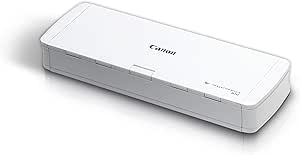
Canon imageFORMULA R10 – Portable Document Scanner, USB Powered, Duplex Scanning, Document Feeder, Easy Setup, Convenient, Perfect for Mobile Users, White
The Canon R10 is tailored for mobile professionals who need reliable duplex scanning in a compact package. Its USB power and lightweight design (under 4 pounds) make it easy to carry between locations, with a 20-sheet automatic feeder that speeds up small batch scans. Unlike the ScanSnap iX2500, it offers no wireless support, but its simplicity and portability make it excellent for remote work or field use. The scanner handles various media types, including receipts and legal documents, with decent color and black-and-white output at 12 pages per minute. Its software is straightforward, but the speed and capacity are lower than larger, desktop models. Best for mobile users who need a quick, reliable scanner without the bulk or complexity of full-sized units.Pros:- Lightweight and portable design
- USB powered—no external power source needed
- Duplex scanning in a compact form
- Supports multiple media types
Cons:- Lower scan speed of 12 ppm
- Limited sheet capacity of 20 pages
- No wireless or cloud support
Best for: Traveling salespeople, remote workers, or small businesses needing portable scanning solutions
Not ideal for: High-volume office environments or those requiring wireless connectivity, due to its limited capacity and connectivity options
- Scanner Type:Portable document
- Connection Type:USB
- Resolution:600 dpi
- Sheet Capacity:20 sheets
- Speed:12 ppm duplex
- Weight:3.66 pounds
Bottom line: This scanner is perfect for mobile professionals who need a dependable, space-saving device for light, on-the-go scanning.
Plustek PS186 Desktop Document Scanner, with 50-Pages Auto Document Feeder (ADF). for Windows 7/8 / 10/11 (Intel/AMD only)
The Plustek PS186 offers a balanced mix of affordability and functionality, supporting up to 50 pages in its auto feeder and providing high-quality black-and-white scans ideal for legal or text-heavy documents. Its user-friendly presets and OCR support streamline converting paper to searchable PDFs, making it a good fit for small offices. Compared to the ScanSnap iX2500, it lacks wireless or cloud features but excels in simplicity and speed for document archiving. Its limited sheet capacity and somewhat basic software interface mean it’s less suited for very high-volume workflows, but its compact size and straightforward setup make it attractive for desk-based use. Best for small offices that need reliable document scanning without advanced features.Pros:- Supports up to 50 pages in the feeder
- OCR and PDF creation included
- Easy to set up and operate
- Compact and desktop-friendly
Cons:- No wireless connectivity
- Limited sheet capacity for large batches
- Basic software with fewer advanced options
Best for: Small business or office users seeking dependable, straightforward document scanning and OCR capabilities
Not ideal for: Businesses requiring wireless, cloud, or high-volume batch processing, due to its capacity and feature set
- Scanner Type:Document
- Connection Type:USB
- Resolution:600 dpi
- Sheet Capacity:50 sheets
- Color Depth:24-bit
- Light Source:LED
- Dimensions:5.02″D x 10.36″W x 5.83″H
Bottom line: This scanner is well-suited for small offices needing dependable, simple document management with OCR.
Brother DS-640 Compact Mobile Document Scanner, (Model: DS640)
The Brother DS-640 provides a highly portable, reliable scanning solution at a budget-friendly price, supporting duplex color and black-and-white scans at 16ppm. Its ultra-compact size (less than a foot long) and lightweight build make it ideal for on-the-go professionals, fitting easily into bags or briefcases. Its simple interface and support for multiple platforms (Windows, Mac, Linux) make it versatile for varied environments. While it doesn’t include wireless or cloud features, its wired USB connection and automatic features like bleed-through prevention and auto-rotation make it a solid choice for basic document digitization. The main tradeoff is its lower speed and limited capacity, which may not satisfy those with heavy daily volume needs. Best for mobile users who need a dependable, affordable document scanner that fits in a pocket or bag.Pros:- Extremely compact and portable
- Supports multiple OS platforms
- Automatic image adjustments and OCR software included
- Powered via micro USB, no external power needed
Cons:- Maximum of 16ppm speed
- Limited to 50-page capacity
- No wireless or cloud features
Best for: Traveling professionals or small offices needing a compact, affordable, dependable mobile scanner
Not ideal for: High-volume or wireless users, due to its limited speed and lack of wireless connectivity
- Scanner Type:Mobile document
- Connection Type:USB
- Resolution:600 dpi
- Sheet Capacity:50 sheets
- Speed:16 ppm duplex
- Weight:1.03 pounds
Bottom line: This scanner is ideal for mobile professionals who need a reliable, lightweight device for occasional document scanning.
Plustek Mobile Scanner S410 Plus – Portable Sheet-Fed Document Scanner – for Windows 7 / 8 / 10 / 11, Featuring Button-Free Scanning with Included OCR Software
The Plustek Mobile Scanner S410 Plus stands out for its portability and effortless operation, making it ideal for small business owners who frequently travel or work remotely. Unlike bulkier scanners like the Doxie Pro, this model is ultra-lightweight, weighing less than a pound, and connects directly via bus power, eliminating the need for batteries. Its button-free, automatic scanning process streamlines workflow, and built-in OCR software allows quick conversion into searchable PDFs or editable files. Compared to larger desktop options, it sacrifices some speed and media capacity but excels in convenience and portability. Its paper handling covers a range from business cards to receipts and legal documents, making it versatile for mobile professionals. The main tradeoff is limited capacity and slower batch processing, which might not suit high-volume needs.
Pros:- Extremely lightweight and compact, perfect for travel
- Automatic, button-free operation simplifies use
- Built-in OCR converts scans into editable/searchable files
- No external power needed—bus powered via USB
Cons:- Limited media capacity, not suitable for large batches
- Slower scan speeds compared to desktop models
- No duplex or high-volume features
Best for: Small business owners or freelancers who need quick, portable scanning on the go.
Not ideal for: Businesses requiring high-volume batch scanning or handling large stacks of documents regularly.
- Connectivity:USB (bus powered)
- Scan Resolution:600 dpi
- Media Handling:Letter, Legal, business cards, receipts
- Weight:Less than 1 lb
- Operation:Automatic, button-free
- Software:Included OCR software
Bottom line: This pick is best for small business owners who prioritize portability and quick digitization during travel.
Doxie Pro – Duplex Document Scanner and Receipt Scanner for Home and Office with Amazing Software for Mac and PC
The Doxie Pro makes the most sense for small offices or home users who need reliable duplex scanning without sacrificing quality. Compared to the Epson ES-50, it offers faster speeds and more advanced software capabilities, including automatic cropping, straightening, and text recognition. Its collapsible feed and ability to handle delicate or thick papers add to its versatility, though it comes at a higher price point, especially when new. The image quality is good for most business documents and receipts, but it’s less suited for high-resolution graphics or detailed images. Its compact size and ability to scan up to 20 pages at once make it a strong choice for moderate daily use. The main tradeoff is the slightly higher cost and limited high-volume capacity.
Pros:- Fast duplex scanning with 20 pages capacity
- Automatic cropping, straightening, and text recognition
- Compact, foldable design saves space
- Works seamlessly with Mac and PC
Cons:- Higher price for a scanner with moderate volume capacity
- Image resolution not ideal for detailed graphics
- Scan speed is good but not as fast as high-end desktop models
Best for: Small office or home users who need duplex scanning with good software support and portability.
Not ideal for: High-volume or graphics-intensive scanning environments where speed and image detail are critical.
- Scan Speed:Up to 22 ppm
- Resolution:600 dpi
- Media Handling:Up to 20 sheets, includes thick/delicate paper support
- Connectivity:USB
- Compatibility:Mac and Windows
- Size:11.75 x 4 x 3 inches
Bottom line: This device is ideal for small office or home environments needing reliable duplex scan quality and software support.
Epson WorkForce ES-50 Portable Sheet-Fed Document Scanner for PC and Mac
The Epson WorkForce ES-50 is a standout for small business owners who need rapid, single-sheet scanning in a pocket-sized device. It surpasses the Plustek S410 Plus in speed, capable of scanning a page in just 5.5 seconds, and its ultra-lightweight design makes it highly portable. While it handles documents up to 8.5 x 72 inches and ID cards effectively, it lacks the bulk capacity or duplex scanning features of larger desktop models like the Doxie Pro. Its simplicity and quick operation make it perfect for quick, on-the-spot document capture, especially when combined with Epson’s ScanSmart software for easy organization. The main tradeoff is that it’s limited to one page at a time, which might be a drawback for users needing to scan multiple pages frequently.
Pros:- Fast scan speed—up to 5.5 seconds per page
- Extremely lightweight and portable
- USB powered—no external power supply needed
- Compatible with both Windows and Mac
Cons:- Limited to single-page scans, not suitable for large batches
- No duplex or multi-page document feeder
- Best for simple, quick captures rather than high-volume work
Best for: Small business owners or mobile professionals needing swift, single-page scans on the go.
Not ideal for: Users requiring batch scanning or duplex document handling for larger projects.
- Scan Speed:Up to 5.5 seconds per page
- Resolution:1200 dpi
- Media Handling:8.5 x 72 inches, ID cards
- Connectivity:USB
- Weight:9.44 ounces
- Compatibility:Windows and Mac
Bottom line: This scanner is perfect for mobile professionals who need rapid, single-page document capture without bulk or duplex features.
How We Picked
I evaluated each scanner based on performance metrics like scanning speed, reliability, and compatibility with common small business workflows. Usability factors such as ease of setup, user interface, and maintenance were key, along with build quality and durability for daily office use. Value was assessed by comparing features against price, ensuring each model offers a meaningful advantage for its cost. The rankings reflect a balance of these factors, prioritizing devices that deliver consistent, fast, and easy scanning suited for small business environments.Factors to Consider When Choosing Document Scanner For Small Business
When selecting a document scanner for a small business, it’s important to consider several factors beyond just price and brand. Your choice should match your daily scanning volume, mobility needs, and integration with existing systems. Making the wrong decision can lead to frustration, slow workflows, or unnecessary expenses, so understanding these key considerations will help you find the best fit.Scanning Speed and Capacity
Speed matters if you process large volumes of documents regularly. Look for models with high pages per minute (PPM) ratings and sufficient automatic document feeder (ADF) capacity. A faster scanner reduces bottlenecks, but often costs more and may be bulkier. For occasional use, a slower, more compact device might suffice, saving both space and money.
Connectivity Options
Wireless connectivity enables flexible placement and multi-device access, which is ideal for small teams and mobile users. USB-only models tend to be simpler and more reliable but limit placement options. Consider your network setup and whether seamless integration with cloud services and apps is a priority for your workflow.
Portability and Size
If you need to scan on the go, portable models like the Canon R10 or Epson ES-50 excel. However, portability often comes with tradeoffs in speed and document capacity. Larger, desktop units may be better for dedicated office use, providing faster scans and higher volumes but less flexibility in movement.
Software and Compatibility
Effective software can automate file naming, OCR, and integration with cloud storage, saving time and reducing errors. Some models include advanced OCR software, which is valuable if you need editable digital copies. Ensure the scanner’s software is compatible with your existing operating systems and workflows to avoid integration headaches.
Cost and Total Value
Price ranges widely based on features, build quality, and speed. Cheaper models may lack durability or advanced features, leading to higher long-term costs. Consider total cost of ownership, including software, maintenance, and replacement parts, to choose a device that offers the best value for your volume and needs.
Frequently Asked Questions
How do I choose between a portable and a desktop scanner?
If your workflow requires frequent scanning outside the office or at multiple locations, a portable scanner like the Canon R10 or Epson ES-50 makes sense. However, these tend to have lower speeds and capacities, making them less suitable for high-volume tasks. Desktop scanners are better suited for dedicated office use, offering faster speeds and higher document capacity, but they require a fixed space. Your choice depends on whether mobility or volume is your priority.
Is wireless connectivity worth it for a small business?
Wireless connectivity provides flexibility, allowing multiple users to access the scanner and scan directly to cloud services. It reduces clutter from cables and enables placement in convenient locations. However, setup can sometimes be complex, and wireless connections may be less stable than wired options. For busy small teams or those working remotely, the convenience often outweighs the setup hassle.
Should I prioritize speed over software features?
Speed is important if you handle large document volumes daily, but software features like OCR, auto file naming, and cloud integration can significantly improve efficiency and accuracy. For infrequent or light use, software features might provide more value than raw speed. Balancing both is key; a slightly slower device with better software can save time in the long run.
How much should I expect to spend on a good small business scanner?
Entry-level models can start around $200, suitable for light use. Mid-range devices with higher speeds and features typically range from $300 to $600. Premium models with advanced software, durability, and higher capacity can exceed $600. Investing more often means better reliability, faster processing, and software that reduces manual work, which pays off for busy small businesses.
What’s the biggest mistake small businesses make when buying a scanner?
One common mistake is choosing a device based solely on initial price rather than considering volume, software, and connectivity needs. This can lead to frustration, slow workflows, or needing an upgrade sooner than expected. It’s better to evaluate your typical document volume and select a scanner that can handle it comfortably, even if it costs a bit more upfront.
Conclusion
For small business owners seeking an all-around performer, the ScanSnap iX2500 offers excellent speed, features, and ease of use. Budget-conscious buyers will find the Brother DS-640 or Epson ES-50 valuable for occasional or mobile scanning. Those needing high-volume or professional-quality results should consider the Canon imageFORMULA R40 for its data extraction capabilities or the Doxie Pro for dual duplex scanning paired with robust software. Ultimately, select based on your workflow, volume, and whether portability or advanced features take priority.