📊 Full opportunity report: Phone-based injury-risk movement screening for hiring on IdeaNavigator AI — validation score, market gap, and execution plan.
TL;DR
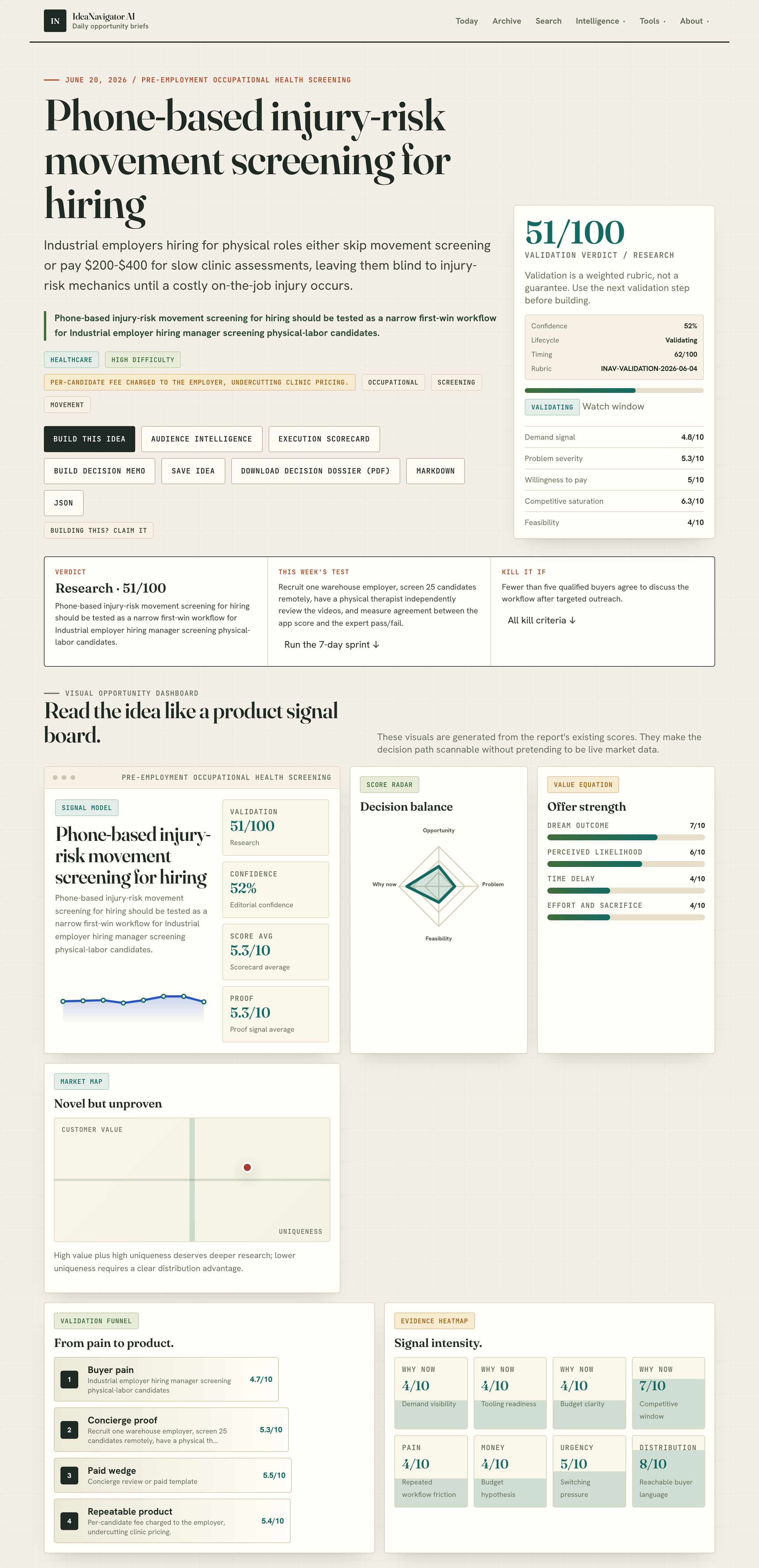
A pilot program is testing a phone-based movement screening tool for industrial employers to evaluate injury risk in job candidates remotely. The approach leverages phone cameras and pose estimation to provide quick, cost-effective assessments, potentially replacing clinic evaluations and reducing injury costs.
A new remote movement screening tool using phone cameras and pose estimation technology is being tested as a way for industrial employers to evaluate injury risk in job candidates before hiring. This approach aims to address longstanding gaps in pre-employment physical assessments, potentially reducing costly on-the-job injuries and lowering screening costs.
The proposed system involves candidates performing 5-7 standardized movements—such as squats, reaching, lifting simulations, and balance holds—while recording videos on their phones. The app then analyzes these videos to generate a pass/fail injury-risk score based on occupational benchmarks. The goal is to deliver results within 24 hours at a cost of $30-50 per candidate, significantly cheaper and faster than traditional clinic assessments, which can cost $200-$400 and take several days.
This initiative is currently in the pilot phase, where one warehouse employer plans to screen 25 candidates remotely. An independent physical therapist will review the videos to validate the app’s scoring accuracy, comparing it against expert assessments. The project aims to demonstrate that remote, app-based screening can reliably identify candidates with higher injury risks, enabling employers to make better-informed hiring decisions and reduce injury-related costs.
Potential Impact on Industrial Hiring Practices
If successful, this remote screening approach could significantly change how industrial employers evaluate physical-labor candidates. By providing quick, affordable, and reliable injury-risk assessments before hiring, companies could reduce the incidence of on-the-job injuries, lower workers’ compensation costs, and improve overall workplace safety. This method also offers a scalable solution for remote or high-volume hiring processes, addressing a longstanding gap in pre-employment health screening.

Phone Camera Remote Control for iPhone Android iPad with Zoom, Bluetooth Camera Remote Clicker with Front/Rear Camera Switch, Fingertip Bluetooth Button for Photo & Video Recording Content Creator.
- Remote Camera Shutter: Control camera within 33 feet
- Zoom & Camera Switch: Zoom in/out and switch cameras easily
- Multi-function Remote: Includes zoom, page turn, scroll, volume
As an affiliate, we earn on qualifying purchases.
As an affiliate, we earn on qualifying purchases.
Growing Need for Cost-Effective Injury Prevention Tools
Traditional movement screening methods for physically demanding jobs often involve clinic-based assessments that are costly and time-consuming. Many employers either skip pre-employment screening or rely on expensive, slow evaluations, leaving them exposed to injury risks and associated costs. Rising workers’ compensation expenses and the increasing adoption of telehealth technologies have created an opportunity for remote, app-based solutions. Advances in phone cameras and pose estimation algorithms now make it feasible to remotely analyze movement mechanics with reasonable accuracy, prompting interest in new screening workflows.
Previous efforts to incorporate movement assessments into hiring have been limited by logistical challenges and high costs. The current pilot aims to test whether a simplified, phone-based approach can serve as a practical first step toward more widespread adoption of remote occupational health screening tools.
“Using phone cameras and pose estimation, we can now remotely analyze candidate movements with a level of detail that was previously only possible in clinics.”
— an anonymous researcher
Validation and Reliability of Phone-Based Screening
It remains unclear how accurately the app’s injury-risk scores will match expert assessments across diverse candidate populations and movement types. The pilot results are still pending, and questions about the system’s reliability, scalability, and acceptance by employers and candidates have not yet been fully addressed.
Upcoming Pilot and Evaluation Timeline
The next step involves completing the pilot screening of 25 candidates for one employer, with independent physical therapist review to validate the app’s scoring. Results are expected within the next few months, which will determine whether the approach warrants broader deployment or further refinement. Success could lead to expanded trials with additional employers and eventual commercial rollout.
Key Questions
How accurate is the phone-based injury risk assessment?
The accuracy is currently being tested in a pilot with independent expert review. Final results are pending, and validation against clinical assessments is a key focus of the upcoming evaluation.
What movements are candidates asked to perform?
Candidates will perform 5-7 movements including squats, reaching, lifting simulations, and balance holds, recorded via their phone cameras.
How much does the screening cost per candidate?
The estimated cost is between $30 and $50 per candidate, significantly lower than traditional clinic assessments.
When will this remote screening approach be available for widespread use?
If the pilot results are positive, broader deployment could occur within the next year, pending further validation and employer adoption.
Could this replace all traditional pre-employment screening methods?
It is unlikely to fully replace clinical assessments but could serve as a first-pass screening tool to identify high-risk candidates efficiently.
Source: IdeaNavigator AI