
🔍 Read the full analysis: Need An OLED Gaming Monitor? Compare 8 Options For 2027 on ThorstenMeyerAI.com

Get business pricing on office and shipping supplies
- Business-only prices and quantity discounts
- Tax-exempt purchasing
- Multiple users, one account, clear invoices
TL;DR
A comparison published by ThorstenMeyerAI.com highlights eight OLED gaming monitors, led by the ASUS ROG Strix XG27AQDMGR for its stated 27-inch QHD, 240Hz specification and the Alienware AW3425DW for its curved 34-inch ultrawide format. The source does not provide complete or consistent specifications for every model, so buyers should confirm exact configurations and features before purchasing.
ThorstenMeyerAI.com has compared eight OLED gaming monitors for buyers considering a display in 2027, naming the ASUS ROG Strix XG27AQDMGR its best overall pick and the Alienware AW3425DW its choice for curved ultrawide gaming. The comparison focuses on screen size, shape, resolution and stated refresh rate, while cautioning that some listings lack enough detail for a full specification-to-specification assessment, as detailed in the original analysis.
The ASUS pick is described as a 27-inch QHD monitor with a 240Hz refresh rate, a combination the source says suits players seeking high frame rates in a standard 16:9 format; buyers can also review how to choose a high-refresh gaming monitor. The Alienware is the distinct large-screen choice: a curved 34-inch ultrawide aimed at players who want more horizontal viewing space. The source also identifies the MSI MAG 272QP QD-OLED X24 as another 27-inch QHD option.
The article says the eight-model lineup includes a mix of 27-inch QHD screens and wider formats, with QD-OLED appearing across more than one size and shape; see also these OLED gaming monitors to watch. Some listings state a 240Hz refresh rate; others do not provide one in the supplied material. The comparison does not fill those gaps with estimates, and advises checking the precise model configuration rather than assuming specifications from a product family or OLED label.
ThorstenMeyerAI.com says its ranking gives priority to versatility, then assigns other models roles based on their stated format and panel information. It does not establish comparative results for brightness, ports, warranty terms or burn-in protection. The source material names only three of the eight monitors, so the remaining five cannot be identified or assessed from the details provided here.
The 8 picks
- 1
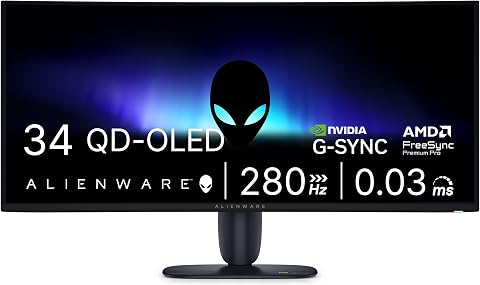 Alienware AW3426DW 34-Inch QD-OLED Gaming MonitorView on Amazon →
- 2
 Alienware 34 AW3425DW 240Hz QD-OLED Curved Gaming MonitorView on Amazon →
- 3
 ASUS ROG Strix XG27AQDMGR 27-Inch QHD 240Hz OLED Gaming MonitorView on Amazon →
- 4
 Acer Predator 26.5-inch QHD 2560×1440 QD-OLED Gaming Monitor X27U W1View on Amazon →
- 5
 MSI MAG 272QP QD-OLED X24 27-Inch WQHD Gaming MonitorView on Amazon →
- 6
 LG UltraGear 27-inch QHD OLED Gaming Monitor, 240HzView on Amazon →
- 7
 Samsung 27-Inch Odyssey OLED G5 QHD Gaming MonitorView on Amazon →
- 8
 AOC Q27GAZDV 27-Inch QHD 240Hz QD-OLED Gaming MonitorView on Amazon →
How Screen Format Shapes the Choice
The comparison is useful because OLED is a panel category, not a complete description of how a monitor will fit a player’s setup. Buyers still have to decide between a conventional 27-inch 16:9 display and a wider 34-inch curved screen, then match resolution and refresh rate to their computer and game library. A large ultrawide may suit supported games and available desk space, while a standard-format screen can be a more straightforward fit for competitive play and everyday desktop use.
Refresh-rate details also affect how confidently shoppers can compare models. A stated 240Hz specification is relevant to players whose systems can supply high frame rates, but it is not proof that every model in the roundup offers the same capability. Missing figures should be treated as unknown, not as a reason to rank a monitor above or below another on performance.
OLED’s deep blacks and fast pixel response are cited as general strengths, but they do not resolve questions about long-term care or model-specific protections. The source advises checking manufacturer guidance and panel-care features, particularly for people who keep fixed desktop elements on screen for extended periods. Those details are not supplied for each product in the comparison.
Products Worth Considering

LG UltraGear 27-Inch QHD OLED Gaming Monitor, 240Hz, 0.03ms, G-SYNC Compatible, FreeSync Premium Pro, HDMI 2.1, Black

Samsung 27-Inch Odyssey OLED G6 QHD Gaming Monitor (G61SH)

LG UltraGear 32GX870A-B 32-inch 4K UHD OLED Dual-Mode Gaming Monitor
As an affiliate, we earn on qualifying purchases.
What the Eight-Model Comparison Covers
The source frames the list as a practical buying comparison, weighing stated resolution and refresh rate alongside screen size, shape and panel type. Its central distinction is between compact, standard-format gaming screens and a wider, more immersive ultrawide. The ranking favors the ASUS model for the combination of its listed size, QHD resolution and refresh rate, while the Alienware is presented for a different use case rather than as a direct substitute.
The supplied material does not identify all eight products or provide a complete specification table. It also does not give a dated test method, independent benchmark results or current prices. As a result, this article can report the source’s named picks and stated rationale, but cannot verify whether the models are available, unchanged or priced competitively in 2027.
“The ASUS ROG Strix XG27AQDMGR is the best overall for its 27-inch QHD format and 240Hz refresh rate.”
— ThorstenMeyerAI.com
Specifications Still Missing from Listings
The supplied source material does not name five of the eight monitors, nor does it provide every model’s resolution, refresh rate, panel type or configuration. It is not possible from this material to verify the full lineup, compare all eight on equal terms, or confirm whether specifications vary by region or version. No current prices, release dates or availability information are given.
The comparison also leaves model-specific details on connectivity, stand adjustment, mounting, warranty and burn-in safeguards unresolved. Those omissions matter for setup and long-term ownership, but the source does not support claims that any one of the named monitors performs better on those points. Buyers should check the manufacturer’s current product page and care instructions before ordering.
Check Models Before You Buy
For shoppers using the comparison, the next step is to confirm each monitor’s exact model number and current specifications with its manufacturer or retailer. Verify native resolution, refresh rate, supported connections, physical dimensions and any care features, then compare those details against desk space, graphics hardware and the games played most often.
The source does not announce a future test, product launch or update date. Its guidance is therefore best treated as an initial shortlist, not a complete purchasing record for 2027. Additional listings or updated specifications would be needed to make a full eight-way comparison.
Key Questions
Which monitor does the source rank first overall?
ThorstenMeyerAI.com names the ASUS ROG Strix XG27AQDMGR, citing its stated 27-inch QHD format and 240Hz refresh rate.
Which model is the ultrawide option?
The source identifies the Alienware AW3425DW as a curved 34-inch ultrawide for players who want a wider field of view. Check game support and desk fit before choosing that format.
Are refresh rates listed for all eight monitors?
No. The source says refresh-rate information is not equally specified across the listings. Confirm the exact configuration instead of assuming a rate from the OLED label or product family.
Does the comparison establish which monitor has the best ports or burn-in protection?
No. The supplied material does not establish comparative port selection, warranty terms or burn-in protections. Check current manufacturer documentation for those details.
Source: ThorstenMeyerAI.com