📊 Full opportunity report: How Govtech Is Using Benefit Check Bots To Improve Benefits Distribution on IdeaNavigator AI — validation score, market gap, and execution plan.

Get office and shipping supplies delivered free — and shop member deals
- Fast, free delivery on millions of items
- Access to Prime Big Deal Days deals on October 6–7
- Prime Video, Amazon Music and more included
TL;DR
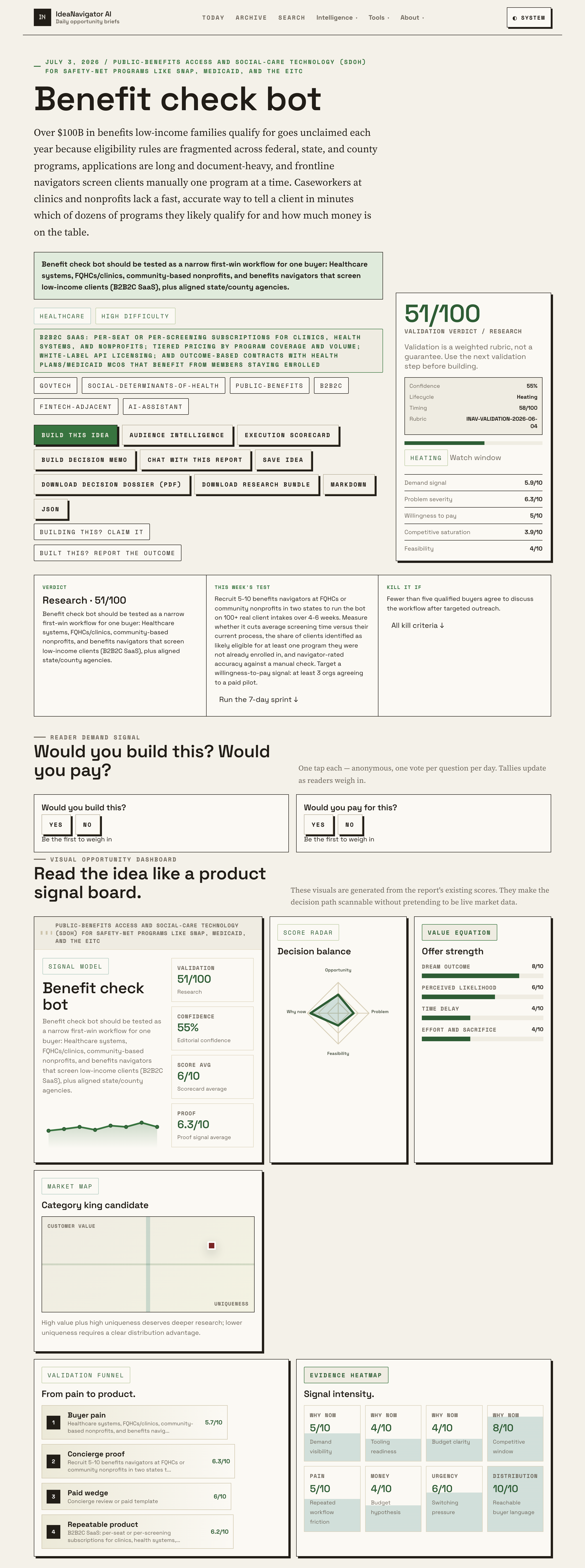
Government and nonprofit agencies are testing AI-driven benefit check bots to efficiently identify low-income individuals’ eligibility for multiple programs. This innovation aims to reduce unclaimed benefits and improve service delivery amid recent capacity gaps.
Government and nonprofit agencies are testing AI-powered benefit check bots to streamline eligibility screening for low-income clients. This initiative aims to address the large volume of unclaimed benefits, which exceeds $100 billion annually, by making screening faster, more accurate, and less labor-intensive. The deployment of these conversational tools comes amid recent capacity gaps and increased redeterminations in Medicaid eligibility.
The benefit check bot is a white-label conversational screening tool designed for use by healthcare systems, Federally Qualified Health Centers (FQHCs), community-based nonprofits, and state or county agencies. It asks a series of yes/no and multiple-choice questions to quickly identify which federal, state, and local benefits a client is likely eligible for, including SNAP, Medicaid, EITC/CTC, WIC, and LIHEAP. The system then provides an estimate of potential benefits, next-step application links, and required documentation.
Developed as a response to the recent closure of Benefits Data Trust, a 20-year nonprofit that served multiple states, the initiative aims to fill a critical gap in benefits access capacity. The shutdown of this organization in 2024 left many health systems and local agencies without a key partner for benefits enrollment support. Additionally, the post-pandemic Medicaid redetermination process, which has affected tens of millions of beneficiaries, has increased the need for efficient eligibility screening.
The pilot involves deploying the bot across 2-3 states, with plans to log anonymized screening outcomes, measure reductions in screening time, and evaluate the accuracy of the bot’s eligibility estimates compared to manual checks. Early testing will focus on real client intakes, with the goal of identifying whether the bot can improve efficiency and increase enrollment in benefits programs.
Potential to Transform Benefits Access and Reduce Unclaimed Funds
This initiative could significantly impact how benefits are accessed by low-income populations, potentially reducing the $100 billion in unclaimed benefits each year. By automating eligibility screening with AI, agencies can deliver faster, more accurate assessments, freeing up staff resources and reducing client wait times. If successful, the benefit check bot could become a standard tool for social services, improving efficiency and equity in benefits distribution.
benefit eligibility screening software
As an affiliate, we earn on qualifying purchases.
As an affiliate, we earn on qualifying purchases.
Recent Challenges in Benefits Screening and Capacity Gaps
The closure of Benefits Data Trust in 2024 has created a notable gap in outsourced benefits access capacity for many health systems and local agencies. Prior to this, the nonprofit screened and enrolled clients across seven states, helping to identify unclaimed benefits and streamline applications. Simultaneously, the post-pandemic Medicaid redetermination process has led to millions of beneficiaries undergoing eligibility checks, often resulting in disenrollment due to administrative hurdles. These developments have underscored the need for scalable, automated screening tools that can operate at near-zero marginal cost.
Advances in conversational AI and the urgency of redeterminations have made the deployment of benefit check bots feasible. These tools can handle multilingual interactions, adapt to different state and federal rules, and log anonymized data for performance monitoring. The concept has gained traction among policymakers and service providers seeking to modernize benefits access and reduce administrative burdens.
Unclear Outcomes and Long-Term Adoption Prospects
It is not yet clear how effectively the benefit check bot will perform at scale, including its accuracy, user acceptance by clients and staff, and actual impact on unclaimed benefits. The pilot programs are still in early stages, and broader adoption depends on results from initial testing, funding, and policy support. Questions remain about how well the system can handle complex cases and multilingual interactions over diverse regions.
Next Steps Include Pilot Expansion and Performance Evaluation
The immediate next step is to complete pilot testing in the selected states, measuring reductions in screening time, accuracy, and client engagement. If results are promising, plans include expanding deployment to additional regions, refining the technology based on user feedback, and establishing partnerships with Medicaid agencies and health systems. Long-term success depends on demonstrating cost-effectiveness and securing ongoing funding or policy buy-in.
Key Questions
How does the benefit check bot improve current screening processes?
The bot automates initial eligibility assessments through conversational AI, reducing manual work, speeding up screening times, and increasing the likelihood of identifying benefits for clients who might otherwise be overlooked.
Which benefits programs can the bot screen for?
The system is designed to screen for programs including SNAP, Medicaid, EITC/CTC, WIC, and LIHEAP, with plans to expand to other local benefits as needed.
What are the main challenges in deploying these benefit check bots?
Challenges include ensuring accuracy across diverse state and federal rules, handling multilingual interactions, gaining user trust, and integrating with existing agency workflows.
Will this technology eliminate the need for human navigators?
While the bots aim to reduce manual screening time and improve efficiency, human navigators will still play a critical role in complex cases, providing personalized assistance where needed.
When will we see wider adoption of benefit check bots?
Wider adoption depends on pilot outcomes; if initial results demonstrate effectiveness, broader deployment could occur within the next 1-2 years, contingent on funding and policy support.
Source: IdeaNavigator AI
Halloween Picks
halloween
As an affiliate, we earn on qualifying purchases.