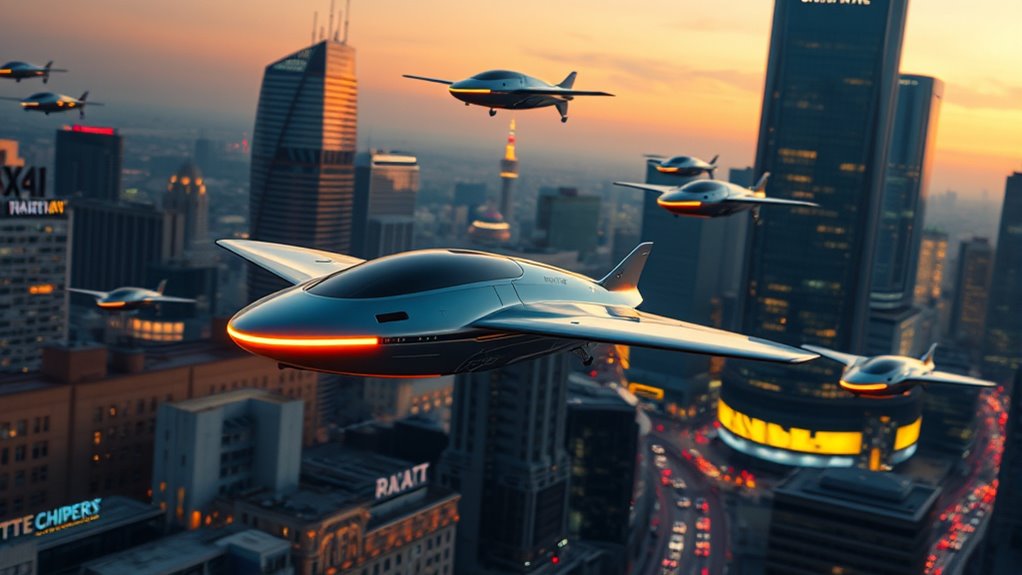

Urban air mobility with flying cars and eVTOL aircraft is transforming how you get around cities by offering faster, safer, and more efficient travel options. These vehicles use autonomous guidance, advanced sensors, and real-time data to navigate crowded airspaces and avoid obstacles. While safety, regulations, and privacy are still being addressed, ongoing innovations promise smoother integration into daily life. Keep exploring to see how these cutting-edge solutions will shape your future commutes.
Key Takeaways
- eVTOL aircraft and flying cars are revolutionizing urban transportation by reducing congestion and enabling faster city commutes.
- Autonomous guidance systems, sensors, and AI ensure safe, obstacle-free navigation for urban air mobility vehicles.
- Regulatory frameworks are developing to address safety standards, airspace management, and certification for autonomous eVTOLs.
- Data security and privacy are critical, requiring cybersecurity measures and designated airspace corridors.
- Widespread adoption depends on technological safety validation, regulatory approval, and public acceptance.

Flying cars and electric vertical takeoff and landing (eVTOL) aircraft are rapidly transforming the way we think about urban transportation. These innovative vehicles promise to reduce congestion, cut transit times, and open up new possibilities for daily commutes. As you imagine steering a city skyline filled with these craft, you might wonder how they operate safely and efficiently. Autonomous guidance plays a vital role here, allowing eVTOLs to fly precisely and avoid obstacles without human intervention. Advanced sensors, AI algorithms, and real-time data help these aircraft chart ideal routes while detecting and responding to unexpected obstacles, weather changes, or air traffic. This technology minimizes human error and enhances safety, making urban air mobility more reliable. However, integrating autonomous systems into crowded airspaces introduces significant regulatory challenges. Authorities need to develop exhaustive frameworks that address safety standards, air traffic management, and certification processes for these autonomous vehicles. You might find yourself questioning how regulators will guarantee that every eVTOL complies with rigorous safety protocols without stifling innovation. The challenge lies in balancing rapid technological advancements with strict oversight to prevent accidents or misuse. Governments and industry stakeholders are working closely to establish clear guidelines, but the process is complex and often slow, given the novelty of the technology. You’ll also need to reflect on privacy and security concerns, as autonomous eVTOLs will collect and transmit vast amounts of data during flight. Data protection laws and cybersecurity measures will be essential to prevent hacking or unauthorized surveillance. Another regulatory obstacle revolves around airspace integration—how these vehicles will coexist with traditional aircraft, helicopters, and drones. Creating designated corridors and air traffic control systems specifically for urban air mobility requires international cooperation and innovation. Additionally, payment processing solutions tailored for the transportation industry can facilitate seamless fare collection and user transactions for these new mobility services. Creating designated corridors and air traffic control systems specifically for urban air mobility requires international cooperation and innovation. As you envision cities buzzing with flying cars, you should know that policymakers are actively exploring these issues, but widespread adoption will depend heavily on resolving regulatory challenges. Meanwhile, public acceptance hinges on demonstrating consistent safety and reliability, which depends on thorough testing and regulation. The path to incorporating eVTOLs into daily urban life is exciting but complex. It involves refining autonomous navigation systems for safety and efficiency while establishing regulatory frameworks that foster growth without compromising security. As these hurdles are addressed, you’ll likely see urban air mobility become an integral part of how cities function, transforming the way you commute and experience city life.
Frequently Asked Questions
What Are the Safety Standards for Urban Air Mobility Vehicles?
You should know that safety standards for urban air mobility vehicles focus on strict vehicle certification and safety protocols. Regulators require thorough testing, including structural integrity, redundancy systems, and emergency procedures, to make certain passenger safety. You’ll find that manufacturers must comply with these standards before deployment, helping to minimize risks. Continuous monitoring and updates are also essential for maintaining safety, giving you confidence in the reliability of these innovative transportation options.
How Will Traffic Congestion Be Managed in Urban Airspaces?
You’ll see traffic congestion in urban airspaces managed through advanced air traffic control systems that coordinate vehicle movements efficiently. These systems use real-time data and automation to prevent collisions and streamline routes. Congestion mitigation strategies include designated flight corridors and altitude layers, reducing bottlenecks. By actively monitoring and adjusting traffic flows, authorities guarantee safe, smooth urban air mobility, making flying cars and Evtols practical and reliable in crowded skies.
What Is the Cost Comparison Between Flying Cars and Traditional Vehicles?
Did you know that flying cars could cost up to three times more than traditional vehicles? While they promise cost efficiency in reducing commute times, their affordability comparison varies. Currently, flying cars are more expensive upfront but could save money long-term through lower congestion costs. You might find that, initially, traditional vehicles are cheaper, but as technology advances, urban air mobility could become more accessible and cost-effective for daily use.
How Will Noise Pollution Impact City Environments?
Noise pollution from urban air mobility could substantially impact city environments, affecting your daily life. You’ll notice increased noise levels, especially during peak hours, which may disturb communities. To minimize this, noise mitigation strategies like quieter engine designs and designated flight paths are essential. These efforts aim to reduce community impact, ensuring that advanced transportation doesn’t compromise the quality of urban living or lead to noise-related health issues.
What Are the Privacy Concerns Related to Aerial Urban Transportation?
Privacy problems persist with aerial urban mobility, as you face escalating surveillance risks and data privacy dilemmas. You might worry that flying vehicles could capture countless images and data, invading personal privacy. Surveillance risks increase as authorities or corporations could monitor movements and activities from above. To protect yourself, you should advocate for strict regulations ensuring data privacy and transparent surveillance practices, preventing unwarranted intrusion into your personal space.
Conclusion
So, next time you marvel at the promise of flying cars and eVTOLs, just remember: urban air mobility might lift us above traffic, but it probably won’t lift our pollution levels or cost of living. Maybe instead of zipping through the skies, we should focus on fixing the roads below first. After all, it’s easier to ground a traffic jam than to clear the skies of overpriced, overhyped flying toys.