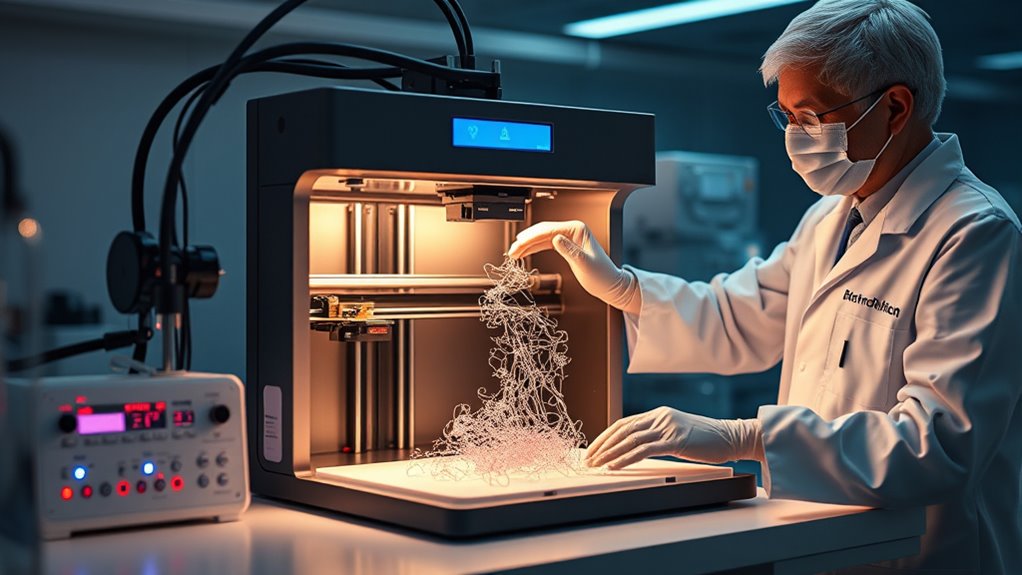

Bioprinting technologies are transforming future healthcare by allowing you to create living tissues and organs with precision. Techniques like inkjet, extrusion, and laser-assisted bioprinting enable structures that mimic real biological systems, helping replace damaged tissues, test drugs, and develop personalized treatments. These advances aim to make medicine more proactive and regenerative, potentially saving many lives. If you stay engaged, you’ll discover how these innovations could reshape healthcare as you know it.
Key Takeaways
- Bioprinting enables precise fabrication of functional tissues and organs for regenerative medicine and personalized healthcare.
- Advanced bioprinting methods like inkjet, extrusion, and laser-assisted techniques maintain cell viability and complex tissue architecture.
- Future healthcare benefits include reduced organ transplant dependence and improved disease modeling for drug testing.
- Ongoing innovations aim to enhance tissue durability, integration, and mimic natural biological systems for long-term functionality.
- Bioprinting has the potential to revolutionize medicine by enabling proactive, regenerative treatments and more accessible healthcare solutions.

Bioprinting technologies are revolutionizing healthcare by enabling the precise creation of biological tissues and organs. When you delve into the world of bioprinting, you’ll find that 3D tissue generation is at the forefront of this innovation. Using advanced biofabrication techniques, scientists can layer living cells, biomaterials, and growth factors with accuracy that was unimaginable just a decade ago. These processes allow for the construction of complex tissue structures that mimic natural biological systems, opening doors to personalized medicine and regenerative therapies.
Bioprinting revolutionizes healthcare through precise, layered creation of functional biological tissues and organs.
With biofabrication techniques, you can understand that the process involves more than just printing cells onto a surface. It’s about carefully designing the architecture of tissues, ensuring the right spatial organization, and maintaining cell viability throughout the process. Techniques such as inkjet bioprinting, extrusion-based bioprinting, and laser-assisted bioprinting give you multiple options to achieve specific tissue properties. For example, inkjet bioprinting employs droplets of bioinks to build up tissues layer by layer, while extrusion-based methods push bioinks through nozzles to create thicker, more complex structures. Laser-assisted bioprinting, on the other hand, uses focused laser pulses to deposit cells precisely, which is especially useful for creating highly detailed tissue features.
The goal of these biofabrication techniques is to produce functional 3D tissue that can integrate seamlessly into the human body. Imagine being able to replace damaged skin, cartilage, or even entire organs without waiting for donor organs to become available. This is where your understanding of bioprinting becomes vital. It’s not just about printing tissue; it’s about replicating the intricate cellular and extracellular matrix interactions that give tissues their strength, flexibility, and functionality. Researchers are working tirelessly to perfect these methods, ensuring that the printed tissues can withstand physiological stresses and support cell growth over time.
As you explore the potential of bioprinting, you realize that these biofabrication techniques are also instrumental in drug testing and disease modeling. Instead of relying on animal models, you can use bioprinted tissues to observe how drugs interact within human-like environments, making the development process more ethical and efficient. Overall, by mastering the science behind 3D tissue creation and biofabrication techniques, you’re contributing to a future where healthcare becomes more personalized, effective, and accessible. The ongoing advancements in bioprinting hold the promise of transforming medicine from reactive treatments to proactive, regenerative solutions.
Frequently Asked Questions
What Are the Main Ethical Concerns With Bioprinting Human Organs?
You might worry about ethical concerns like organ ownership, where questions arise about who owns bioprinted organs. Consent complexities also pose challenges, as obtaining clear permission from donors can be tricky, especially if organs are made from cells without explicit approval. These issues raise important debates about rights, fairness, and the moral implications of creating and using bioprinted organs, making it essential to address them carefully as technology advances.
How Long Does It Take to Print a Functional Organ?
Printing a functional organ is like crafting a complex symphony, taking anywhere from several hours to days, depending on its complexity. The printing speed varies, with simpler tissues taking less time, while intricate organs like the heart or liver demand more layers and precision. Ultimately, the process’s duration hinges on the organ’s size and detail, making each project a unique masterpiece in the making.
What Are the Costs Associated With Bioprinting Procedures?
The costs of bioprinting procedures vary widely, but a thorough cost analysis shows that equipment expenses are the main factor, often running into hundreds of thousands of dollars for advanced printers. You should also consider material costs, labor, and facility expenses. While initial investments are high, ongoing costs may decrease as technology advances. Planning your budget carefully helps guarantee you can afford and sustain bioprinting projects effectively.
Can Bioprinting Fully Replace Traditional Organ Donation?
You might wonder if bioprinting can fully replace traditional organ donation. While artificial organs made through 3D printing are advancing, they’re not yet a complete substitute. For example, researchers successfully printed a functioning kidney prototype, but it lacks the complexity of natural organs. So, bioprinting complements, rather than replaces, organ donation, offering hope for future solutions but still needing significant development to fully take over.
How Durable Are Bioprinted Tissues and Organs Over Time?
Bioprinted tissues and organs have promising bioprinting longevity, but their durability over time varies. You’ll find that tissue durability depends on materials used and how well the bioprinting process mimics natural structures. Currently, some bioprinted tissues last months to years, but ongoing research aims to improve long-term stability. While not yet as durable as natural organs, advancements are rapidly enhancing bioprinting longevity for future medical applications.
Conclusion
As you explore bioprinting’s potential, remember that by 2030, the market is expected to reach $1.7 billion. This rapid growth shows how close we are to revolutionizing healthcare, from printing custom tissues to replacing damaged organs. You’re on the cusp of a future where personalized medicine becomes reality, and life-saving treatments are more accessible. Embrace these innovations—because in this evolving field, your role could be pivotal in shaping tomorrow’s healthcare.