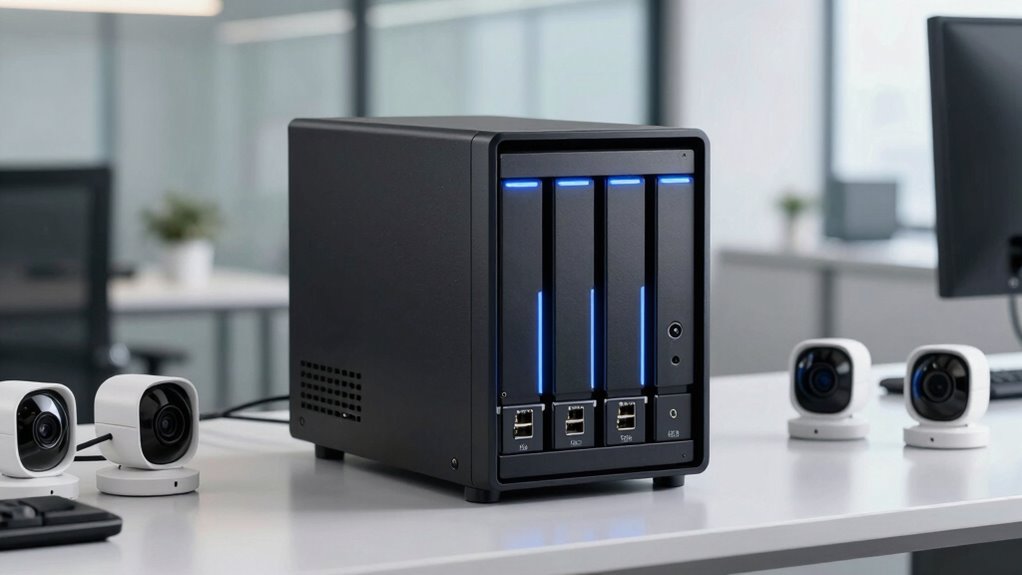

When choosing the best business NAS for surveillance storage, look for features like cloud integration for remote access, scalable storage to grow with your needs, and support for expandable drives. It should also include RAID configurations, like RAID 1 or RAID 5, to protect your footage from hardware failures. These features help guarantee your footage stays secure and accessible at all times. Keep going to discover more about how these specs keep your surveillance system reliable.

Get business pricing on office and shipping supplies
- Business-only prices and quantity discounts
- Tax-exempt purchasing
- Multiple users, one account, clear invoices
Key Takeaways
- Look for NAS with cloud integration for remote access and off-site backups.
- Prioritize models supporting scalable and expandable storage options.
- Choose NAS with RAID configurations like RAID 1 or RAID 5 for data redundancy.
- Ensure the NAS offers fault tolerance features to protect against hardware failures.
- Select systems that simplify storage expansion without disrupting ongoing surveillance operations.
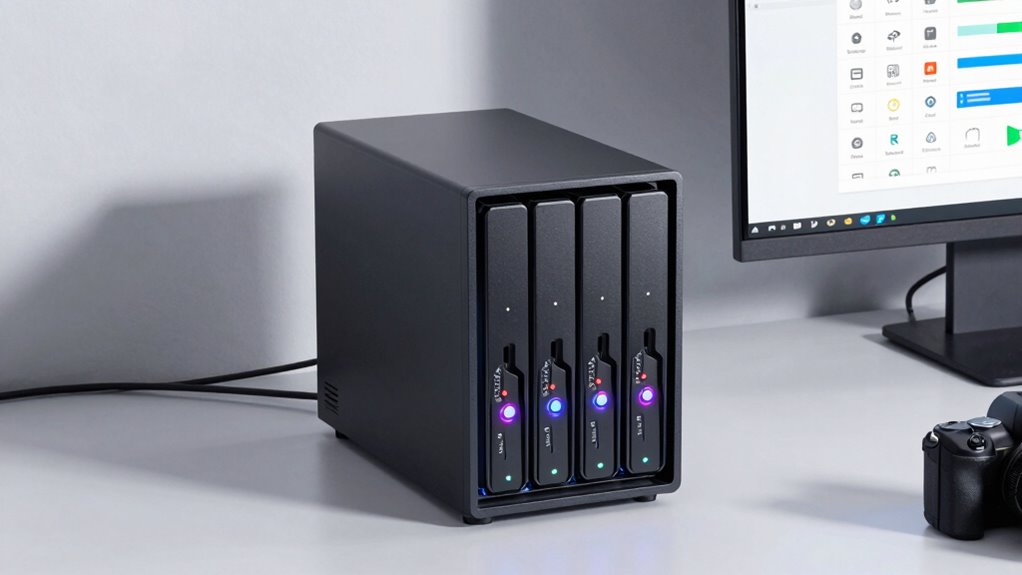
Are you searching for the most reliable business NAS to handle your surveillance storage needs? If so, understanding the key specifications that define a good surveillance NAS can help you make an informed choice. One of the most critical features to look for is cloud integration. This allows your NAS to connect seamlessly with cloud services, enabling you to back up footage remotely and access your data from anywhere. Cloud integration guarantees your surveillance data isn’t confined to a single location, providing an extra layer of security and convenience. It also simplifies the process of scaling storage capacity as your surveillance system grows, eliminating the need for complex hardware upgrades. Additionally, ensuring your NAS supports scalable storage options can future-proof your surveillance setup as your requirements evolve. Incorporating expandable storage options allows for easier hardware upgrades without disrupting your existing system.
Cloud integration enhances security, remote access, and scalable storage for your surveillance NAS.
Another essential aspect is data redundancy. This feature is essential because it protects your footage against hardware failures or accidental data loss. Data redundancy in a NAS usually involves multiple drives configured in RAID (Redundant Array of Independent Disks). Depending on your needs, you can choose different RAID levels—like RAID 1, which mirrors data across two drives for high fault tolerance, or RAID 5, which spreads data and parity information across multiple disks for a good balance of performance and redundancy. With data redundancy, even if one drive fails, your footage remains safe and accessible, minimizing downtime and preventing potential security gaps. Incorporating fault tolerance into your NAS setup can further enhance data protection and system reliability.
Products Worth Considering

Apple MacBook Air 13-inch Laptop with M5 Chip, 16GB Memory, 512GB SSD, 12MP Center Stage Camera, Touch ID, Wi-Fi 7, Midnight

Apple MacBook Neo 13-inch Laptop with A18 Pro Chip, 8GB Memory, 256GB SSD, Liquid Retina Display, and 1080p FaceTime HD Camera – Blush

Logitech MX Keys Combo for Business Keyboard and Mouse – Graphite
As an affiliate, we earn on qualifying purchases.
Frequently Asked Questions
How Do I Choose the Right NAS Capacity for My Surveillance Needs?
To choose the right NAS capacity for your surveillance needs, consider your camera resolution and network bandwidth. Higher resolution cameras generate more data, so you’ll need more storage. Also, verify your NAS can handle your network bandwidth to avoid lag or data loss. Calculate your daily footage size based on these factors, then add extra capacity for future growth. This approach guarantees smooth, reliable storage tailored to your surveillance setup.
What Security Features Should I Look for in a Surveillance NAS?
Did you know that 87% of data breaches involve weak or stolen credentials? When choosing a surveillance NAS, prioritize security features like robust remote access controls and customizable user permissions. These safeguards guarantee only authorized personnel view footage, minimizing risks. Look for encrypted connections, regular firmware updates, and audit logs to track access. Strong security helps protect your surveillance data from cyber threats and unauthorized access.
Can a NAS Support Both Surveillance and Business Data Backups?
Yes, a NAS can support both surveillance and business data backups. You’ll want one with cloud integration and remote access features, so you can securely manage your footage and backups from anywhere. Look for models that offer flexible storage options and robust security measures. This way, you guarantee seamless, reliable operation for your surveillance needs while safeguarding your business data without needing separate systems.
How Easy Is It to Expand NAS Storage in the Future?
Expanding your NAS storage is like adding new rooms to a house—you can do it as needed. Many NAS devices now support cloud integration and remote access, making upgrades straightforward. You can add drives or swap out existing ones without disrupting your setup. This flexibility allows you to scale storage seamlessly, ensuring your surveillance and business data stay protected and accessible, no matter how much your needs grow.
What Are the Energy Consumption Considerations for a Surveillance NAS?
You should consider power efficiency when choosing a surveillance NAS, as it directly impacts energy costs. Look for models with energy-saving features like low-power processors and efficient cooling systems. These help reduce overall energy consumption, saving you money on electricity bills. A device with good power efficiency not only minimizes environmental impact but also guarantees your surveillance system runs smoothly without excessive energy use, keeping operational costs manageable.
Conclusion
So, after all this, it’s clear that choosing the right NAS for surveillance isn’t just about tech specs—it’s about peace of mind. Ironically, the more you understand the details, the less you worry about missing a critical moment. You might think a fancy feature or huge storage is all you need, but sometimes, simplicity really is the best security blanket. After all, in surveillance, it’s not just about watching, but about truly seeing.