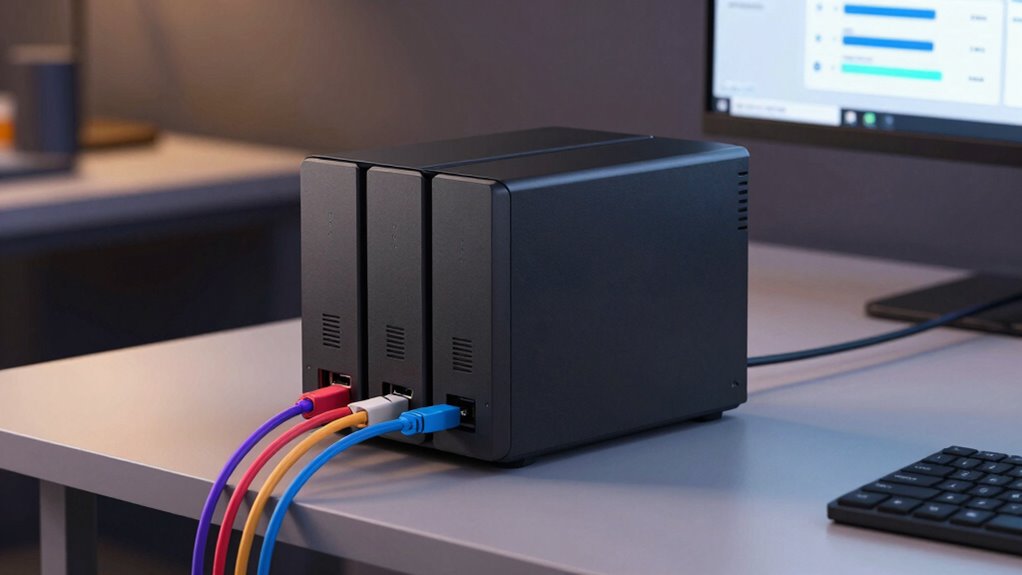

To avoid paying for outdated hardware, choose a modern 4-bay NAS that supports current standards like 2.5GbE or 10GbE and integrates well with your existing devices. Prioritize models with scalable storage, recent processors, and strong security features to future-proof your investment. This guarantees compatibility, speed, and security without costly upgrades soon. Curious about the best options to keep your team’s data safe and up-to-date? Keep exploring to discover more.

Get business pricing on office and shipping supplies
- Business-only prices and quantity discounts
- Tax-exempt purchasing
- Multiple users, one account, clear invoices
Key Takeaways
- Prioritize models with modern processors, ample RAM, and support for the latest Ethernet standards like 2.5GbE or 10GbE.
- Choose NAS devices with built-in cloud backup and disaster recovery features for enhanced data security.
- Verify compatibility with your existing infrastructure and ensure future expandability options.
- Avoid outdated hardware by selecting devices that support current SSDs, HDDs, and hardware standards.
- Balance cost and features by opting for scalable, future-proof models that prevent frequent upgrades.

A 4-bay NAS is an essential tool for teams that need reliable, scalable, and centralized storage. It streamlines collaboration, simplifies data management, and guarantees your files are accessible from anywhere. But to truly maximize its value, you need to choose a model that offers up-to-date features without forcing you into overpriced, outdated hardware. Many vendors push older models as ‘budget-friendly,’ but these often lack the latest hardware compatibility and robust cloud backup options, leading to reduced performance and security vulnerabilities. Instead, focus on newer models that strike a balance between affordability and modern capabilities.
When evaluating the best 4-bay NAS for your team, prioritize models with strong hardware compatibility. This assures seamless integration with your existing infrastructure, whether you’re using Windows, macOS, or Linux. Hardware compatibility also affects performance, especially when it comes to the processor, RAM, and network interfaces. Opt for a NAS that supports the latest Ethernet standards, such as 2.5GbE or 10GbE, to future-proof your setup and avoid bottlenecks. Additionally, check if the device can handle the latest SSDs and HDDs, as this impacts data transfer speeds and storage efficiency.
Cloud backup integration is another critical aspect to contemplate. The best NAS devices come with built-in features or apps that facilitate automatic cloud backup, providing an extra layer of security for your data. This is especially important for teams that deal with sensitive information or need disaster recovery options. Look for models that support popular cloud services like Google Drive, Dropbox, or Amazon S3, and offer easy-to-configure backup routines. This way, you can avoid paying premium prices for hardware that’s outdated or underpowered, while still ensuring your data is safely stored both locally and in the cloud. Additionally, choosing a device with up-to-date hardware standards ensures your system remains compatible with future updates and expansions. Incorporating modern hardware compatibility into your evaluation process can save you from costly upgrades down the line. Moreover, selecting a device with future-proof features can help extend its lifespan and adapt to evolving technology needs. Investing in a scalable storage solution will also allow your team’s storage capacity to grow flexibly as your needs evolve, reducing the need for frequent replacements.
Products Worth Considering

Apple MacBook Pro MPHF3LL/A 14.2-Inch Laptop | M2 Pro 12-Core Chip 16GB Unified Memory 1TB SSD | 19-Core GPU Liquid Retina XDR Display Space

Logitech MX Keys Combo for Business Keyboard and Mouse – Graphite

Apple MacBook Pro 2023 16.2 M2 Max 32GB 1TB SSD Space Gray
As an affiliate, we earn on qualifying purchases.
Frequently Asked Questions
How Long Do 4-Bay NAS Devices Typically Last Before Upgrades Are Needed?
A 4-bay NAS device typically lasts around 3 to 5 years before you might need upgrades, depending on hardware longevity and how intensively you use it. You should expect to upgrade more frequently if you handle large data loads or require faster performance. Regular firmware updates and careful maintenance can extend its lifespan, but staying alert to hardware performance helps you decide when an upgrade becomes necessary.
Can 4-Bay NAS Units Support Virtualization for Team Use?
Most 4-bay NAS units support virtualization, but you should check for virtualization limitations and hardware compatibility before deciding. Some models handle virtual machines well, while others may struggle with resource-intensive tasks. Make certain your NAS has a powerful processor, sufficient RAM, and compatible virtualization features. By selecting a model with strong hardware and clear virtualization support, you can effectively use it for team work without hitting major limitations.
What’s the Average Energy Consumption of a 4-Bay NAS?
A 4-bay NAS typically consumes around 15-30 watts during active use, depending on the model and hard drives. You’ll find it offers good power efficiency, helping you save on energy costs. Noise levels are usually low, often under 30 decibels, making it suitable for office environments. By choosing a power-efficient model, you minimize energy consumption and maintain quiet operation, ideal for team use.
How Often Should Firmware and Software Be Updated on NAS Devices?
Oh, don’t wait until your NAS screams for mercy—update firmware and software patches regularly. You should check for updates at least once a month to keep security tight and performance smooth. Ignoring firmware updates risks vulnerabilities, while skipping software patches can cause bugs and crashes. Staying proactive guarantees your data stays safe, your device runs efficiently, and you avoid costly downtime—because nobody has time for a preventable disaster.
Are Refurbished 4-Bay NAS Options Reliable for Business Use?
Refurbished 4-bay NAS options can be reliable for business use if you check hardware compatibility and vendor reputation. Look for models with a warranty coverage to protect against potential issues. Confirm the refurbisher has tested the device thoroughly and offers support. While they may save you money, verify these factors to avoid unexpected downtime or hardware failures that could disrupt your team’s productivity.
Conclusion
Choosing the right 4-bay NAS is like finding a trusty compass for your team’s data voyage—guiding you through the stormy seas of outdated hardware and inflated prices. By spotting modern features and avoiding vintage treasures, you steer clear of costly pitfalls. So, arm yourself with knowledge, sail confidently past the choppy waters of expensive, old tech, and lead your team toward a smooth, secure data horizon. Your digital expedition starts with the right choice—don’t let it set sail without you.