📊 Full opportunity report: A Platform Brings New Businesses To Vacant Main Street Spaces on IdeaNavigator AI — validation score, market gap, and execution plan.

Get business pricing on office and shipping supplies
- Business-only prices and quantity discounts
- Tax-exempt purchasing
- Multiple users, one account, clear invoices
TL;DR
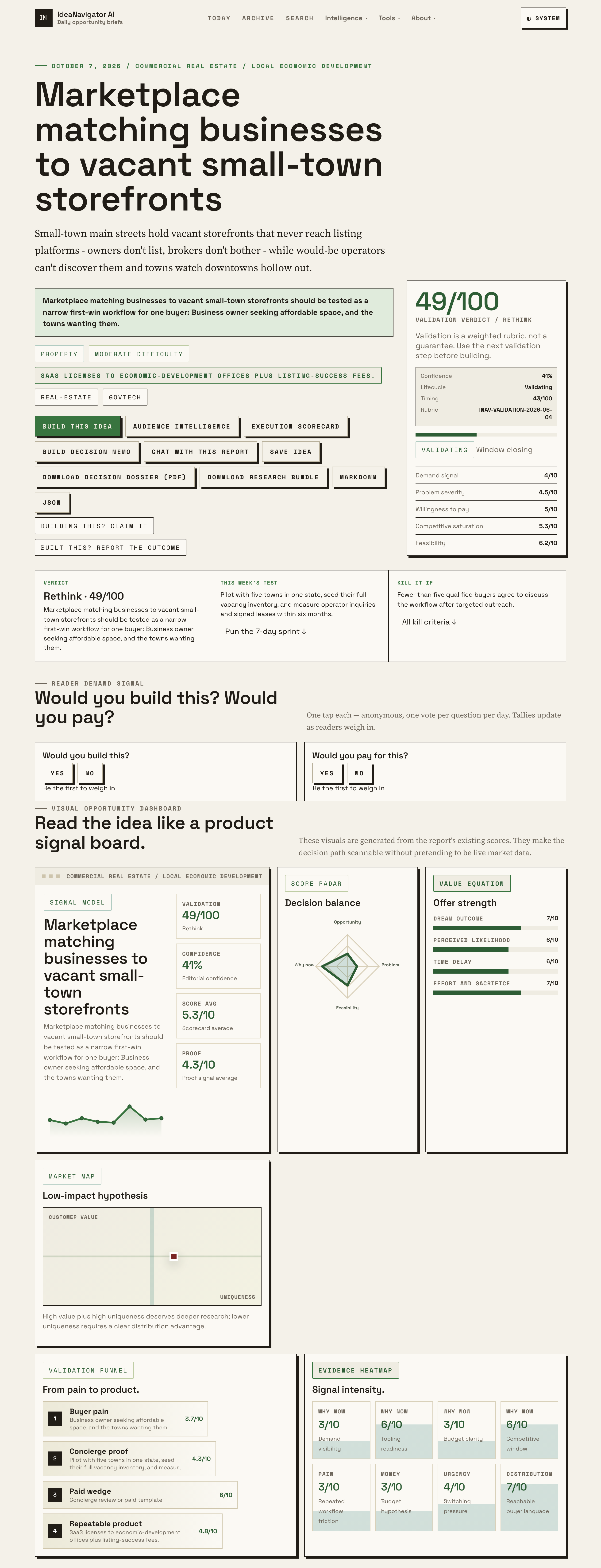
IdeaNavigator AI has outlined a proposed marketplace to connect business owners seeking affordable space with small towns that have vacant storefronts. The concept calls for a five-town pilot, but no launch, participating towns, or results have been reported.
IdeaNavigator AI has proposed a marketplace to connect business operators with vacant small-town storefronts, offering towns and property owners a way to advertise spaces that may not appear on commercial listing platforms. The proposal recommends a pilot in five towns in one state, but does not identify participating communities or say that a platform has launched. These details come from IdeaNavigator AI’s proposal; it does not report an active marketplace or pilot.
According to IdeaNavigator AI’s proposal, the service would let towns and storefront owners post listings with photos, floor area, rent and available incentive programs. Operators could browse by town profile and foot-traffic data, then contact a local economic-development office through the marketplace. The proposal suggests attaching information about available grants to potential matches.
For an initial test, IdeaNavigator AI recommends gathering a complete vacancy inventory in five towns within one state. The proposal says the pilot should track operator inquiries and signed leases over six months. It does not report an existing test, user totals, lease agreements, or evidence that the approach has increased occupancy.
The suggested business model, also described by IdeaNavigator AI, combines software licenses for economic-development offices with fees tied to successful listings. Those are proposed revenue sources, not confirmed contracts or earnings. The proposal provides no pricing, platform name, development budget, or operator behind a product launch.
A Route From Listings to Leases
IdeaNavigator AI’s proposal identifies a visibility gap: some vacant storefronts may never be listed, while operators looking for affordable space may not know they exist. A shared inventory could give prospective businesses one place to find premises and give local officials a clearer channel for responding to inquiries.
For towns, the potential value would depend on more than collecting listings. The marketplace would need accurate rents and availability, useful town and foot-traffic information, and timely connections to owners and development staff. Signed leases within six months would offer a more direct test of whether the service helps fill spaces than listing counts alone, as the proposal suggests.
The concept also links property discovery with local incentives. If grant programs are relevant and current, presenting them alongside listings could help operators assess the cost of opening in a town. IdeaNavigator AI’s proposal does not establish that grants are available in any particular community or that they would be awarded to marketplace users.
Products Worth Considering

FLEXISPOT 60-Inch Executive Standing Desk with Drawers and CPU Cabinet

Samsung 32-inch Odyssey OLED G8 (G80SH) 4K QD-OLED Gaming Monitor

Apple MacBook Air 13-inch with M5 chip, 16GB memory, 1TB SSD, and 12MP Center Stage camera (Midnight)
As an affiliate, we earn on qualifying purchases.
How the Proposed Pilot Works
IdeaNavigator AI frames the marketplace as a narrow first test for two groups: business owners seeking affordable space and towns trying to attract them. Its proposal says small-town storefront owners may not list through commercial platforms and brokers may not pursue those properties, leaving operators with limited ways to discover vacancies.
The proposal points to renewed small-town commercial interest associated with remote-work migration and grant funding for local economic development as reasons to explore the idea now. These are IdeaNavigator AI’s stated rationale; the proposal provides no data quantifying migration, storefront demand, or grant availability across towns.
IdeaNavigator AI recommends recruiting five towns in one state, compiling their available storefronts, publishing details, and routing prospective matches through local development offices. The proposed six-month measurement period would focus on inquiries and signed leases. The proposal gives no timetable for recruiting towns or starting that period.
Launch, Funding and Demand Unknown
IdeaNavigator AI’s proposal identifies no operating marketplace and does not name a company, founder, participating town, or launch date. It is unclear whether any local governments or property owners have agreed to contribute listings or whether a five-town pilot is being organized.
The proposal provides no evidence about how many storefronts are vacant, how many operators are searching, or whether users would pay the proposed license and success fees. Its reference to grant money does not identify specific programs, eligibility rules, amounts, or remaining funds. Demand, lease outcomes and commercial viability remain untested.
Further details would be needed on how listings would be verified and updated, how foot-traffic data would be obtained, and how inquiries would be handled when properties are no longer available. IdeaNavigator AI’s concept does not specify how a lease would count as a marketplace success or how fees would be assessed.
Pilot Results Would Test Demand
IdeaNavigator AI’s proposed next step is to select five towns in one state and assemble a full inventory of available storefronts. Town officials and property owners would need to supply listing details, while the platform would need a process for keeping rents, availability and incentive information current.
After the pilot begins, the proposal’s stated evaluation window is six months, with operator inquiries and signed leases as measures. IdeaNavigator AI specifies no start date or reporting plan. Until a pilot is announced and results are made public, the marketplace remains a business concept rather than a demonstrated solution for vacant main streets.
Source: IdeaNavigator AI
Key Questions
Has the storefront marketplace launched?
No launch is reported. IdeaNavigator AI describes a proposed marketplace and recommends a pilot, but gives no launch date or operating platform.
Who would use the proposed service?
According to IdeaNavigator AI’s proposal, the service is aimed at business operators looking for space, storefront owners with vacancies, and local economic-development offices seeking to attract businesses.
What would a pilot measure?
IdeaNavigator AI proposes a test covering five towns in one state and tracking operator inquiries and signed leases over six months. No pilot results are available.
How would the marketplace make money?
IdeaNavigator AI’s suggested model combines software licenses for economic-development offices with fees tied to successful listings. Pricing and customer commitments have not been specified.
Are grants guaranteed for businesses using the service?
No. IdeaNavigator AI’s concept proposes showing available grant programs alongside listings, but names no specific grants and does not indicate that any applicant would qualify or receive funding.
Source: IdeaNavigator AI