
TL;DR

Get business pricing on office and shipping supplies
- Business-only prices and quantity discounts
- Tax-exempt purchasing
- Multiple users, one account, clear invoices
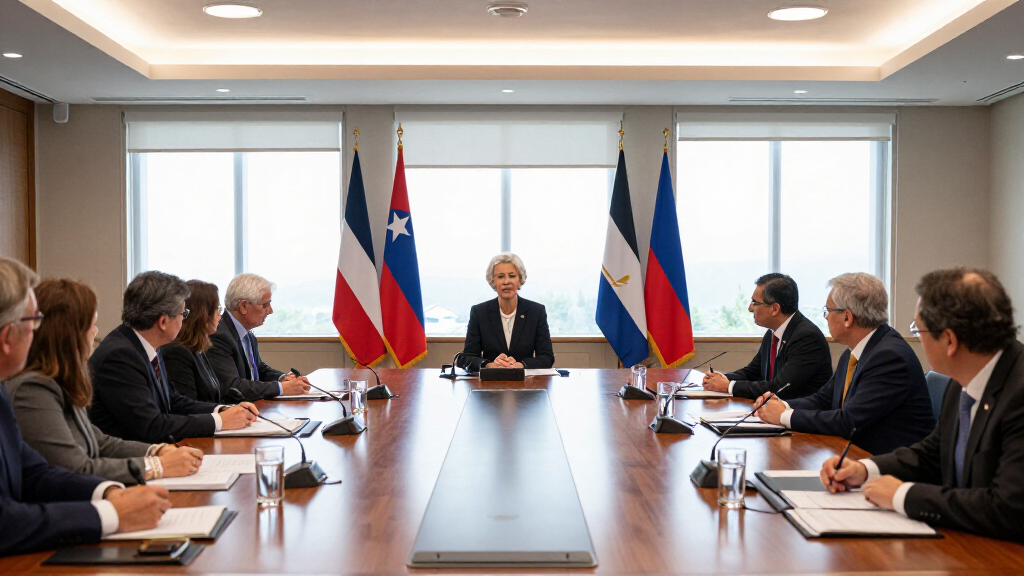
In a statement to the International Monetary and Financial Committee on Oct. 17, ECB President Christine Lagarde said the euro area has remained resilient but faces downside growth risks and upside inflation risks from the Middle East conflict and energy prices. She cited the ECB’s September 25-basis-point rate increase and said future decisions will depend on incoming data and the bank’s policy criteria.
European Central Bank President Christine Lagarde told the International Monetary and Financial Committee on Oct. 17 that the euro area economy has held up amid global uncertainty, while energy-market disruption threatens to push inflation higher and weigh on growth. Her statement described the ECB’s September decision to raise key interest rates by 25 basis points and said future moves will be guided by incoming data and the bank’s assessment of inflation and monetary-policy transmission.
Lagarde said the global economy had proved “surprisingly resilient” despite high uncertainty, including the Middle East conflict, trade tensions and protectionist measures. She said investment in artificial intelligence has supported economic activity and trade, especially in countries integrated into technology supply chains. The statement nevertheless assessed risks as tilted to the downside for growth and to the upside for inflation.
For the euro area, the ECB’s September staff projections put growth at 0.9% in 2026, 1.4% in 2027 and 1.5% in 2028. Lagarde said activity was broad-based across most countries and sectors in the first half of 2026. The projections anticipate support from recovering real incomes, a resilient labour market, public spending on infrastructure and defence, and investment in AI and digital technology.
Inflation was reported at 3.8% in September, mainly because of higher energy prices, with food and services also contributing to the increase. Core inflation rose slightly to 2.5%. Lagarde said underlying inflation measures were broadly stable and wages had not yet shown a material response to the energy shock. The ECB expects energy prices to keep headline inflation well above its target into the first half of 2027, before inflation declines toward around target near the end of that year.
The statement said the Governing Council raised rates by 25 basis points in September, following an increase of the same size in June. Lagarde said the shock was too large to ignore, but that a measured policy response remained appropriate. She also noted that long-term interest rates had risen since the ECB’s prior meeting, tightening financing conditions and potentially slowing growth.
Energy Shock Shapes ECB Policy
The statement ties the ECB’s near-term policy challenge to an energy shock that could affect both prices and activity. If higher energy costs persist, they may feed into food and other prices, while also reducing household purchasing power and raising costs for businesses. The ECB’s assessment matters to borrowers, savers and companies because interest-rate decisions influence financing conditions across the euro area.
Lagarde did not signal a predetermined path for rates. Instead, she said the Governing Council would assess the inflation outlook, underlying inflation and the strength of monetary-policy transmission. That approach leaves policy dependent on how the conflict, energy prices and broader economic data develop. The statement also highlights a tension for governments: temporary support for households and firms facing energy costs, while maintaining sustainable public finances.
energy price inflation protection investment
As an affiliate, we earn on qualifying purchases.
As an affiliate, we earn on qualifying purchases.
September Projections and Rate Moves
The statement was delivered at the 54th meeting of the International Monetary and Financial Committee during the IMF Annual Meetings. It presents the ECB president’s assessment of the international and euro area outlook, rather than announcing a new rate decision on Oct. 17.
The ECB had raised rates by 25 basis points in June and by another 25 basis points in September, according to Lagarde’s statement. The September staff projections provide the growth and inflation outlook cited in her remarks. The statement also noted that the ECB Governing Council decided in July on operational arrangements and onboarding for an enhanced EUREP, a repo facility for central banks. The ECB said more than 30 central banks had expressed interest in the facility over the previous six months.
“The global economy has proven surprisingly resilient in the face of high uncertainty.”
— Christine Lagarde, ECB president, in her statement to the IMFC
Conflict and Inflation Risks Remain
The duration and intensity of the Middle East conflict, and how its effects may spread through the economy, remain uncertain. The ECB also does not yet know how much higher energy prices will pass through to core inflation, food prices, wages and other costs. Lagarde said there was no evidence at that stage of significant pass-through to prices and wages beyond what the ECB had already included in its projections.
The projections are conditional estimates, not a guarantee of future growth or inflation. The statement described risks from a more persistent energy shock and extreme weather, as well as possible factors that could lower inflation, including a lasting resolution of geopolitical conflicts. It did not specify the timing or size of any future interest-rate changes.
ECB Decisions Depend on Incoming Data
The ECB Governing Council will continue to assess incoming economic and financial data against its stated policy criteria when setting rates. The next decisions will depend in part on whether energy inflation persists, whether price increases spread beyond energy, and how tighter financing conditions affect demand and growth. Lagarde’s statement did not announce a date or outcome for a future rate decision.
For governments, the statement called for fiscal responses to the energy shock to be temporary, targeted and tailored. Lagarde also pointed to spending efficiency, fiscal rules, labour-market participation and investment in technology as areas relevant to longer-term resilience. The extent to which those measures are adopted, and how the energy shock evolves, remain to be seen.
Key Questions
What did Christine Lagarde tell the IMFC?
She said the euro area economy had remained resilient but faced growth risks from global uncertainty and inflation risks from higher energy prices. She also described the ECB’s recent rate decisions and its data-dependent approach to future policy.
Did the ECB announce a new rate decision on Oct. 17?
No new rate decision is reported in the statement. Lagarde referred to the ECB’s 25-basis-point increases in June and September and said future decisions would depend on incoming data and the Governing Council’s policy assessment.
How high was euro area inflation in September?
Lagarde’s statement put headline inflation at 3.8% in September 2026 and core inflation at 2.5%. It attributed most of the headline increase to energy inflation, with food and services also contributing.
What is the ECB’s inflation outlook?
The statement said higher energy prices were expected to keep headline inflation well above the ECB’s target into the first half of 2027. It projected a decline after the first quarter, with inflation returning to around target toward the end of 2027.
Source: primary
Halloween Picks
halloween
As an affiliate, we earn on qualifying purchases.