📊 Full opportunity report: Parents And IEP Meetings: How Rehearsal Simulators Help on IdeaNavigator AI — validation score, market gap, and execution plan.
TL;DR
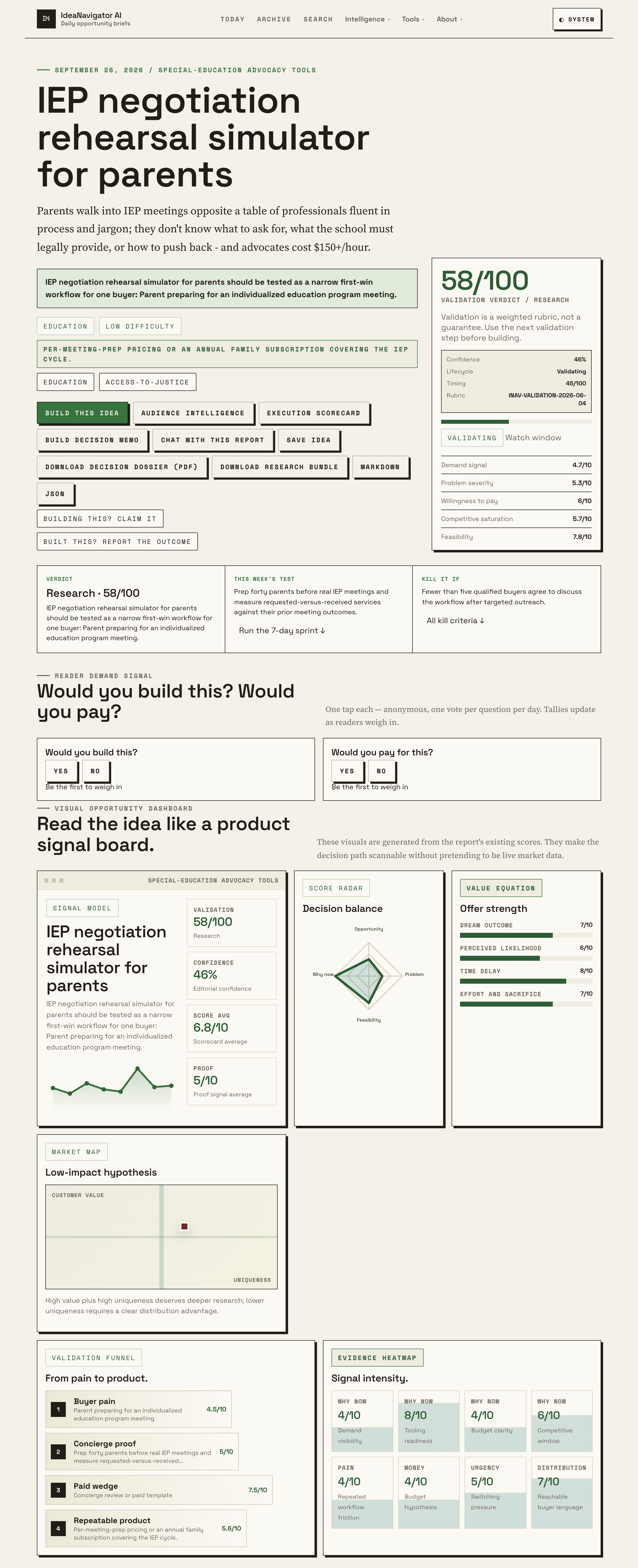
IdeaNavigator AI has outlined a proposed simulator to help parents prepare for individualized education program meetings by reviewing documents and rehearsing discussions with a simulated school team. The concept has not been validated; a proposed test would prepare 40 parents and compare services requested and received with prior meeting outcomes.
IdeaNavigator AI has proposed testing an IEP meeting rehearsal simulator for parents preparing for individualized education program meetings, where families discuss the special education services and supports a student needs. The concept would let parents review existing documents, prepare requests and practice responding to school staff, but it remains a proposal rather than a tested service.
The proposed tool would let a parent upload a student’s current IEP and evaluation reports. It would then explain relevant entitlements in plain language and generate a list of requests with legal grounding, according to IdeaNavigator AI’s outline. The concept is intended to help parents prepare questions and understand their position before meeting with school personnel.
The simulator would also conduct a practice meeting, including realistic pushback from simulated school representatives, so a parent could rehearse maintaining or explaining requests. The proposal names two possible payment models: a fee for each meeting preparation or an annual family subscription covering an IEP cycle. No pricing, privacy terms, technical design or operating service is specified.
To evaluate the idea, the outline proposes preparing 40 parents before real IEP meetings and measuring the services they request against those they receive, with prior meeting outcomes as a comparison. That is a suggested validation plan, not evidence that the tool improves outcomes. No findings from a parent group or comparison data are reported.
Preparing Parents for IEP Discussions
IEP meetings can shape a student’s educational supports, while parents may be less familiar than school staff with special education procedures and terminology. A tool that helps families understand documents and rehearse requests could give them a structured way to prepare before those discussions. The proposed workflow addresses a specific moment: the period before a parent meets with the school team.
The idea also responds to the cost of individual advocacy. Its outline says advocates can charge $150 or more per hour, but gives no location, date range or pricing survey for that figure. If preparation software were effective and affordable, it might offer another option for families. Whether a simulator can match the judgment of an experienced advocate, or change the services a student receives, is not established.
A Proposed Special Education Tool
The concept focuses on parents preparing for an individualized education program meeting, rather than offering a general special education information service. It combines document review, plain-language explanations, a request list and role-play. IdeaNavigator AI frames it as a narrow first workflow for one intended buyer: a parent preparing for a meeting.
The proposal says special education identification rates are rising and district resources are tightening, conditions it presents as reasons to explore the idea. It provides no figures, dates or cited data for those trends, and does not document that meetings are becoming more adversarial. Those points are part of the proposal’s rationale, not independently demonstrated findings in the information available.
Likewise, the suggested comparison with parents’ prior meeting outcomes would need a defined method to show whether the simulator made a difference. The outline does not explain how prior outcomes would be collected, how differences among students and districts would be handled, or what counts as a service being received.
Evidence and Safeguards Not Reported
Effectiveness remains unknown. There are no reported pilot results, parent testimonials or comparisons showing that role-play changes what families request or what schools provide. The proposed 40-parent exercise would be an initial test, but the outline does not give a schedule, recruitment plan or measurement protocol.
The concept also does not specify how it would protect sensitive student records uploaded for analysis. It is unclear what legal sources the tool would use, how it would handle differences in applicable rules, or how it would flag uncertainty. No product launch, developer, price or availability date is identified. Parents would also need to know how to check generated guidance before relying on it in an individual case.
Testing Before Wider Use
The next step described in the proposal is to prepare 40 parents for upcoming IEP meetings and compare requested services with those received, using each family’s earlier meeting outcomes as a baseline. The plan does not state when or where that test would occur, who would run it, or whether a simulator has been built.
Any reported evaluation would need to explain how outcomes were measured and account for differences across students and school settings. Until such details and results are available, the simulator should be understood as a proposed product idea, not an established way to secure services or replace individualized advocacy.
Source: IdeaNavigator AI
Key Questions
What is the proposed IEP meeting simulator?
It is a concept for a tool that would review a student’s IEP and evaluation reports, help a parent prepare requests and simulate a meeting for practice.
Has the simulator been shown to improve IEP outcomes?
No results are reported. The proposal suggests testing the idea with 40 parents and comparing meeting outcomes with their prior experiences.
Would the tool replace an education advocate?
The concept is described as meeting preparation. There is no evidence that it can replace an advocate’s individual guidance or professional judgment.
What would parents upload?
The proposed workflow calls for a parent to upload the student’s current IEP and evaluation reports. The concept does not specify data storage or privacy protections.
Source: IdeaNavigator AI