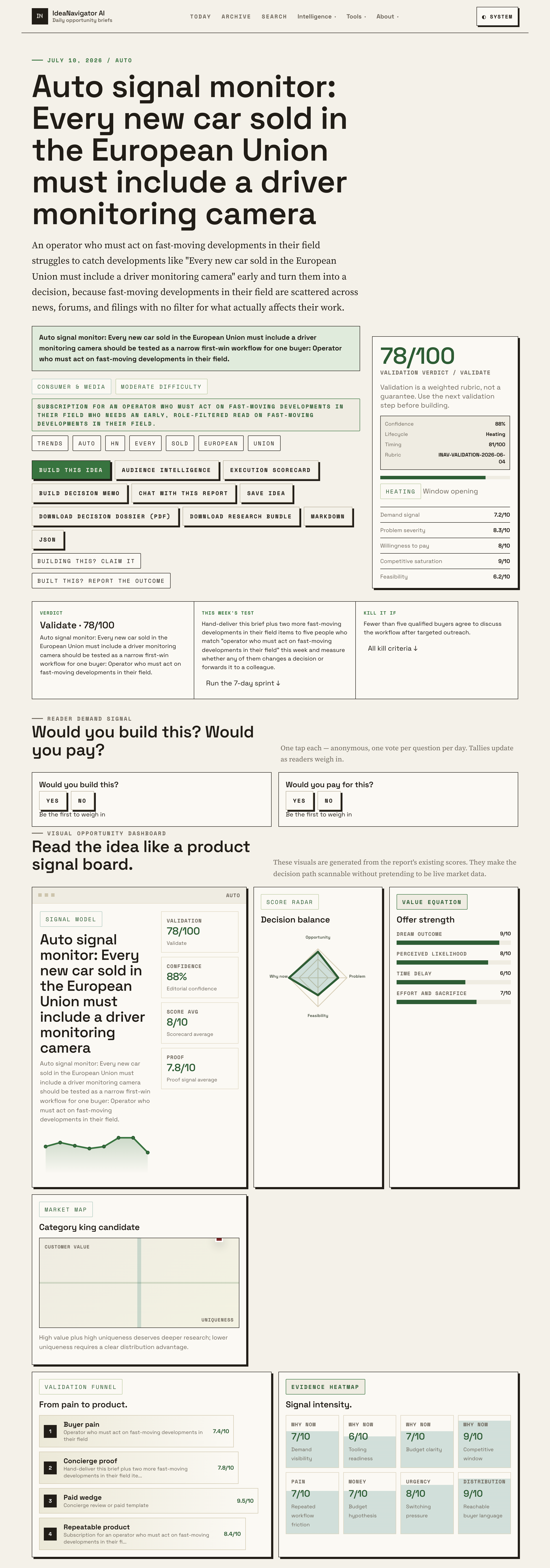
📊 Full opportunity report: Why The EU Says Every New Car Needs A Camera Monitoring Its Driver on IdeaNavigator AI — validation score, market gap, and execution plan.

Get office and shipping supplies delivered free — and shop member deals
- Fast, free delivery on millions of items
- Access to Prime Big Deal Days deals on October 6–7
- Prime Video, Amazon Music and more included
TL;DR
European Union vehicle safety rules require new cars sold in the bloc to include driver monitoring systems that detect drowsiness and distraction, with camera-based technology as the main method automakers are using to comply. The requirement stems from the EU’s General Safety Regulation, phased in from July 2024, and gained fresh attention after discussion on Hacker News flagged it as a fast-moving development.
New cars sold in the European Union must be equipped with driver monitoring systems capable of detecting drowsiness and distraction, under EU vehicle safety rules that have made the technology a standard feature on vehicles sold in the bloc. The requirement, introduced through the EU’s General Safety Regulation, has attracted renewed public attention after a discussion on Hacker News, scored by IdeaNavigator AI at 88/100 as a high-signal development, surfaced the mandate for a broader audience.
The requirement comes from Regulation (EU) 2019/2144, known as the General Safety Regulation, which was adopted in 2019 and set out a phased schedule of mandatory safety technologies for new vehicles. From July 2024, all new car types and newly registered cars in the EU had to include driver drowsiness and attention warning systems. These systems are designed to detect signs of fatigue or distraction and alert the driver.
While the regulation does not prescribe a single technology, camera-based monitoring aimed at the driver’s face and eyes has become the primary way automakers comply, because cameras can track eye closure, gaze direction, and head position in real time. The rules also mandate other systems alongside monitoring, including intelligent speed assistance, event data recorders, and emergency lane-keeping technology.
The mandate applies to new vehicles sold in the EU, regardless of where the manufacturer is based, which means models from European, American, and Asian automakers sold in the bloc all carry the technology. Vehicles sold in other markets, including the United States and the United Kingdom, are not directly covered by the EU regulation, though similar driver monitoring features are increasingly common there as optional or standard equipment on higher-end models.
Safety Gains Versus Surveillance Concerns
The mandate matters for two competing reasons. On the safety side, EU regulators have argued that driver monitoring addresses the reality that driver error and inattention remain a leading factor in road collisions. Systems that detect a driver falling asleep or looking away from the road for extended periods can trigger warnings before a crash occurs, and the technology becomes more relevant as semi-automated driving features spread and drivers may disengage from the task of driving.
On the privacy side, the requirement means millions of vehicles now carry cameras pointed at their occupants. Civil liberties groups and privacy advocates have raised questions about what the systems record, how long data is stored, whether it can be accessed by manufacturers, insurers, or law enforcement, and how drivers can be sure the footage is not retained. Under the EU’s GDPR framework, biometric data such as face images receives heightened protection, but the practical handling of camera data varies by manufacturer, and critics argue the rules around retention and sharing are not uniform or transparent enough.
How the Mandate Entered EU Law
: “The General Safety Regulation was adopted by the European Parliament and Council in 2019 as part of a broader push to reduce road deaths in line with the EU’s long-term road safety targets. Rather than mandating a single device, the regulation lists required safety systems and sets performance requirements, leaving manufacturers to choose how to meet them.
The rollout was phased: some requirements applied to new type approvals from July 2022, while the drowsiness and attention warning requirements applied to all new vehicles registered from July 2024. Additional provisions, including expanded driver monitoring obligations tied to assisted driving systems, extend into 2026. According to IdeaNavigator AI, which surfaced the topic through a high-signal Hacker News discussion, the development illustrates how regulatory changes affecting whole industries can circulate in technical communities before reaching wider public awareness.
Unanswered Questions on Data Handling
Several aspects remain unclear or unresolved. The EU regulation sets performance requirements for monitoring systems but leaves considerable discretion to manufacturers on implementation details, including sensor placement, warning thresholds, and how long the system stays active. There is no single, public standard describing how driver camera data must be stored, anonymised, or deleted across all brands.
It is also not yet clear how enforcement will work in practice, how systems will perform in real-world conditions across diverse drivers, lighting, and eyewear, or whether regulators will act on complaints about false alerts or intrusive warnings. Privacy advocates have called for clearer rules on data retention and third-party access, but no uniform EU-wide answer has been settled. Public reaction, as reflected in online discussion, remains divided between safety support and surveillance concern.
The 2026 Phase and Beyond
The next regulatory milestone comes in 2026, when further driver monitoring obligations tied to automated and assisted driving features are scheduled to apply, expanding the situations in which systems must verify that the driver is attentive. Automakers will continue rolling out camera-based systems across model ranges as older designs are retired and new type approvals come online.
Watch for EU guidance or enforcement actions clarifying data retention and privacy practices, consumer testing of how well the systems perform, and whether other jurisdictions follow the EU’s approach with their own mandates. Readers who want to track how the requirement is being implemented by individual manufacturers can follow regulatory filings and type-approval documentation as they are published.
Source: IdeaNavigator AI
Key Questions
Does every new car in the EU literally have a camera watching the driver?
The regulation requires systems that detect drowsiness and distraction. Cameras are the main way automakers comply, but some systems combine cameras with steering-input sensors and other signals. Coverage applies to new vehicles sold in the EU from July 2024 onward.
What happens if the system detects I’m distracted or tired?
Typical responses escalate from visual and audible warnings to more insistent alerts. The regulation does not allow the car to take control or stop itself purely because of distraction in ordinary driving; that behaviour is tied to specific assisted-driving scenarios covered by later provisions.
Is the camera footage stored or shared?
That varies by manufacturer and is not uniformly regulated across brands. Most systems process images in real time without saving footage, but data retention and access policies differ, and privacy advocates continue to press for clearer EU-wide rules under GDPR.
Do cars sold outside the EU need these cameras?
The EU mandate applies only to vehicles sold in the bloc. However, many automakers sell globally shared platforms, so monitoring features are increasingly appearing in the same models sold in other markets, sometimes as standard equipment.
Can I disable the driver monitoring system?
In most implementations the system can be adjusted or its warnings muted for a session, but it is a mandatory safety feature and generally reactivates on the next drive. Fully disabling it is typically not permitted for vehicles registered under the EU rules.
Source: IdeaNavigator AI
Halloween Picks
halloween
As an affiliate, we earn on qualifying purchases.