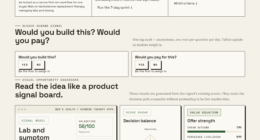

📊 Full opportunity report: The policy menu. There’s no single answer. There’s a menu — and choosing is a values choice in disguise. on ThorstenMeyerAI.com — validation score, market gap, and execution plan.

Get business pricing on office and shipping supplies
- Business-only prices and quantity discounts
- Tax-exempt purchasing
- Multiple users, one account, clear invoices
TL;DR
A recent analysis presents a ‘policy menu’ for addressing AI-induced economic changes. It emphasizes that there is no single correct response, but a range of options reflecting different societal values. The choice depends on what society prioritizes—efficiency, security, or fairness.
Thorsten Meyer’s latest dispatch presents a detailed ‘policy menu’ for responding to economic shifts driven by AI, emphasizing that there is no single correct answer. Instead, policymakers face a range of options, each aligned with different societal values, and the choice among them is fundamentally moral rather than purely technical.
The analysis argues that the debate over how to respond to AI-induced economic change is often framed as a technical problem, but in reality, it is a set of value-laden choices. Meyer outlines four main responses: doing nothing, implementing universal basic income (UBI), expanding ownership through models like universal basic capital (UBC), and funding redistribution via data dividends or sovereign wealth funds.
Each option is evaluated not only on its merits but also on what it optimizes—efficiency, security, agency, or fairness—and what trade-offs it entails. Meyer stresses that the debate is often muddled because participants tend to collapse two axes: what to redistribute (income or ownership) and how to fund it (taxing workers or common wealth). He highlights that the funding mechanism is crucial, as taxing workers to fund benefits can be self-defeating.
Crucially, Meyer emphasizes that the actual question is whether the labor-share shift is real—a fact that remains uncertain—and that the best response is the one most robust to being wrong. The dispatch concludes that responses should be judged by their resilience to uncertainty rather than their presumed correctness, framing the policy debate as a moral choice rather than a purely technical one.
The policy menu.
There’s no single answer.
There’s a menu — and
choosing is a values
choice in disguise.
shift isn’t real, catastrophic if it is
dignifying · fiscally heavy, cause-blind
robust · but slow, concentration-prone
under the question · funds either
The honest service is the menu itself: here are the options, here is what each optimizes for and trades away, here is the funding axis that matters more than the fight everyone is having. The decision is yours, the tradeoffs are real, and the one thing you should not accept is anyone telling you it’s obvious.Thorsten Meyer · The Policy Menu · Post-Labor 03 · Capstone
Implications of a Values-Based Policy Approach
This analysis underscores that policy responses to AI-driven economic change are fundamentally moral choices, not purely technical fixes. The range of options reflects different societal priorities—whether to prioritize efficiency, security, or fairness—and highlights the importance of robustness in policy design amid uncertainty. For readers, this means that debates over AI and economic redistribution are as much about values as they are about economics, and the choice made will shape societal structures for decades.
universal basic income (UBI) calculator
As an affiliate, we earn on qualifying purchases.
As an affiliate, we earn on qualifying purchases.
The idea of a policy menu emerges from ongoing discussions about the impacts of AI on labor and wealth distribution. Earlier dispatches by Meyer examined the ownership argument, tested its premises, and identified signals about labor-share shifts. This final piece synthesizes those insights, emphasizing that responses are inherently value-based and that the debate has been clouded by false dichotomies and assumptions about technical correctness. The concept aligns with broader post-labor thinking, which questions traditional economic models and advocates for a pluralistic approach to societal adaptation.
“A policy menu is honest only when each option is presented as its strongest advocates would present it and critiqued as its strongest critics would critique it.”
— Thorsten Meyer
The core uncertainty remains whether the labor-share shift caused by AI is real or just a temporary fluctuation. Meyer notes that current data is inconclusive, and this uncertainty complicates the choice of response. Without clarity on this point, the optimal policy remains a matter of debate and depends on which assumptions about the future prove correct.
Next Steps in Policy and Research
Further empirical research is needed to clarify whether the labor-share shift is ongoing or reversing. Policymakers should consider designing flexible, robust responses that can adapt to new data. Public discourse should shift towards understanding the moral and value-based dimensions of these choices, recognizing that no single solution fits all scenarios.
Key Questions
What are the main policy options for responding to AI-driven economic change?
The main options include doing nothing, implementing universal basic income (UBI), expanding ownership through models like universal basic capital (UBC), and funding redistribution via data dividends or sovereign wealth funds.
Why is there no single correct response to the AI economic shift?
Because each option reflects different societal values—efficiency, security, fairness—and involves trade-offs that cannot be resolved purely through technical analysis. The choice is fundamentally moral.
What is the biggest uncertainty in determining the best policy response?
Whether the shift in labor share caused by AI is actually happening remains unconfirmed. This uncertainty influences which policies are most robust and appropriate.
How should policymakers approach these choices amid uncertainty?
They should prioritize options that are resilient to error—those that do the least harm if their assumptions prove wrong—and recognize that the debate is rooted in values, not just economics.
Source: ThorstenMeyerAI.com
Evergreen bestsellers Picks
bestsellers
As an affiliate, we earn on qualifying purchases.