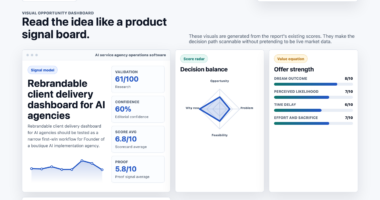
📊 Full opportunity report: Step Into The Future: AI Near-Miss Detection For Safer Warehousing on IdeaNavigator AI — validation score, market gap, and execution plan.

Get business pricing on office and shipping supplies
- Business-only prices and quantity discounts
- Tax-exempt purchasing
- Multiple users, one account, clear invoices
TL;DR
AI-powered near-miss detection systems are being tested in warehouses to identify forklift-pedestrian conflicts, rack contacts, and speed violations using existing CCTV feeds. This development aims to improve safety and lower insurance costs.
AI near-miss detection technology is being tested in warehouses to analyze existing CCTV footage for safety hazards. This development aims to help safety managers identify forklift-pedestrian conflicts, rack contacts, and speed violations more efficiently, potentially reducing injuries and insurance costs.
The AI system, developed by IdeaNavigator AI, ingests existing RTSP camera feeds from warehouses and automatically flags near-miss events such as forklift-pedestrian proximity, blind-corner conflicts, rack strikes, and speed violations. The system then compiles a weekly digest of relevant video clips, including details like dates, shifts, and severity levels, which can be reviewed by safety teams.
This technology is designed as a first-step workflow for safety managers at warehouses or third-party logistics providers operating dozens of cameras across multiple shifts. The goal is to make existing CCTV footage actionable, addressing the current problem where hundreds of hours of footage are rarely reviewed, leaving safety issues unaddressed until injuries occur and insurance claims are filed.
Initial testing involves processing two weeks of archived footage from three mid-market warehouses. The effectiveness of the system will be measured by safety managers’ willingness to pay, based on reductions in incident rates and potential insurance premium savings, with a subscription model scaled by camera count.
Impact of AI Near-Miss Detection on Warehouse Safety
This technology could significantly improve safety management by providing real-time insights into hazards that are currently difficult to monitor manually. By proactively identifying near-misses, warehouses may reduce injury rates, improve compliance, and lower insurance premiums. The integration of AI with existing CCTV infrastructure offers a cost-effective way to enhance safety without extensive hardware upgrades, making it accessible for many facilities.
As an affiliate, we earn on qualifying purchases.
Growing Need for Safer Warehouse Operations
Warehouses record hundreds of hours of CCTV footage daily, but manual review is impractical, leading to overlooked hazards and delayed responses. Recent advances in computer vision enable classification of unsafe behaviors, such as forklift proximity to pedestrians and excessive speeds, on commodity CCTV feeds. Insurers are increasingly incentivizing documented safety improvements, creating market opportunities for AI solutions that automate hazard detection.
Previous safety initiatives often relied on manual audits or costly hardware upgrades, but the current technological landscape allows for AI-driven analysis using existing infrastructure, promising a scalable safety enhancement.
“The AI system can process existing CCTV feeds and identify near-misses that would otherwise go unnoticed, enabling proactive safety measures.”
— an anonymous researcher
Uncertainties in System Effectiveness and Adoption
It is not yet clear how accurately the AI system will identify all relevant near-misses across diverse warehouse setups. The long-term impact on injury reduction and insurance savings remains to be validated through extended testing. Additionally, the willingness of safety managers to adopt and pay for this technology at scale is still being assessed.
Next Steps in Testing and Validation
IdeaNavigator AI plans to complete two weeks of processing archived footage from three warehouses and gather feedback from safety managers. The company will evaluate system accuracy, user satisfaction, and potential cost savings. Based on these results, further deployment and refinement are expected, with possible expansion to larger facilities and integration with broader safety management systems.
Key Questions
How does the AI system detect near-misses in warehouses?
The system analyzes existing CCTV feeds using computer vision models that classify forklift proximity to pedestrians, rack contacts, speed violations, and blind-corner conflicts, flagging potential hazards automatically.
Will this AI system replace manual safety inspections?
No, it is designed to augment existing safety protocols by providing additional data and insights, making hazard detection more efficient and comprehensive.
What are the costs associated with implementing this AI solution?
The model involves a per-facility monthly subscription scaled by camera count, with potential savings from reduced injury-related costs and insurance premiums.
When will the system be available for wider deployment?
Following successful testing and validation, wider deployment could occur within the next few months, depending on customer feedback and system performance.
Does this technology require new cameras or hardware upgrades?
No, it works with existing RTSP-enabled CCTV feeds, making it a cost-effective upgrade for many warehouses.
Source: IdeaNavigator AI
Evergreen bestsellers Picks
bestsellers
As an affiliate, we earn on qualifying purchases.