
🔍 Read the full analysis: 10 Best 4K Monitors For Productivity, Entertainment, And Gaming In 2027 on ThorstenMeyerAI.com

Get business pricing on office and shipping supplies
- Business-only prices and quantity discounts
- Tax-exempt purchasing
- Multiple users, one account, clear invoices
TL;DR
A ThorstenMeyerAI.com buying guide names 10 4K monitors for productivity, entertainment and gaming, including LG’s 27US500-W as its overall pick and ASUS’s VG27UQ1A for high-refresh gaming. The recommendations are source-based assessments, not independent lab results; buyers should check current prices, specifications and availability before purchasing.
ThorstenMeyerAI.com’s 2027 guide compares 10 4K monitors for office work, entertainment and gaming, naming the LG 27US500-W its best overall choice and the ASUS TUF Gaming VG27UQ1A its high-refresh gaming option. The recommendations highlight a key tradeoff for buyers: faster 4K screens can make motion smoother, but need more graphics-card power than standard 60Hz models.
The guide’s top picks reflect different priorities rather than a single best fit for every desk. It describes the LG 27US500-W as a balance of IPS image clarity, color accuracy and price, while the ASUS TUF Gaming VG27UQ1A is highlighted for a claimed 160Hz refresh rate. For mixed office use and light gaming, it points to Dell’s S2725QC and its 120Hz experience.
The other listed models are the Dell S3225QS, Samsung ViewFinity S71H, Sceptre U275W-UPT, LG 32UR500K-B, ASUS ProArt PA279CV, Acer Nitro XV275K P3 and BenQ EW2880U. The source’s descriptions are uneven: it gives specific comparative points for some models but does not supply a complete specification table or explain every model’s rank in the material provided.
The guide says its comparisons considered panel technology, refresh rate, connections and ergonomics, favoring monitors with clear use cases. It also cautions that budget models may offer limited stand adjustment or connectivity, while high-refresh models may not suit lower-powered gaming PCs. These are the guide’s evaluations, not results from a documented independent test protocol.
The 10 picks
- 1
 Dell 27" S2725QC 4K UHD IPS Monitor with 120Hz Refresh Rate and FreeSync PremiumView on Amazon →
- 2
 Dell 32 Plus 4K Monitor S3225QSView on Amazon →
- 3
 ASUS TUF Gaming VG27UQ1A 27‑inch 4K 160 Hz G‑Sync Gaming MonitorView on Amazon →
- 4
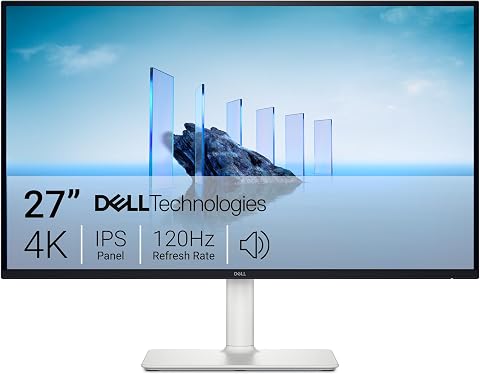 Dell 27 Monitor S2725QS, 4K UHD IPS, 120Hz, 5ms, FreeSync PremiumView on Amazon →
- 5
 Samsung ViewFinity S7 32-Inch 4K UHD Monitor (S70H)View on Amazon →
- 6
 Samsung 27" ViewFinity S7 (S71H) 4K UHD IPS HDR10 High Resolution MonitorView on Amazon →
- 7
 LG 27US500-W 27-Inch 4K UHD IPS MonitorView on Amazon →
- 8
 LG 32U701B-B 32-inch Ultrafine 4K UHD 60Hz HDR10 HDMI DP Computer MonitorView on Amazon →
- 9
 Sceptre Prime 4K IPS 27" 3840 x 2160 UHD Monitor up to 70+Hz DisplayPort HDMI…View on Amazon →
- 10
 Sceptre U275W-UPT 27-inch 4K UHD IPS MonitorView on Amazon →
Choosing Between Smoothness and Sharpness
The recommendations matter because a 4K label alone does not tell buyers how a monitor will perform in their setup. Refresh rate, color reproduction, ports and stand design can affect daily work as much as resolution. A screen that suits spreadsheets and video viewing may not provide the motion handling or adaptive sync a competitive gamer wants.
The central tradeoff is hardware demand. According to the guide, 4K at 120Hz or 160Hz requires a capable graphics card to make full use of the higher refresh rate. Buyers with a less powerful PC may get a steadier experience from a 60Hz display, while laptop users may value USB-C power delivery and a built-in hub more than top-end gaming speed.
Products Worth Considering

Logitech MX Master 4 Ergonomic Wireless Mouse with Haptic Feedback, Graphite

Logitech MX Ergo S Advanced Wireless Trackball Mouse USB-C – Graphite

Samsung 27-Inch S3 FHD IPS Monitor, 120Hz
As an affiliate, we earn on qualifying purchases.
What the Guide Compares
The source frames 4K resolution as a starting point, not a complete measure of value. It says 27-inch screens generally have higher pixel density than 32-inch models, which can make text appear sharper, though some users may need operating-system scaling for comfortable reading. Screen size and viewing distance can change how useful that extra density feels.
It also distinguishes IPS panels, which it associates with viewing angles and consistent color, from other panel types that may prioritize contrast. For HDR, it warns that an HDR10 input label does not establish strong HDR performance; brightness and local dimming matter. The supplied source does not provide measured brightness, color-gamut results or independent verification for each monitor.
“The LG 27US500-W stands out as the best overall 4K monitor for most users.”
— ThorstenMeyerAI.com guide
Specs and Test Evidence Not Supplied
The source material does not include current prices, stock information, test dates or links to product listings. It also does not provide a full specification sheet for all 10 picks, independent measurements of color accuracy or brightness, or a detailed explanation of every ranking. Buyers should confirm the exact model and regional specification before purchase.
Some claims, including the description of color consistency and the relative value of particular screens, are assessments by the guide. The material does not establish a standardized side-by-side testing method. It also does not state which graphics cards were used to assess high-refresh performance or how each model handles adaptive sync across different systems.
Check Models Before Buying
The source does not announce a follow-up test or a specific update schedule. Readers comparing these recommendations should check manufacturer specifications and retailer listings for current pricing, port versions, refresh-rate limits and stand adjustment. Those details can vary by region or product revision.
Gaming buyers should also compare their PC’s expected frame rates at 4K with the display’s refresh rate and verify adaptive-sync support. For desk work, check whether USB-C provides the required power delivery and whether the included stand reaches a comfortable height. A final purchase decision should account for the monitor’s actual use, not resolution alone.
Key Questions
Which monitor does the guide recommend for most users?
The guide names the LG 27US500-W as its overall pick, citing its balance of IPS clarity, color accuracy and price. That is the source’s assessment, not an independently verified test result.
Which listed monitor is aimed at high-refresh gaming?
The guide highlights the ASUS TUF Gaming VG27UQ1A for a stated 160Hz refresh rate. It also cautions that reaching high frame rates at 4K requires a capable graphics card.
Is a 60Hz 4K monitor enough for productivity?
According to the guide, 60Hz is suitable for static work such as spreadsheets and video editing. Higher refresh rates can make scrolling and cursor movement look smoother, but the best choice depends on the user’s tasks and hardware.
Does an HDR10 label guarantee strong HDR picture quality?
No. The guide says an HDR10 input label alone does not establish meaningful HDR performance. Brightness and local dimming are among the other specifications buyers should check.
What should laptop users check before choosing a monitor?
Check whether the monitor’s USB-C port supports video, data and sufficient power delivery, and whether it includes a useful USB hub. The source highlights Dell’s S-series connectivity but does not provide full port specifications for every pick.
Source: ThorstenMeyerAI.com