
📊 Full opportunity report: How To Use Risk-Assessment Tools Before E-Commerce Platform Migration on IdeaNavigator AI — validation score, market gap, and execution plan.

Get business pricing on office and shipping supplies
- Business-only prices and quantity discounts
- Tax-exempt purchasing
- Multiple users, one account, clear invoices
TL;DR
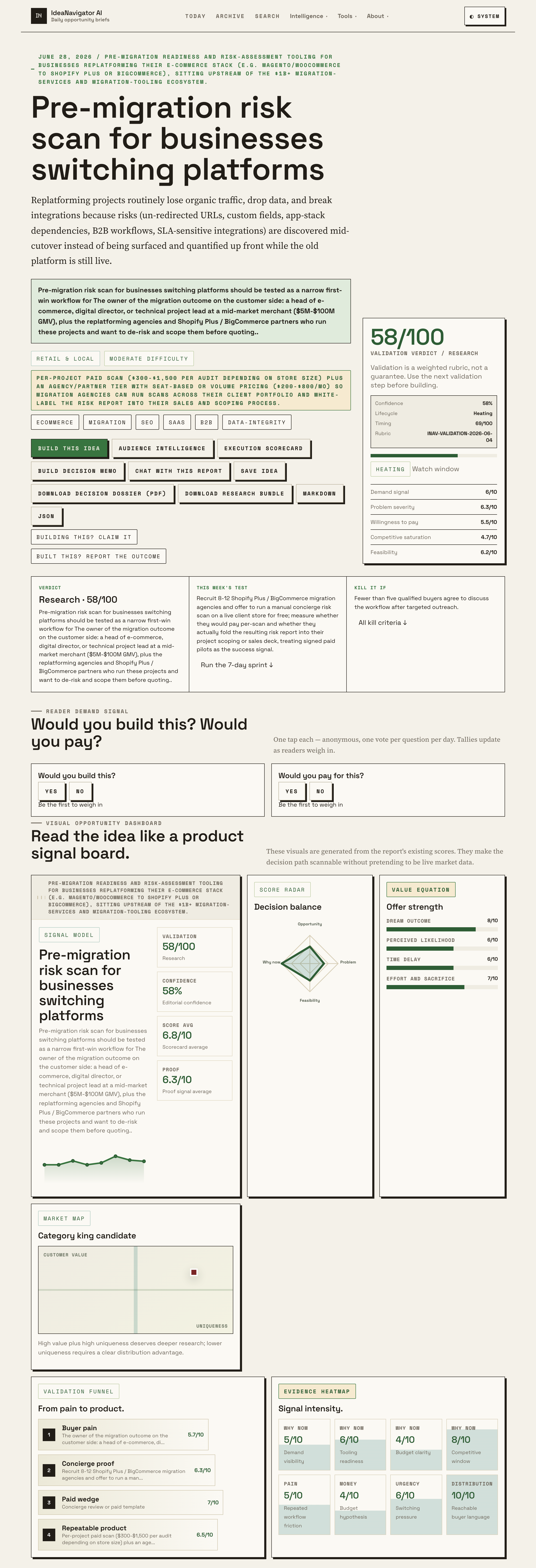
E-commerce businesses planning platform migrations can reduce risks by using pre-migration risk-assessment tools. These tools quantify potential issues, helping teams scope and de-risk projects before cutover.
Pre-migration risk-assessment tools are emerging as a critical step for e-commerce businesses planning platform switches, offering a way to identify potential issues before the cutover. These tools provide a quantified risk profile, helping teams scope projects more accurately and avoid costly disruptions. The approach is gaining traction amid rising migration volumes and the limitations of automated tools, which often leave gaps in risk identification.
Replatforming projects frequently encounter challenges such as organic traffic loss, data discrepancies, and broken integrations, often discovered only during or after the migration. This can lead to significant operational disruptions and increased costs. To address this, a new class of pre-migration risk tools is being developed, capable of connecting to source stores via URL crawl and API access to generate comprehensive risk reports.
These reports include detailed inventories of URLs and redirects, SEO asset status, app and integration dependencies, custom data flags, and an estimated risk score based on potential traffic loss and downtime. The goal is to enable project teams—such as e-commerce directors, technical leads, and migration agencies—to scope projects more precisely and mitigate risks proactively. Pilot programs are underway, with agencies testing these tools on live client stores to evaluate their value and integration into sales and planning processes.
Why Risk-Assessment Tools Are Critical for Migration Success
Implementing risk-assessment tools before migration can significantly reduce unexpected disruptions, data loss, and downtime. For mid-market merchants, this means more predictable project timelines and budgets, and a smoother transition that preserves revenue and SEO rankings. For agencies, these tools add a layer of confidence and precision to their scope definitions, potentially increasing win rates and client satisfaction. As e-commerce migration volumes grow—77% of merchants plan to move platforms within a year—such tools could become standard practice, helping the industry manage complexity and scale effectively.
risk assessment tools for e-commerce migration
As an affiliate, we earn on qualifying purchases.
As an affiliate, we earn on qualifying purchases.
The Growing Need for Pre-Migration Risk Management
The e-commerce landscape is experiencing a surge in platform migrations, driven by end-of-life deadlines for legacy systems like Magento 1 and the desire to leverage newer, more flexible platforms like Shopify Plus and BigCommerce. Currently, automated migration tools handle only about 50-60% of the process, leaving significant gaps in risk detection. Without proper assessment, merchants risk losing organic traffic, breaking integrations, or encountering data inconsistencies post-migration, which can damage revenue and brand reputation.
Traditional planning often relies on manual audits or post-migration testing, which can be costly and time-consuming. The emerging pre-migration risk scan offers a proactive solution, providing a quantified, comprehensive view of potential risks while the source platform remains operational. Early pilots by migration agencies suggest this approach can streamline planning and reduce costly surprises during cutover.
Uncertainties Around Adoption and Effectiveness of Risk Tools
While pilot programs show promise, it is still unclear how widely these risk-assessment tools will be adopted across the industry or how effectively they will integrate into existing workflows. The long-term impact on project success rates and cost savings remains to be validated through larger-scale deployments and industry feedback.
Next Steps for Scaling and Validating Risk-Assessment Tools
The next phase involves recruiting 8-12 migration agencies to run free manual risk scans on live client stores, measuring their willingness to pay and whether they incorporate the reports into project planning. Success will be indicated by adoption rates, client feedback, and measurable reductions in migration-related issues. Broader industry acceptance will depend on demonstrated ROI and seamless integration with existing project management processes.
Key Questions
How do pre-migration risk-assessment tools work?
They connect to the source e-commerce store via URL crawl and API access to generate a detailed risk report, including URL inventories, SEO assets, dependencies, custom data flags, and risk scores.
What are the main benefits of using risk assessment before migration?
They help identify potential issues early, improve project scoping accuracy, reduce unexpected disruptions, and ensure smoother cutovers with less downtime and data loss.
Are these tools suitable for all types of e-commerce platforms?
Initially, they are targeted at mid-market merchants migrating from platforms like Magento, WooCommerce, or legacy systems to Shopify Plus or BigCommerce, but the approach may expand to other scenarios as the technology matures.
What remains uncertain about the adoption of these tools?
It is not yet clear how quickly industry-wide adoption will occur or how effectively these tools will integrate into existing workflows, which will depend on pilot results and industry feedback.
What is the next step for businesses considering migration?
Engage with migration agencies testing these risk-assessment tools, and consider including pre-migration scans as part of your planning process to mitigate risks proactively.
Source: IdeaNavigator AI
Halloween Picks
halloween
As an affiliate, we earn on qualifying purchases.