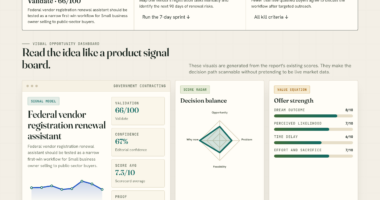
📊 Full opportunity report: Avoid Email Disruptions With Automation-Flow Rebuilders During Migrations on IdeaNavigator AI — validation score, market gap, and execution plan.

Get business pricing on office and shipping supplies
- Business-only prices and quantity discounts
- Tax-exempt purchasing
- Multiple users, one account, clear invoices
TL;DR

A new automation-flow rebuilding tool helps agencies migrate client email accounts between platforms efficiently. It reduces manual re-creation of flows, saving time and minimizing errors. The development is currently being tested with initial agency migrations.
An automation-flow rebuilder for email platform migrations is being tested by agencies to simplify the process of transferring client email automation flows. The tool aims to reduce hours of manual re-creation, errors, and delays during migrations, addressing a common pain point for marketing agencies. This development could significantly impact how agencies handle client migrations, making the process more efficient and less costly.
The automation-flow rebuilder is designed specifically for agencies migrating client accounts between email platforms such as Mailchimp and Klaviyo. Currently, moving automation flows—comprising triggers, branches, delays, and templates—requires extensive manual effort, which is both time-consuming and prone to errors. The new tool leverages APIs exposed by email platforms to extract flow structures and uses large language models (LLMs) to translate automation logic and template markup across platform paradigms. This process aims to turn what used to take weeks into a reviewed import that can be completed in days.
The initial version of the tool connects source and target accounts, exports every flow’s structure, and rebuilds it in the target platform. It also generates an exceptions report for any steps that cannot be automatically mapped and provides a side-by-side verification interface for agency review. The approach has been validated through pilot tests involving ten real agency migrations, where rebuild hours were compared against manual efforts and error rates.
Pricing for the tool is expected to be tiered based on flow count, with agencies paying a fixed fee per migration. The goal is to offer a cost-effective solution that can generate profit margins while significantly reducing the labor involved in migrations. The market focus is on email marketing operations and agency tooling, with early validation showing promising results in reducing rebuild time and errors.
Implications for Agency Migration Efficiency
This development matters because it addresses a longstanding challenge faced by marketing agencies: the manual and error-prone process of migrating client email automation flows. By automating the translation and rebuild of flows, agencies can save time, reduce costs, and improve accuracy during migrations. This could lead to more frequent and smoother platform transitions, enabling agencies to adopt new tools faster and better serve their clients. Ultimately, the tool could reshape the competitive landscape of agency email marketing operations by lowering barriers to migration and increasing operational agility.
email automation flow migration tool
As an affiliate, we earn on qualifying purchases.
As an affiliate, we earn on qualifying purchases.
Evolution of Email Platform Migration Tools
Historically, migrating email automation flows involved manual recreation of complex workflows, often taking weeks and risking errors that could impact campaign performance. As email platforms increasingly expose their flow structures via APIs, developers and third-party tools have begun exploring automated solutions. Recent advances include the integration of large language models capable of translating automation logic across different platform paradigms, which has opened new possibilities for streamlining migrations. The current focus on agency-specific tools reflects a broader industry trend toward automation and efficiency in marketing operations.
This new approach builds on prior efforts but emphasizes a practical, scalable solution tailored for agency workflows. Pilot tests with ten real migrations suggest that the tool can cut rebuild hours significantly, though full commercial deployment and broader validation are still underway.
Unconfirmed Aspects and Validation Challenges
While early tests show promising results, it is not yet clear how well the tool will perform across a broader range of platforms and complex workflows. The accuracy of flow translation, especially for highly customized automation, remains to be fully validated. Additionally, the extent to which agencies will adopt and rely on the tool during full-scale migrations is still uncertain, as broader deployment and user feedback are pending.
Next Steps for Broader Adoption and Validation
The developers plan to expand testing to include more agencies and a wider variety of email platforms. They will gather data on rebuild hours, error rates, and user satisfaction to refine the tool. Pending successful validation, a commercial version is expected to be released, with tiered pricing based on flow count. Further integration with platform APIs and enhanced translation accuracy are also in development to support larger, more complex workflows.
Key Questions
How does the automation-flow rebuilder work?
The tool connects source and target email accounts, extracts flow structures via APIs, uses AI to translate automation logic, and rebuilds flows in the target platform, providing a verification interface for review.
What platforms are supported?
Initial focus is on popular platforms like Mailchimp and Klaviyo, with plans to expand support to others as the technology matures.
Will this eliminate manual effort entirely?
While the tool aims to automate most of the process, some manual review and adjustments may still be necessary, especially for highly customized flows.
When will the tool be commercially available?
A full commercial release is expected after further validation, likely within the next few months, depending on ongoing testing outcomes.
How much will it cost?
Pricing is expected to be tiered based on flow count, with fixed fees per migration, designed to provide a cost-effective alternative to manual rebuilds.
Source: IdeaNavigator AI
Fall Picks
fall essentials
As an affiliate, we earn on qualifying purchases.