
For a toddler-ready introduction to STEM, I’d start with the Melissa & Doug Pattern Blocks and Boards Set for approachable shape and pattern play. PicassoTiles Magnetic Clear 3D Building Blocks suit families looking for open-ended construction, while the HABA Town Maze offers a more focused option for travel and guided problem-solving. The main tradeoffs are age fit, small-piece supervision, and whether a child prefers building, experimenting, or matching. Some picks are better suited to older toddlers, and a toy labeled for young children may still need close adult oversight. Read on for how all 10 compare and which one fits your child’s play style.
Key Takeaways
- Pattern Blocks and Boards lead for structured, low-tech problem-solving; the magnetic tiles offer more open-ended building but call for closer attention to age guidance and piece handling.
- HABA Town Maze is the clearest travel pick, while the larger building sets make more sense when there is room to spread out and leave a project in progress.
- The lineup’s strongest toddler fits favor simple actions—sorting, matching, steering, and stacking—over toys that depend on a screen, motor, or many assembly steps.
- The microscope and binoculars shift STEM play toward observation, but their appeal depends on adult help and a child’s ability to handle the equipment.
- The dinosaur, tool, rocket, and flower garden sets offer themed building or pretend play; their many parts can add variety while making setup and cleanup harder.
| Educational Insights GeoSafari Kidnoculars – Toy Binoculars for Kids Ages 3+ |  | Best for Outdoor Observation | Magnification: 2× | Age guidance: Ages 3+; recommended for ages 4–8 | Focus: Focus-free | VIEW ON AMAZON | See Our Full Breakdown |
| HABA Town Maze Magnetic Travel Toy for Toddlers |  | Best for Travel and Quiet Play | Brand: HABA | Age range: 2 years and up | Board dimensions: 10 × 8.75 inches | VIEW ON AMAZON | See Our Full Breakdown |
| BMDSAE 1000x Handheld Digital Microscope for Kids with 2.0-Inch IPS Screen |  | Best for Growing Science Skills | Magnification: Up to 1000× | Display: 2.0-inch IPS screen | Camera resolution: 2MP | VIEW ON AMAZON | See Our Full Breakdown |
| PicassoTiles 100 Piece Magnetic Clear 3D Building Blocks for Kids 3+ |  | Best for Open-Ended Building | Piece count: 100 | Material: Clear magnetic plastic | Recommended age: 3+ | VIEW ON AMAZON | See Our Full Breakdown |
| Melissa & Doug Pattern Blocks and Boards Set |  | Best for Guided Shape Practice | Tile count: 120 wooden tiles | Puzzle boards: 5 double-sided boards | Shape variety: 6 shapes | VIEW ON AMAZON | See Our Full Breakdown |
| Take Apart Dinosaur Toy Set with Electric Drill – 4 Pack (Tyrannosaurus Rex, Triceratops, Parasaurolophus, Velociraptor) |  | Best for Dinosaur Fans | Brand: Officygnet | Age range: 3–8 years | Dinosaur models: 4 | VIEW ON AMAZON | See Our Full Breakdown |
| iPlay, iLearn Rocket Space STEM Toy for Kids |  | Best for Space Role-Play | Toy type: Buildable space rocket | Boosters: Included | Detachable stages: Included | VIEW ON AMAZON | See Our Full Breakdown |
| Montessori Wooden Shape Sorter Set for Ages 1‑4 |  | Best for Early STEM Basics | Brand: PEBIRA | Age range: 1–4 years | Piece count: 20 | VIEW ON AMAZON | See Our Full Breakdown |
| Wooden Kids’ Tool Set with Battery-Powered Drill |  | Best for Guided Building Variety | Age range: 3 years and up | Piece count: 44 | Included drill: Battery-powered, with separate forward and reverse buttons | VIEW ON AMAZON | See Our Full Breakdown |
| 156-Piece Toddler Flower Garden Building Set |  | Best for Open-Ended Building | Brand: Leetous | Model: LTND110 | Piece count: 156 | VIEW ON AMAZON | See Our Full Breakdown |
More Details on Our Top Picks
Educational Insights GeoSafari Kidnoculars – Toy Binoculars for Kids Ages 3+
For toddlers who want to look closely at birds, leaves, or distant playground activity, the GeoSafari Kidnoculars offer an accessible first step into observation. Their focus-free design and oversized eyepieces avoid the adjustments that can frustrate young children, while the breakaway strap is a practical safety detail. Compared with the HABA Town Maze, this pick gets children moving and noticing the world around them rather than concentrating on a tabletop puzzle. The tradeoff is that 2× magnification gives only a modest closer view, so older children may want more capable optics. The plastic construction keeps the binoculars lightweight, though it may feel less substantial than sturdier models. I’d choose these for outdoor curiosity, not for detailed viewing.
Pros:- Focus-free design is straightforward for young children
- Oversized eyepieces make it easier to find a view
- Breakaway neck strap adds a practical safety feature
- Encourages outdoor observation and nature questions
Cons:- 2× magnification offers only a modest closer view
- Plastic construction may feel less sturdy than more substantial binoculars
Best for: Families seeking a simple, lightweight tool to prompt outdoor observation with preschoolers
Not ideal for: Older children who want strong magnification or more detailed nature viewing
- Magnification:2×
- Age guidance:Ages 3+; recommended for ages 4–8
- Focus:Focus-free
- Eyepieces:Oversized
- Construction:Lightweight plastic
- Strap:Breakaway neck strap
Our verdict“Choose the Kidnoculars for easy outdoor observing with young children; skip them if stronger magnification is a priority.”
HABA Town Maze Magnetic Travel Toy for Toddlers
The HABA Town Maze is the lineup’s most contained choice: a toddler guides metal balls through a printed route using a tethered magnetic wand. That gives little hands a concrete way to practice control and persistence, while the enclosed board suits car trips or quiet stretches at home. Compared with the open-ended PicassoTiles set, the maze offers a defined challenge and keeps the activity on one board, but it leaves less room for children to invent their own structures. Its 10 × 8.75-inch format is portable, though it still takes more room than a small handheld toy. The age focus is another tradeoff: toddlers may enjoy the route, while older children are more likely to want a harder puzzle. I’d pick it for focused, screen-free play on the go.
Pros:- Tethered wand stays with the board and stores at its side
- Guiding the balls practices fine motor control and focus
- Defined maze gives toddlers a clear problem to work through
- Board format works for travel and quiet play
Cons:- Fixed maze offers less creative freedom than PicassoTiles
- Older children may outgrow the toddler-level challenge
- Board takes up more space than a compact handheld activity
Best for: Caregivers who want a self-contained, screen-free activity for toddlers during travel or quiet time
Not ideal for: Families looking for open-ended construction or a challenge that will engage older children
- Brand:HABA
- Age range:2 years and up
- Board dimensions:10 × 8.75 inches
- Included components:Puzzle board and tethered magnetic wand
- Ball material:Metal; balls are not magnets
- Set name:Town Maze
- Model number:301056
- Warranty:30 days against manufacturer defects
Our verdict“Choose the HABA Town Maze for portable, focused toddler play when a defined puzzle is more useful than open-ended building.”
BMDSAE 1000x Handheld Digital Microscope for Kids with 2.0-Inch IPS Screen
The BMDSAE microscope is the lineup’s most technically involved science tool, pairing a 2.0-inch screen with adjustable LEDs and photo and video capture. That lets a child revisit what they observed, while USB transfer gives families a way to view saved files on compatible computers. Compared with the Kidnoculars, it can document close-up subjects indoors, but it asks for more setup and practice. Manual focus may be difficult for a toddler to manage without help, and the listed age recommendation is over 3, so this is better suited to supervised exploration than fully independent play. Battery life is listed at up to two hours, which can limit longer sessions. I’d choose it for families ready to guide a more involved investigation, rather than as the simplest first STEM toy.
Pros:- Screen displays observations without requiring an eyepiece
- Eight adjustable LEDs offer control over specimen lighting
- Can save photos and AVI videos for transfer to compatible computers
- Includes a lanyard, USB-C cable, and one-year warranty
Cons:- Manual focus can take practice and may need adult help
- Battery life is listed as up to two hours
- More involved to operate than the focus-free Kidnoculars
Best for: Adults who want to guide preschoolers through close-up observation and save images for later discussion
Not ideal for: Toddlers expected to use a science toy independently or children who need long sessions between charges
- Magnification:Up to 1000×
- Display:2.0-inch IPS screen
- Camera resolution:2MP
- Lighting:8 adjustable LEDs with 3 brightness modes
- Battery:600mAh; up to 2 hours
- Storage:32M; stores 200+ photos or AVI videos
- Recommended age:Over 3 years
- Included items:Microscope, instruction manual, lanyard, and USB-C data cable
- Warranty:1 year
Our verdict“Choose this microscope for supervised, recordable close-up exploration if the child is ready for manual focusing.”
PicassoTiles 100 Piece Magnetic Clear 3D Building Blocks for Kids 3+
With 100 magnetic tiles, PicassoTiles gives children room to move from flat patterns to three-dimensional structures, making spatial relationships visible through play. The clear pieces connect quickly, so children can experiment with shapes and rebuild without needing tools. Compared with the Melissa & Doug Pattern Blocks set, this one favors constructing larger forms over completing designs on fixed boards; that flexibility is useful for group play, but it can also make the activity less guided for beginners. The key tradeoff is structural: the supplied description notes that magnetic strength may not support very large builds. Small pieces also call for age-appropriate supervision, especially around younger siblings. I’d rank it for families who want creative building with an early geometry angle, rather than a contained matching activity.
Pros:- 100 pieces support varied flat and 3D constructions
- Magnetic connections make setup and rebuilding straightforward
- Open-ended designs invite experimentation with geometry and space
- Suitable for solo play or collaborative building
Cons:- Magnetic strength may not hold very large structures securely
- Small pieces require care around younger children
- Less guided than the Melissa & Doug board-based pattern activities
Best for: Families with children age 3+ who want open-ended shape building for solo or shared play
Not ideal for: Households with younger children who may mouth small pieces or builders who expect very large structures to stay stable
- Piece count:100
- Material:Clear magnetic plastic
- Recommended age:3+
- Building format:Magnetic 3D building blocks
- Play modes:Solo or group play
- Learning focus:Creativity, geometry, spatial reasoning, and early math
Our verdict“Choose PicassoTiles for flexible, collaborative building if your child is ready for the small pieces and modest structural limits.”
Melissa & Doug Pattern Blocks and Boards Set
The Melissa & Doug set makes early geometry more structured: children sort and place wooden shape tiles against designs on double-sided boards, then can use the pieces to create their own patterns. That defined matching task may suit a beginner who benefits from a visible goal. Compared with PicassoTiles, it offers less scope for tall 3D construction, but its boards provide clearer prompts for shape recognition and spatial planning. The wooden case helps keep the many pieces together, although 120 tiles still create plenty to collect and small pieces can go missing. The product data also gives conflicting board and pattern counts, so I’d focus on the listed five double-sided boards rather than assume there are additional activities. I’d choose it for table-based sorting and pattern work, not large collaborative builds.
Pros:- Five double-sided boards provide visual prompts for pattern matching
- Six shape types support sorting and shape recognition
- Wooden tiles offer hands-on pattern building
- Wooden case provides a dedicated storage place
Cons:- Small tiles can be misplaced and need supervision around younger children
- The supplied description gives conflicting board and pattern counts
- Offers less 3D construction than PicassoTiles
Best for: Caregivers seeking a guided tabletop activity for practicing shapes, matching, and simple patterns
Not ideal for: Families who want large-scale 3D building or a small set with few pieces to manage
- Tile count:120 wooden tiles
- Puzzle boards:5 double-sided boards
- Shape variety:6 shapes
- Storage:Wooden case
- Activity types:Sorting, matching, and design creation
- Learning focus:Shape recognition, spatial awareness, coordination, and early math
Our verdict“Choose this set for guided shape and pattern practice if your child enjoys tabletop puzzles and you can keep track of the tiles.”
Take Apart Dinosaur Toy Set with Electric Drill – 4 Pack (Tyrannosaurus Rex, Triceratops, Parasaurolophus, Velociraptor)
Four assemble-and-take-apart dinosaurs give young builders a clear payoff: they can use the included low-speed drill or manual screwdrivers to put together familiar creatures, then start again. The different models invite shared play, while fastening parts gives little hands practice with coordination and simple problem-solving. Compared with the Wooden Kids’ Tool Set, this kit focuses on completing specific figures rather than trying several construction ideas; it is the stronger choice for a child motivated by dinosaurs. That focus also limits how much the play can vary once the models are familiar. The drill is described as low speed, so older children may find it underpowered, and assembly can test a young child’s patience. Small screws also need careful storage. The stated age range begins at three, so this is not a fit for younger toddlers.
Pros:- Four distinct dinosaur models give the assembly activity variety
- Includes a low-speed electric drill, two drill bits, and four manual screwdrivers
- Taking figures apart and rebuilding them practices fastening and hand coordination
- Multiple figures can support cooperative play
Cons:- Small screws and parts can be misplaced without a storage routine
- The low-speed drill may disappoint older children seeking more power
- Repeated assembly may frustrate children who have little patience for step-by-step tasks
Best for: Families with children aged 3 to 8 who are especially interested in dinosaurs and enjoy rebuilding toys with an adult or sibling
Not ideal for: Caregivers shopping for a child under three, or for an older child who wants a powerful drill and open-ended construction
- Brand:Officygnet
- Age range:3–8 years
- Dinosaur models:4
- Models included:Tyrannosaurus Rex, Triceratops, Parasaurolophus, Velociraptor
- Drill:Low-speed electric drill
- Drill bits:2
- Manual screwdrivers:4
- Model number:Take Apart Dinosaur Toys – 817
Our verdict“Choose this set for a dinosaur-loving child aged three or older who will enjoy assembling specific figures with included tools.”
iPlay, iLearn Rocket Space STEM Toy for Kids
Detachable rocket stages, boosters, and a command module make this a space-play set with an assembly element: children can build the rocket, then use it in pretend launches and exploration. Lights and sounds add an interactive payoff that a quieter building activity such as the Montessori Wooden Shape Sorter Set does not offer. That makes the rocket more appealing to children who learn through imaginative stories, though its sensory features may be less welcome in homes seeking quiet play. The description says assembly can support problem-solving and hand-eye coordination, but gives no age range, material details, or safety certification information. Those gaps make it harder to judge whether it suits a particular toddler, so I would check the product packaging and suitability before choosing it for a young child.
Pros:- Detachable stages and boosters create parts to assemble and rearrange
- Command module gives the rocket a recognizable role-play focus
- Lights and sounds add an interactive element
- Space theme can prompt imaginative exploration play
Cons:- The provided description does not specify an intended age range
- Material and safety certification details are not provided
- Lights and sounds may be distracting for families looking for quiet play
Best for: Caregivers of a space-obsessed child who want an assembly toy that also supports pretend rocket missions
Not ideal for: Buyers who need a clearly stated toddler age range, material details, or a quiet toy without lights and sounds
- Toy type:Buildable space rocket
- Boosters:Included
- Detachable stages:Included
- Command module:Included
- Lights:Included
- Sounds:Included
- Assembly instructions:Included
- Intended age:Not specified in the provided content
Our verdict“Pick this rocket for a space-loving child when the age guidance and product details have been checked for that child.”
Montessori Wooden Shape Sorter Set for Ages 1‑4
Shape and color matching makes this wooden set the simplest entry into early STEM play among these picks. Its 20 blocks let toddlers handle geometric forms and sort by visible features, while the stated age range of one to four includes younger children who are not ready for the drill-and-fastener tasks in the Take Apart Dinosaur Toy Set. The compact design is also described as travel-friendly, a practical advantage for families who want a straightforward activity to bring along. This is a focused puzzle, not a growing construction challenge: children who already sort shapes confidently may outgrow it, and there is less room for pretend building than with the 156-Piece Toddler Flower Garden Building Set. The supplied product details also describe a pack quantity of six sets, so buyers should check that quantity against what they intend to purchase.
Pros:- Five shapes and five colors offer clear matching and sorting activities
- Wood construction with water-based paint and smooth edges is specified
- Compact form is described as suitable for travel and small hands
- Stated age range includes toddlers as young as one
Cons:- Twenty pieces may offer limited challenge as a child grows
- Sorting play is less open-ended than assembling the flower garden set
- The listed pack quantity of six sets may not match a buyer seeking only one set
Best for: Caregivers of children aged 1 to 4 seeking a compact, hands-on introduction to shapes and colors
Not ideal for: Families looking for open-ended building or a challenge for an older toddler who already sorts shapes easily
- Brand:PEBIRA
- Age range:1–4 years
- Piece count:20
- Colors:5
- Geometric shapes:5
- Material:Wood
- Paint:Water-based
- Pack quantity:6 sets per pack
Our verdict“Choose this sorter for a younger toddler who is beginning to match shapes and colors and needs a portable activity.”
Wooden Kids’ Tool Set with Battery-Powered Drill
Twenty-one model ideas give this 44-piece kit more guided variety than the four fixed dinosaur builds in the Take Apart Dinosaur Toy Set. Children can use the battery-powered drill and hand tools for construction play, then pack the pieces into the toolbox; the washable apron adds a pretend repair role. Its separate forward and reverse buttons also make the drill feel like part of the activity, though an adult may need to help when fasteners get too tight. Compared with the simpler Montessori Wooden Shape Sorter, this set asks for more steps and suits the stated age of three and up. It needs two AA batteries, which are not included, and the tool-and-part assortment may be a lot for a child who prefers a short, simple task.
Pros:- Twenty-one guide ideas provide several starting points for builds
- Combines pretend tool play with hands-on fastening and construction
- Toolbox has separate storage sections and the apron is washable
- Materials and compliance details specify solid wood, water-based paint, ASTM F963, and CPSIA
Cons:- Requires two AA batteries that are not included
- An adult may need to help when fasteners are tightened too firmly
- The assortment of pieces and steps may overwhelm children who prefer simpler activities
Best for: Families with children aged three or older who enjoy pretend repair play and benefit from a guide with multiple build ideas
Not ideal for: Caregivers seeking a battery-free activity or a simple sorting toy for a younger toddler
- Age range:3 years and up
- Piece count:44
- Included drill:Battery-powered, with separate forward and reverse buttons
- Hand tools:7
- Guide:21 model ideas
- Battery requirement:2 AA batteries, not included
- Materials:Solid wood with non-toxic water-based paint
- Safety standards:Tested to ASTM F963 and CPSIA requirements
Our verdict“Choose this kit for a child aged three or older who wants several guided construction activities and enjoys pretend tool play.”
156-Piece Toddler Flower Garden Building Set
156 flower, stem, leaf, and insect pieces let children make and rearrange a pretend garden, giving this set more open-ended variation than the Montessori Wooden Shape Sorter, which centers on matching shapes and colors. The large assortment can support repeated design choices and fine motor practice, while the carrying case gives families a place to put the components away. It suits children drawn to arranging colorful creations more than those who want a specific mechanical build like the Wooden Kids’ Tool Set. The age guidance needs care: the manufacturer recommends three and up, even though the target age also lists two to six. Buyers shopping for a two-year-old should follow the stated recommendation and check the pieces with that child’s needs in mind.
Pros:- Large assortment allows many flower and garden arrangements
- Flowers, stems, leaves, bases, and insects support varied designs
- Carrying case provides a place to store the pieces
- Description identifies the material as BPA-free, non-toxic, and odorless
Cons:- Manufacturer recommendation begins at age three despite the listed target age beginning at two
- The many pieces may require more sorting and cleanup than a small shape sorter
- Does not offer the guided tool-based builds found in the wooden tool set
Best for: Families with children aged three to six who enjoy arranging colorful pieces into changing pretend gardens
Not ideal for: Caregivers seeking a clearly recommended toy for a two-year-old, or a guided mechanical building activity
- Brand:Leetous
- Model:LTND110
- Piece count:156
- Contents:34 flower pieces, 24 stamens, 74 stems and leaves, 12 green bases, 8 insects, 4 butterflies, 1 carrying case
- Recommended age:3 years and up
- Target age:2–6 years
- Material:BPA-free, non-toxic, and odorless
- Set name:Garden Building Set
Our verdict“Choose this set for a child aged three or older who enjoys creating and changing colorful garden arrangements.”
How We Picked
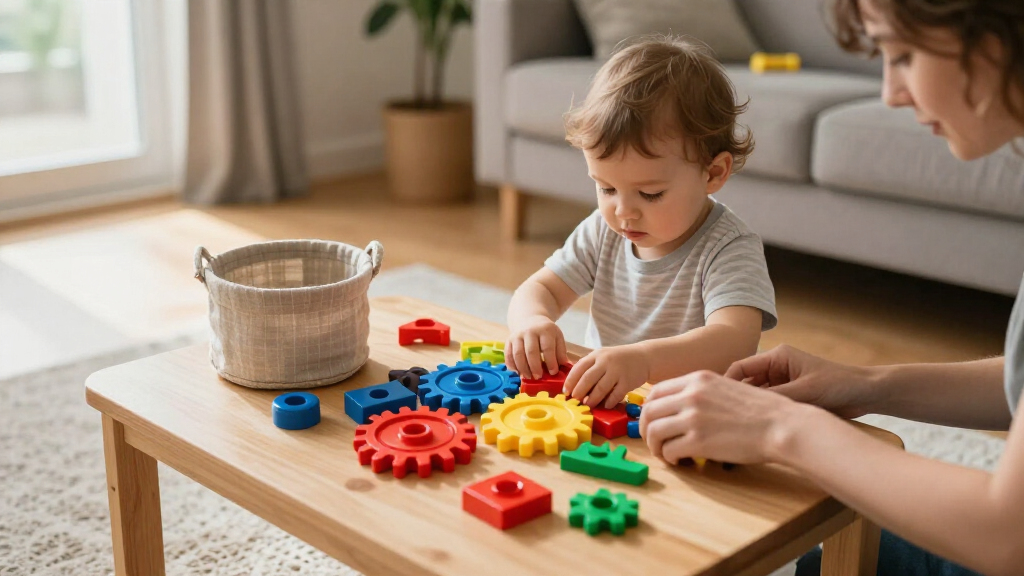
I compared the 10 options by how clearly they invite a toddler to explore a STEM idea through play: shapes and patterns, cause and effect, spatial reasoning, observation, or simple construction. I also weighed age fit, ease of handling, likely adult involvement, portability, and how much the toy can support different kinds of play over time. A strong toddler pick needs a clear first action and room to repeat or vary it.
The ranking favors approachable, reusable play with manageable setup. Pattern blocks rank highly for their direct visual puzzles, while magnetic tiles stand out for open-ended construction. The maze earns a distinct place for compact, guided play. Toys with electronics, many components, or narrower age appeal rank lower for this roundup because they can require more assistance or supervision; that does not make them poor choices for a child whose interests match.
Factors to Consider When Choosing Stem Toys For Toddlers
I’d choose by the play experience a child can manage now, rather than by the number of pieces or the word “STEM” on the box. These factors help distinguish a toy that gets used independently from one that needs an adult to set up each session.
Match the toy to your child’s current actions
Think about what your toddler already enjoys doing: fitting shapes, stacking, turning knobs, or watching things move. A toy that extends a familiar action can invite experimentation without requiring lengthy instructions. For a younger toddler, simple cause and effect may be a better fit than a kit with several assembly steps. Age labels are useful starting points, but hand control and attention vary widely. Check the maker’s age guidance and small-part warnings, then plan to supervise wherever the child’s play calls for it. A more advanced toy can work as a shared activity if an adult handles the tricky parts.
Choose the kind of learning you want to encourage
STEM play can mean different things: comparing shapes, building stable structures, observing nature, or following a problem through several steps. Decide which kind of exploration you want the toy to prompt before choosing a theme. A themed set can attract a child who loves dinosaurs or gardening, while a less specific toy may leave more room for imaginative uses. Avoid assuming that a toy teaches more just because it has electronics or many components. Look for a clear action the child can repeat and change, such as sorting by shape or testing how pieces fit. The best fit is the one that makes your child want to try another idea.
Balance open-ended play with guided challenges
Open-ended toys let children invent their own projects, while boards, mazes, and sorters offer a defined task. Neither approach suits every moment: open play can be rewarding but may need an adult to get started, and a puzzle can be satisfying but eventually feel familiar. Consider whether your child likes making choices or prefers a clear goal. A mix at home can cover both moods without requiring one toy to do everything. If storage is limited, prioritize a set with pieces that can be used in several ways. For a first STEM toy, a visible, achievable challenge may be easier to pick up than a large building kit.
Plan for supervision and small parts
Construction kits and multi-piece sets can pose a different supervision burden from a single-piece maze or sorter. Count not only the loose pieces but also any small connectors, accessories, or removable parts. Follow the manufacturer’s age guidance and keep pieces away from younger siblings who may mouth toys. A product described as toddler-friendly still deserves a careful check of its specific warnings and dimensions. If you want independent play, choose a setup you can monitor easily and a toy with fewer loose pieces. For more involved kits, think of adult participation as part of the activity rather than an inconvenience.
Consider setup, cleanup, and where play happens
A toy’s real usefulness depends partly on how easily it fits into your routine. Compact travel toys can work in a car or waiting room, while larger sets need a stable surface and a place to keep unfinished builds. More pieces may offer extra combinations, but they also take longer to sort and put away. Before buying, picture the full session: opening the box, starting play, and storing everything afterward. A small tray or dedicated bin can make a multi-piece set easier to manage. If your child often plays in short bursts, a toy that can be restarted quickly may see more use than one with a lengthy setup.
Decide when added features are worth the effort
Screens, lights, powered drills, and other moving parts can add novelty, but each can change how much help a toddler needs. Ask whether the feature supports the play you want or mainly adds steps such as charging, replacing batteries, or handling controls. For observation toys, consider whether an adult will help the child find something to view and operate the device. A simpler manual toy may invite more repeated experimentation with less setup. Powered features can still be a good match for a child drawn to tools or gadgets, especially during shared play. Prioritize a feature only when it gives the child a meaningful action to explore.
Frequently Asked Questions
Which of these toys is the best first STEM toy for a toddler?
I’d start with a toy that offers one clear action and an easy way to try again. The Pattern Blocks and Boards Set is a strong choice for a child who enjoys matching shapes, while the wooden shape sorter is a simpler starting point for fitting and sorting. A child who prefers movement may connect more with the HABA maze. Check each product’s age guidance and supervise play as needed. The right first toy is the one your child can engage with at their current skill level.
Are building sets with many pieces a good choice for toddlers?
They can be, especially for a child who enjoys stacking, connecting, or making pretend structures, but piece count alone does not predict how engaging a set will be. Many components can create more building options and also increase sorting, cleanup, and supervision needs. Check the manufacturer’s age recommendation and inspect the component sizes before letting a toddler play. You may find it easier to introduce a few pieces at a time. A smaller, simpler set can be a better match if your child prefers short, independent play sessions.
Should I choose a toy with a screen or battery-powered feature?
Choose one when the powered feature gives your child a useful action to explore, such as looking closely at an object or operating a toy drill with help. These features may also add controls, batteries, setup, and adult involvement. If you want a toy that is easy to start anywhere, a manual sorter, maze, or pattern activity may fit your routine better. Consider how often you want to charge or maintain the device and whether your child can use it safely with supervision. A screen is a feature to weigh against the play itself, not a guarantee of a richer STEM experience.
How can I tell if a STEM toy is safe for my toddler’s age?
Start with the manufacturer’s stated age range and warnings, then check the individual pieces rather than relying on the product title. Toddlers develop at different rates, and a toy intended for ages three and up may still need close adult supervision around a younger child. Consider whether your toddler mouths objects, can follow basic play boundaries, and can handle the parts without putting them in their mouth. Keep small components away from younger siblings. If the guidance does not match your child’s current behavior, wait or choose a simpler toy.
Which option makes the most sense for travel or small homes?
The HABA Town Maze is the most purpose-built travel choice in this group because its play is contained and does not depend on a large building surface. In a small home, also consider how many loose pieces a set has and whether it can be stored in one bin. Larger construction sets can still work if you have a consistent place to build and put them away. A compact toy may be easier to bring out, though it can offer a narrower play experience than an open-ended set. Choose based on the space you can give both the play session and cleanup.
Conclusion
For most families, I’d choose the Melissa & Doug Pattern Blocks and Boards Set as the best overall option for clear, repeatable shape challenges. The Montessori Wooden Shape Sorter Set is my best beginner pick for straightforward fitting and sorting, while the HABA Town Maze is best for travel and contained play. For open-ended building, PicassoTiles make the strongest premium-style choice in this lineup; families seeking a value-oriented themed activity can look to the 156-Piece Toddler Flower Garden Building Set, provided its piece handling and age guidance suit their child. Choose the microscope or binoculars for a child drawn to observation, and the tool or dinosaur kits for one who wants hands-on assembly with adult help. Match the toy to the play your toddler already seeks, and the shortlist becomes much easier to navigate.