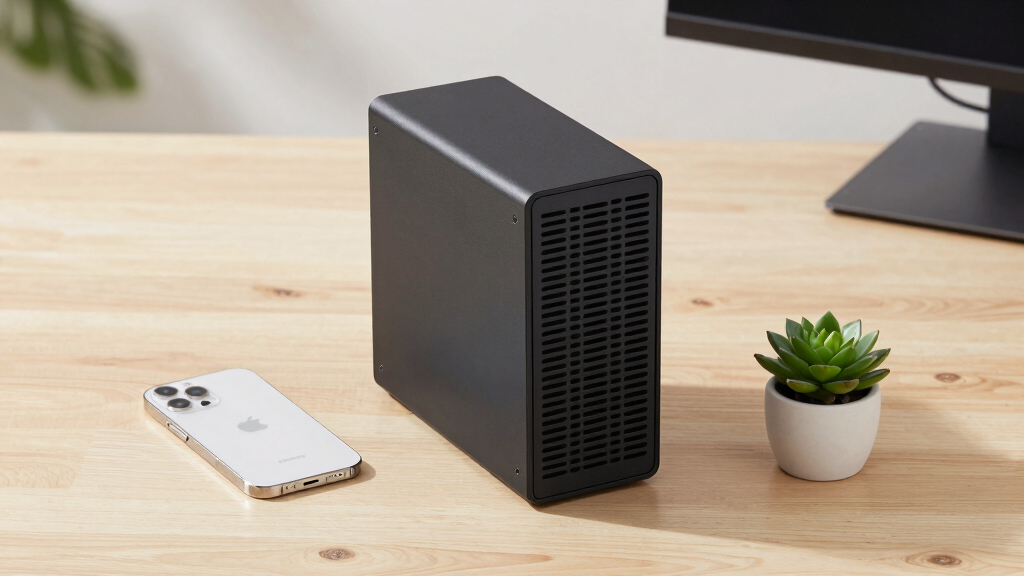
Finding the right NAS enclosure for growing teams involves balancing performance, expandability, and ease of management. The LincStation S1 stands out as the best overall choice for its powerful Intel N97 processor and flexible storage options. For those prioritizing speed, the QNAP TS-464U-8G-US offers high-speed network connectivity, ideal for demanding workflows. Budget-conscious teams might lean toward the MAIWO Dual Bay RAID Enclosure, which provides robust RAID modes at a lower cost. However, tradeoffs often involve balancing expandability against complexity and price. Continue reading for a detailed breakdown of these options and what suits your team best.
Key Takeaways
- Performance hinges on CPU power and network speed—top picks offer robust processors and multi-gigabit networking.
- Expandability varies; higher-end models include multiple M.2 slots and support for numerous drives, suitable for future growth.
- Ease of use and setup differ significantly—diskless models require more technical know-how, while pre-configured units are more user-friendly.
- Price ranges widely; investing in premium models pays off for large teams needing high throughput but may be overkill for smaller groups.
- Cooling and build quality are often overlooked but critical for reliability in continuous operation environments.




More Details on Our Top Picks
LincStation S1 6-Bay Desktop NAS – Intel N97 Quad-Core, 8GB DDR5 RAM (up to 16GB), 128GB eMMC, 4X SATA HDD + 2X M.2 NVMe SSD, Dual 2.5GbE, Unraid License Included, Network Attached Storage(Diskless)
This model stands out for its powerful Intel N97 processor and 8GB DDR5 RAM, making it well-suited for demanding tasks like virtualization, Plex transcoding, and multi-user access. Compared with the TS-464U-8G, it offers greater flexibility with 2 M.2 NVMe slots and an expansive 6-bay configuration, though it involves a higher price and slightly more complex setup. The inclusion of an Unraid license provides exceptional flexibility in drive mixing and virtual machine hosting. Its dual 2.5GbE ports support link aggregation and failover, ensuring fast, reliable network performance. The advanced thermal management and tool-free design simplify maintenance, while the 1.77″ touchscreen offers real-time system monitoring. However, the device’s size and power draw may be less suitable for small or low-power environments.
Pros:- Powerful Intel Alder Lake-N N97 processor for demanding workloads
- Expandable up to 16GB DDR5 RAM, supporting virtualization and media tasks
- Flexible drive options with 4 SATA bays and 2 NVMe slots
Cons:- Higher price point compared to simpler NAS solutions
- Relatively large and may require dedicated space
Best for: Growing small offices or advanced home labs seeking scalable, high-performance storage with virtualization capabilities
Not ideal for: Small teams with limited budget or minimal technical experience, as setup and maintenance are more involved
- Processor:Intel Alder Lake-N N97 Quad-Core
- RAM:8GB DDR5 (expandable to 16GB)
- Storage Bays:4 x SATA HDD, 2 x M.2 NVMe
- Network:Dual 2.5GbE
- Display:1.77-inch touchscreen
- Included Software:Unraid License
Bottom line: This pick makes the most sense for teams needing top-tier performance and flexible drive configurations without size constraints.
QNAP TS-464U-8G-US 4 Bay High-Speed Rackmount Dual-2.5GbE NAS Intel Celeron N5105/N5095 CPU, 8GB DDR4 Memory and 2.5GbE (2.5G/1G/100M) Network Connectivity (Diskless)
The TS-464U-8G provides reliable performance with its Intel Celeron N5105/N5095 processor and 8GB DDR4 RAM, supporting up to 16GB for multi-user file sharing and backup. Its rackmount design makes it ideal for server rooms or data centers, unlike the desktop-focused LincStation S1. The dual 2.5GbE ports support link aggregation for faster transfer speeds across teams, and PCIe Gen 3×2 slots allow for expansion via QM2 cards, boosting performance further. The numerous USB 3.2 ports facilitate quick media transfer and peripheral connectivity. While it excels in throughput and expandability, its rackmount setup may be unnecessary for small or home environments. Its enterprise-oriented features make it a solid choice for growing teams needing high-speed, centralized storage.
Pros:- Quad-core Intel Celeron CPU with support for up to 16GB RAM
- Dual 2.5GbE ports for fast network connectivity and redundancy
- PCIe slot for optional expansion cards
Cons:- Requires rackmount setup, less suitable for compact spaces
- Higher initial cost and complexity
Best for: Medium to large teams with dedicated server room space seeking scalable, high-speed, rackmount storage
Not ideal for: Small offices or home users without rack infrastructure and lower performance demands
- Processor:Intel Celeron N5105/N5095
- Memory:8GB DDR4 (max 16GB)
- Network:Dual 2.5GbE
- Form Factor:Rackmount
- Drive Bays:4 x 3.5-inch bays
- Expansion Slots:PCIe Gen 3×2
Bottom line: This NAS is perfect for teams wanting high throughput and expandability in a rackmount form factor, though it’s overkill for small-scale setups.
MAIWO Dual Bay RAID Enclosure for SATA 3.5″ HDD with Cooling Fan, Type-C USB 3.1 SATA Enclosure with 4 Raid Modes (1/0/JBOD/NORMAL), 48TB Capacity Expansion
This enclosure offers a straightforward dual bay RAID setup with support for RAID 0, 1, JBOD, and normal modes, making it suitable for small backups or media storage. Compared to larger NAS options like the QNAP TS-464U, it’s much more compact and easier to deploy in limited spaces. Its aluminum alloy body provides decent heat dissipation, and the built-in fan helps maintain stable operation during extended use. The device supports up to 48TB total capacity and is compatible with 3.5″ SATA drives up to 24TB each. However, its limited bays restrict scalability, and it lacks network connectivity features, making it unsuitable for multi-user or networked environments. This is best for individuals or small teams needing reliable, simple storage without the complexity of a full NAS.
Pros:- Supports multiple RAID modes for flexible data management
- Supports drives up to 24TB each, total 48TB capacity
- Effective heat dissipation with aluminum alloy body
Cons:- No network connectivity, limited to direct connection
- Only 2 bays restrict scalability
Best for: Small teams or individuals needing reliable RAID-backed external storage for backups or media
Not ideal for: Teams requiring network sharing or virtualization, as it’s purely a direct-attached solution
- Drive Bays:2 x 3.5-inch SATA
- Max Capacity:48TB
- Supported RAID Modes:0, 1, JBOD, Normal
- Material:Aluminum alloy
- Cooling:Built-in fan
- Connectivity:Type-C USB 3.1
Bottom line: Ideal for small-scale, local backup or media storage needs, but not suited for networked teams or extensive expansion.
MAIWO Dual Bay RAID Hard Drive Enclosure with USB 3.0 for 2.5 Inch SATA SSD/HDD, Support UASP 12TB Capacity, RAID 0/1/JBOD/PM, Tool Free External HDD Enclosure
This enclosure excels in portability and ease of use with its tool-free design and support for 2.5″ SATA SSDs and HDDs up to 12TB. It’s comparable to the larger, desktop-oriented LincStation S1, but much smaller and lightweight, making it ideal for mobile workflows or temporary setups. The RAID modes allow for flexible data protection or performance optimization, and the USB 3.0 interface with UASP support ensures fast transfer speeds of up to 5Gbps. Its compact size and simple plug-and-play operation make it perfect for users who need quick, reliable external storage without the need for network connectivity or extensive setup. However, the limited capacity and absence of network features mean it’s less suited for team environments.
Pros:- Tool-free, quick setup and drive swapping
- Supports RAID 0, 1, JBOD, and PM modes
- Compact and lightweight for portability
Cons:- Limited to 12TB maximum capacity
- No network or expansion options
Best for: Frequent travelers or remote workers needing quick, reliable external RAID storage
Not ideal for: Teams requiring network access or large-scale storage, as it’s purely portable and direct-connected
- Supported Drives:2.5″ SATA SSD/HDD up to 12TB
- RAID Modes:0, 1, JBOD, PM
- Interface:USB 3.0
- Transfer Speed:Up to 5Gbps
- Material:High-strength ABS plastic
- Size:132x79x27mm
Bottom line: Perfect for mobile professionals needing fast, portable external RAID storage without network dependency.
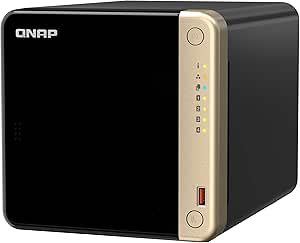
QNAP TS-464-8G-US 4 Bay High-Performance Desktop NAS with Intel Celeron Quad-core Processor, M.2 PCIe Slots and Dual 2.5GbE (2.5G/1G/100M) Network Connectivity (Diskless)
The TS-464-8G offers a robust Intel Celeron quad-core processor and 8GB DDR4 RAM, with support for up to 16GB, making it suitable for intensive multi-user tasks, multimedia editing, and file sharing. Its dual M.2 PCIe slots enable SSD cache acceleration, a feature that outperforms the more basic MAIWO RAID enclosures, which lack SSD options. The dual 2.5GbE ports allow for faster network throughput and redundancy, while multiple USB 3.2 ports facilitate fast external media transfers. The device’s high performance and expandability make it suitable for demanding team environments, although it requires more space and a power source. Its desktop form factor is ideal for offices that need centralized, high-speed storage, but less so for small or portable setups.
Pros:- Quad-core Intel Celeron CPU with support for up to 16GB RAM
- Dual M.2 PCIe slots for SSD cache or storage pools
- Dual 2.5GbE ports for fast, reliable network connectivity
Cons:- Larger desktop footprint, less suited for tight spaces
- More expensive than basic NAS models
Best for: Medium-sized teams or power users seeking high performance, SSD caching, and flexible storage options
Not ideal for: Very small teams or those with limited space, as it’s less portable and more complex to manage
- Processor:Intel Celeron N5105/N5095
- Memory:8GB DDR4 (max 16GB)
- Drive Bays:4 x 3.5-inch bays
- Network:Dual 2.5GbE
- Expansion:2 x M.2 PCIe SSD slots
- Form Factor:Desktop
Bottom line: This NAS offers a high-performance, expandable platform ideal for teams with demanding multitasking and media needs, though it’s less suited for small or simple environments.
Mediasonic PROBOX 4 Bay DAS 3.5” SATA Hard Drive Enclosure – USB 3.0 eSATA Support 30TB HDD (HF2-SU3S3)
This Mediasonic model stands out for its robust support of four SATA drives up to 30TB each, making it ideal for growing team storage needs. Compared to the WAVLINK enclosure, it offers excellent drive capacity and compatibility, but it lacks advanced RAID options, limiting redundancy choices. Its built-in temperature sensor and smart fan help prevent overheating during intensive use. Drive installation is straightforward, with individual drive hot-swap capability, although the manual switch between USB 3.0 and eSATA may be less seamless than some competitors. The enclosure’s metal build ensures durability, but the absence of RAID configurations means you’ll need external software for redundancy. It’s best suited for teams prioritizing high capacity and ease of use over advanced RAID features, but less so for those needing RAID 5 or similar. Overall, this pick makes the most sense for teams needing reliable, large-capacity expansion without complex RAID setups.
Pros:- Supports four drives up to 30TB each, ideal for large data pools
- Built-in temperature sensor and smart fan prevent overheating
- Easy drive installation with hot-swap capability
Cons:- No native RAID support, limiting redundancy options
- Manual switch between USB 3.0 and eSATA can be less convenient
- Lacks advanced management features found in higher-end enclosures
Best for: Growing teams needing large, flexible storage with straightforward setup and reliable performance
Not ideal for: Teams requiring native RAID support or advanced redundancy features, as it only supports JBOD or individual drives
- Support for drives:4 x 30TB SATA HDD
- Interface:USB 3.0, eSATA
- Transfer Rate:6Gbps
- Build Material:Metal
- Dimensions:6.8″L x 4.9″W x 9″H
- Weight:4 pounds
Bottom line: This enclosure suits teams seeking high-capacity, straightforward expansion with reliable cooling but without built-in RAID features.
ORICO 4 Bay Raid Hard Drive Enclosure Support 8 RAID Modes for 3.5inch HDD Max up to 88TB for External Direct Attached Storage, Efficient Expansion Backup (9848RU3)
This ORICO model makes a compelling case for teams needing multiple RAID configurations, supporting 8 modes including RAID 0, 1, 3, 5, 10, JBOD, CLONE, and CLEAR. Unlike the Mediasonic enclosure, it offers native RAID modes, providing enhanced data protection and flexibility suitable for critical team projects. Its capacity up to 88TB supports large-scale storage, comparable to WAVLINK but with more RAID options. The aluminum shell ensures good heat dissipation, and the built-in 150W power supply keeps multiple drives running smoothly. The tray-less design allows easy drive swapping, but the setup process can be more involved due to RAID configuration. While it supports high data transfer speeds up to 235 MB/s, actual performance depends on RAID setup and system configuration. Ideal for teams prioritizing data security and flexible redundancy, though less suited for simple, plug-and-play setups.
Pros:- Supports 8 RAID modes, offering maximum flexibility for data protection
- Supports up to 88TB capacity with four drives
- Excellent heat dissipation with aluminum shell and silent fan
Cons:- Setup and configuration can be more complex than simple enclosures
- Requires RAID management knowledge for optimal use
- Larger physical size due to robust cooling and power supply
Best for: Teams needing customizable RAID configurations and maximum data security
Not ideal for: Users seeking simple, non-RAID storage or plug-and-play solutions, as setup is more complex
- Supports drives:4 x 88TB SATA HDD
- Interface:USB 3.0
- Transfer Speed:up to 235 MB/s
- Material:Aluminum
- Power Supply:150W built-in
- RAID Modes:8 modes including RAID 0,1,3,5,10
Bottom line: This enclosure is best for teams that need flexible RAID options and robust data security, willing to handle more complex setup processes.
WAVLINK 4-Bay Hard Drive Enclosure for 3.5″ and 2.5” SATA HDD/SSD Featuring 10Gbps USB-C 3.2, Max 88TB Capacity, Built-in Temp-Controlled Cooling Fans, 4K HDMI Stunning Video Output, Aluminum Shell
This WAVLINK enclosure excels with its blazing-fast 10Gbps USB-C 3.2 interface, making it ideal for teams handling large multimedia files or high-speed backups. Unlike the Mediasonic and ORICO models, it supports both 3.5” and 2.5” drives with additional mounting brackets, providing versatility for different storage needs. Its integrated HDMI output supporting 4K@60Hz and a USB-C port for peripherals or daisy-chaining extend its use beyond simple storage. The aluminum shell and dual fans ensure efficient cooling during intensive tasks, especially useful for multimedia workloads. Drive swapping is hot-swappable with independent switches, but the initial setup for 2.5” drives requires extra brackets. While performance is excellent, actual transfer speeds depend on host compatibility. Perfect for creative teams needing high-speed storage with display capabilities, but might be overkill for basic backups.
Pros:- Supports both 3.5” and 2.5” drives for versatility
- Ultrafast 10Gbps USB-C 3.2 transfer speeds
- Includes 4K HDMI output and USB-C for peripherals
Cons:- Requires additional brackets for 2.5” drives, complicating setup
- Overkill for simple storage needs, higher cost
- Dependent on host system support for video output
Best for: Creative teams and multimedia professionals requiring high-speed storage and video output
Not ideal for: Teams seeking purely basic or budget-friendly storage solutions without multimedia or display features
- Supports drives:4 x 88TB SATA HDD/SSD
- Interface:USB-C 3.2 Gen 2
- Transfer Rate:up to 10Gbps
- Output:4K HDMI
- Material:Aluminum
- Cooling:Dual temperature-controlled fans
Bottom line: This enclosure is ideal for teams demanding high-speed, multimedia-capable storage with display output capabilities, though it may be more than needed for basic backups.

How We Picked
These products were selected based on their ability to meet the demands of growing teams, emphasizing performance, scalability, build quality, and ease of management. We prioritized models that support multiple drives, fast network connectivity, and flexible configurations. Devices with robust software ecosystems and future-proof features, such as M.2 slots or multiple RAID modes, ranked higher. Price was considered, but only when balanced with features that provide real value for expanding team needs. The ranking reflects a combination of technical capabilities, user-friendliness, and long-term growth potential.Factors to Consider When Choosing NAS Enclosure For Growing Teams
Choosing a NAS enclosure for a growing team requires evaluating several factors to ensure it scales effectively while remaining manageable. Beyond the raw specs, consider how the device fits into your existing infrastructure and future plans. Proper planning can prevent costly upgrades or migrations down the line. Here are key considerations to help you make an informed decision:Performance and Processing Power
For a team experiencing rapid data growth, a NAS with a robust processor and ample RAM is essential. Faster CPUs and higher RAM capacities enable smoother multitasking, faster data transfers, and support for multiple users without lag. Avoid low-power processors if your team relies on heavy file access, media editing, or virtual machines hosted on your NAS. Investing in higher-spec hardware pays off by reducing bottlenecks as your data needs expand.
Scalability and Drive Support
Growth means your storage needs will increase. Look for NAS enclosures that support multiple drive bays and include options for adding M.2 SSDs or additional expansion units. Models with hot-swappable drives and multiple RAID configurations give you flexibility and safeguard your data. Overestimating your current needs can save time and money later, as migrating to a new system can be disruptive and costly.
Network Connectivity
Fast, reliable network access is critical for team collaboration. Dual 2.5GbE or higher interfaces, link aggregation, and support for Wi-Fi 6 can significantly improve transfer speeds and reduce latency. Avoid NAS devices with only Gigabit Ethernet if your team handles large files regularly. The investment in higher network specs can dramatically boost productivity and ensure smooth remote access.
Ease of Use and Management
Intuitive interfaces and helpful software can make a big difference, especially if your team lacks specialized IT staff. Pre-configured or diskless models require initial setup, which might be complex for some users. Conversely, models with user-friendly management tools and comprehensive documentation lower the barrier for effective use. Consider your team’s technical expertise before purchasing to avoid frustration and downtime.
Price and Value
Prices vary widely, often reflecting hardware capabilities and expandability. While budget options are attractive, they may lack features essential for future growth, such as additional drive bays or fast network interfaces. Conversely, premium models offer advanced features but may be excessive for small or less demanding teams. Aim for a balance—spend enough to support growth without overpaying for features you’ll never use. Long-term value hinges on durability, expandability, and ease of management.
Frequently Asked Questions
Can a NAS enclosure support multiple users simultaneously?
Yes, most modern NAS enclosures are designed to support multiple users at once, especially those with higher processing power and dual network interfaces. The key is ensuring the device has sufficient RAM, a capable CPU, and fast network connectivity like 2.5GbE or higher. Proper configuration of user permissions and network settings will maximize performance and security for your team members accessing shared data concurrently.
Is it better to buy a diskless NAS or one with drives pre-installed?
Choosing between diskless and pre-installed NAS depends on your technical comfort and future plans. Diskless models offer flexibility to select and upgrade drives as needed, which is ideal for custom storage setups or large-scale expansion. Pre-installed units are ready to use out of the box, saving setup time but often at a higher cost. If you have the expertise, a diskless system provides more control and potential savings, but for ease and quick deployment, pre-configured options are attractive.
How important are M.2 slots in a NAS for growing teams?
M.2 slots allow the addition of SSD cache drives, significantly boosting performance by accelerating frequently accessed data. For teams with high-speed workflows—such as media editing or large database access—these slots can make a noticeable difference. However, not every NAS offers multiple M.2 slots, so evaluate your current needs and future plans carefully. Investing in models with M.2 support can extend the life of your device by improving performance over time.
What should I consider about network interfaces when choosing a NAS?
Network interfaces determine how quickly and reliably your team can access stored data. Dual 2.5GbE or 10GbE ports enable faster data transfer and better support multiple simultaneous users. If your team handles large files or media streaming, prioritizing higher bandwidth network options will reduce bottlenecks. Additionally, features like link aggregation can combine ports for even greater throughput, making your NAS more future-proof.
Is a higher number of drive bays always better for a growing team?
More drive bays offer greater expansion potential, which is advantageous for rapidly growing teams. However, additional bays often come with increased cost, size, and complexity. It’s important to balance current needs with future growth—buying a NAS with more bays than you need today may lead to unnecessary expense. Focus on models that support easy expansion, such as external enclosures or additional modules, to adapt as your storage requirements increase.
Conclusion
For large teams seeking overall reliability and performance, the LincStation S1 offers a compelling combination of power and expandability. Small to medium teams prioritizing budget without sacrificing key features should consider the MAIWO Dual Bay RAID Enclosure. For teams with intensive workflows demanding high speed, the QNAP TS-464U-8G-US provides robust network connectivity and future-proof features. Beginners or less technical users will benefit from simplified, pre-configured options, while larger organizations should look toward models with extensive drive support and high-speed networking to support continued growth.