🔍 Read the full analysis: What Does Ring’s Flying Home Drone Do, And How Does The Patrol Robot Fit In? on ThorstenMeyerAI.com

Get business pricing on office and shipping supplies
- Business-only prices and quantity discounts
- Tax-exempt purchasing
- Multiple users, one account, clear invoices
TL;DR
Ring announced two mobile security cameras: a flying indoor drone for homes and a wheeled patrol robot aimed at businesses. The Rover Cam is listed at $999.99 and scheduled to ship in the U.S. on Dec. 16, 2026; the $249.99 Drone Cam is listed for Jan. 27, 2027, but Ring says it still needs FCC authorization before it can be sold. Ring has described privacy safeguards, while the devices’ cloud dependence and the company’s record remain relevant concerns.
Ring announced two mobile security cameras on Nov. 10: a small drone designed to fly inside homes and a wheeled robot intended to patrol businesses. The products, part of a new line called Ring Robotics, can move toward a location after another Ring camera, sensor or alarm is triggered; their listed prices are $249.99 and $999.99, respectively.
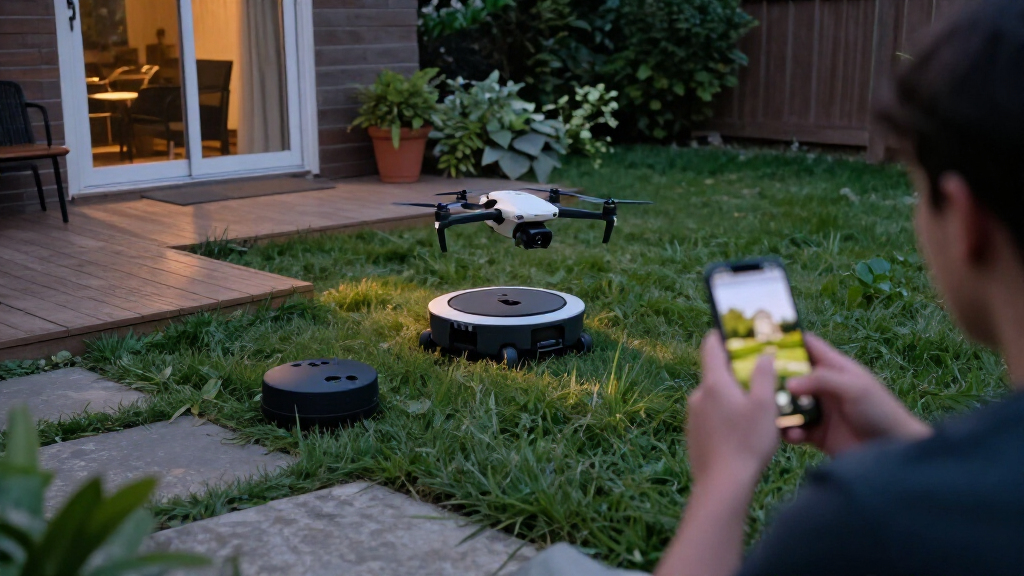
The Ring Drone Cam is designed to launch from a dock and fly along set routes, either on a schedule or on demand, Ring says. It can also take off when a connected Ring device detects an event. Ring lists a 148-degree field of view, 360-degree rotation, 2K video and two lights for dark areas. The company says its camera is off while the drone is docked. Its U.S. price is $249.99, with shipping listed for Jan. 27, 2027, but Ring says it has not received required Federal Communications Commission authorization and may not be sold until it does.
The Ring Rover Cam is a wheeled patrol device for businesses such as shops and offices. Ring says it can follow scheduled routes, travel to patrol points when another Ring device is triggered and make a 360-degree scan when it arrives. Its adjustable mast carries a periscope camera; other listed features include a siren, a light tower and two-way audio. Ring says Rover streams and records in up to 4K while moving or patrolling, and can begin recording when it detects motion even while docked. Ring lists the device at $999.99, with U.S. shipping scheduled for Dec. 16, 2026. Scheduled patrols require a compatible Ring Protect plan.
Both products use software Ring calls AI Pilot. The company says the system maps an area, recommends patrol points and steers around obstacles using cameras, vision models, sensors and cloud processing. Ring’s announcement describes the products’ intended functions, but independent testing and customers’ experience are not yet available. Reporting by The Verge says the drone’s processing relies on an internet connection; without Wi-Fi, it can only land. The Verge also reported estimates of about five to eight minutes of flight time for the drone and roughly 30 minutes of battery life for Rover.
Mobile cameras move to new spaces Home drone meets business patrol
Ring announced an indoor flying camera and a wheeled patrol robot. They can respond to alerts beyond a fixed camera’s view, while availability, privacy and real-world performance remain open questions.
Two devices, different spaces
Both can move toward a location after a connected Ring device detects an event.
Drone Cam
Flies set routes on a schedule or on demand, with a 2K camera and two lights. Ring says its camera is off while docked.
Rover Cam
Wheeled robot for shops and offices, with patrol routes, a periscope camera, siren, light tower and two-way audio.
What to know before buying
Listed capabilities and shipping plans have not yet been established through independent testing.
- Check alerts in areas beyond a fixed camera’s view.
- Rover can stream and record in up to 4K while moving or patrolling.
- Drone sales depend on required FCC authorization.
- Reporting says the drone relies on internet access; without Wi-Fi, it can only land.
- Scheduled Rover patrols require a compatible Ring Protect plan.
Privacy and trust matter
Mobile cameras can record in more places, so controls and data handling matter alongside image quality.
Ring says its TAKE option lets servers temporarily access keys for cloud features; full end-to-end encryption is optional.
The FTC filed a complaint against Ring in 2023 alleging access to private videos and inadequate protections. The supplied material does not detail the full outcome.
Mobile Cameras Change Where Security Goes
Unlike a fixed camera, a mobile device can be sent to a place that is not already covered by a lens. Ring’s pitch is that a homeowner or business can check an event across a room or along a route without installing a camera at every point. That could make the devices useful for checking an alert in a hallway, shop aisle or other area outside a fixed camera’s view.
The trade-off is that a camera capable of moving through a home or workplace can record in more locations than a stationary device. Recording behavior, user control and data handling therefore matter alongside image quality and patrol features. Businesses also need to weigh the Rover’s price, battery limits and single-floor operation against the area they want it to cover. Ring has not yet established through public, independent testing how reliably the products will navigate or respond to alerts in everyday use.
Products Worth Considering

Apple Mac mini Desktop Computer with M6 Chip (2026)

Canon PIXMA PRO-200S Wireless Professional Inkjet Photo Printer

HP DesignJet T650 Large Format 24‑inch Plotter Printer (5HB08T)
As an affiliate, we earn on qualifying purchases.
From Astro to Ring Robotics
Ring’s mobile-camera concept builds on earlier Amazon products and prototypes. Ring first previewed an indoor drone as the Always Home Cam in 2020; The Verge reported that founder Jamie Siminoff said development had begun in 2016. The new Drone Cam is the commercial product described in the Nov. 10 announcement, though its sale remains contingent on FCC authorization.
Rover also draws on Amazon’s experience with Astro for Business. Ring says it developed the device after hearing from Astro customers that they valued its ability to move around and monitor a space. The Verge reported that Amazon discontinued Astro for Business about a year after launching it in 2023. That history is relevant to customers considering Rover, but it does not establish how long Ring will support the new product.
Ring has also promoted a newer encryption option called Throw Away the Key (TAKE), announced Aug. 26, 2026. Ring says its servers temporarily access encryption keys for cloud functions, such as smart alerts, and then delete them. Full end-to-end encryption, in which only a customer’s devices hold the keys, remains an optional setting, according to the source material.
“For years, customers told us they wanted eyes in the places a fixed camera couldn’t reach, and peace of mind in the spots they’d never want one.”
— Jamie Siminoff, Ring founder and chief inventor, in Ring’s announcement
FCC Approval and Privacy Questions
The Drone Cam’s FCC authorization is unresolved in the supplied material. Ring says the device has not been authorized as required by FCC rules and may not be sold until that changes; the material does not give a decision date or explain what steps remain. Its listed January shipping date should therefore be read alongside that condition.
Some operational details are based on launch-event reporting rather than Ring’s announcement. Published estimates include short drone flight time, a loud buzzing sound and Rover coverage of around 5,000 square feet, but the source material does not establish these as independently verified performance results. Ring has not supplied enough information here to assess how its mapping performs in varied layouts, how the devices behave during outages, or how much video is stored and for how long.
Privacy claims also remain open to scrutiny. The FTC filed a complaint against Ring in May 2023 alleging that employees or contractors could access customers’ private videos and that the company had failed to provide basic protections. The supplied material does not detail the full outcome of that case. The EFF has criticized TAKE because Ring’s servers temporarily access keys for cloud features; full end-to-end encryption is optional, according to the material. Ring’s stated safeguards and its past record are separate facts that customers may weigh, not proof of how the new products will perform.
Sales Dates and Product Testing
Ring lists U.S. shipping for Rover Cam beginning Dec. 16, 2026, and for Drone Cam beginning Jan. 27, 2027. The drone’s sale depends on the required FCC authorization. The next clear milestones are whether that authorization is granted and whether Ring keeps the announced shipping schedule.
Once the products are available, independent testing and customer reports may clarify battery life, navigation, recording controls and performance when internet access is interrupted. Buyers will also need to check which Ring Protect plan supports scheduled patrols and review the devices’ privacy settings, including whether they want to use optional end-to-end encryption where available.
Key Questions
What does Ring’s Drone Cam do?
Ring says the indoor drone flies scheduled or on-demand routes and can take off when a connected Ring camera, sensor or alarm is triggered. It has a dock, a 2K camera and two lights for dark areas. Ring says its camera is off while it is docked.
What is the Ring Rover Cam for?
Rover Cam is a wheeled patrol robot for businesses. Ring says it follows scheduled routes, responds to alerts from other Ring devices, scans when it reaches a patrol point and records while moving or patrolling.
How much do the two devices cost?
Ring lists the Drone Cam at $249.99 and the Rover Cam at $999.99. Scheduled patrols require a compatible Ring Protect plan, according to the announcement.
When will Ring’s mobile cameras ship?
Ring lists U.S. shipping for Rover Cam beginning Dec. 16, 2026, and Drone Cam beginning Jan. 27, 2027. Ring says the drone may not be sold until it receives required FCC authorization.
What privacy protections does Ring describe?
Ring says the drone’s camera is off in its dock, Rover has a Sleep Mode that retracts its camera mast and turns off its microphone, and both devices show recording indicators. Ring also says videos use TAKE encryption; the supplied material says full end-to-end encryption remains an optional setting.
Source: ThorstenMeyerAI.com