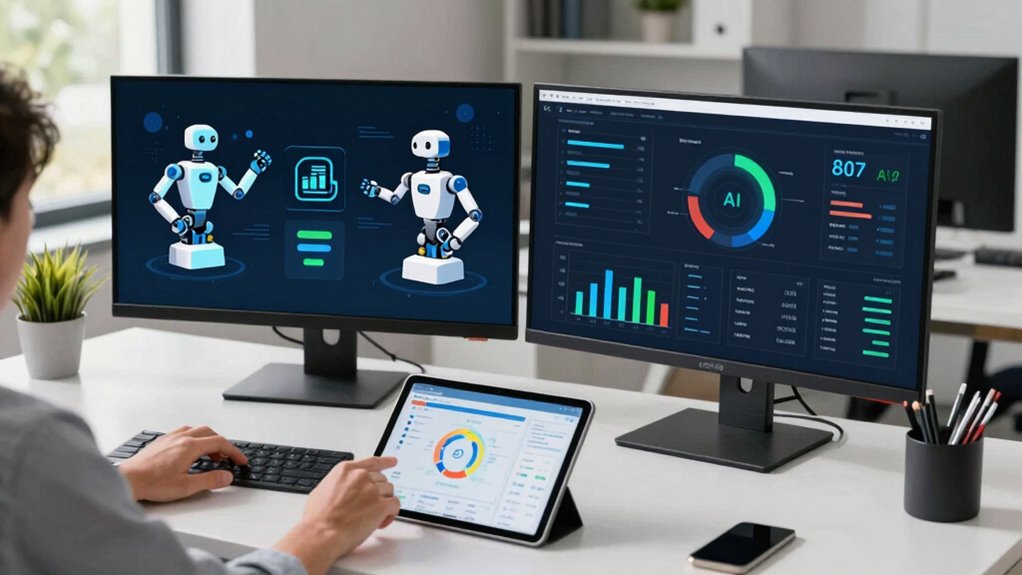

Choosing between RPA and AI agents for your small business isn’t just about automation—it’s about aligning the right tool with your needs. RPA handles simple, rule-based tasks quickly and affordably, while AI agents take on complex decision-making and customer interactions, often requiring a larger investment but offering broader capabilities. Understanding these differences helps you make smarter choices to boost efficiency, security, and growth. Keep exploring to discover how the right automation can truly transform your business.

Get business pricing on office and shipping supplies
- Business-only prices and quantity discounts
- Tax-exempt purchasing
- Multiple users, one account, clear invoices
Key Takeaways
- RPA is ideal for simple, rule-based tasks, while AI agents handle complex, adaptive decision-making processes.
- Small businesses should consider security risks, as AI processes more sensitive data compared to RPA.
- RPA offers quick, affordable automation for basic tasks; AI provides broader capabilities with higher initial costs.
- Choosing the right technology depends on task complexity, strategic goals, and long-term scalability needs.
- Proper automation selection enhances operational efficiency, security, and cost-effectiveness for small business growth.
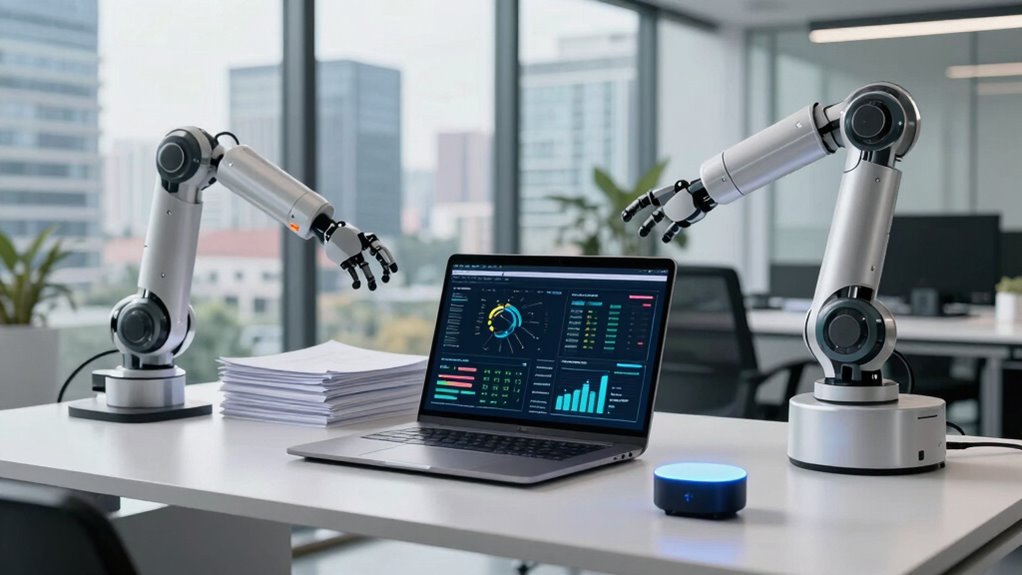
When it comes to automating tasks in small businesses, understanding the differences between Robotic Process Automation (RPA) and AI agents is essential. Both can streamline operations, but they do so in distinct ways that impact your business’s efficiency, security, and budget. RPA typically handles repetitive, rule-based tasks by mimicking human actions on digital systems. It’s like having a virtual worker that can copy and paste, extract data, or update records without needing much oversight. AI agents, on the other hand, are more advanced; they learn from data, adapt to new situations, and can make decisions independently. This makes AI suitable for tasks like customer interactions, insights generation, or complex problem-solving. Recognizing the differences helps you choose the right tool for your needs and avoid costly mistakes.
One of the key considerations in choosing between RPA and AI agents is data security. With RPA, since it operates based on predefined rules and scripts, security risks are generally lower. You control exactly what the software can access and do, reducing exposure to sensitive information. However, it’s still crucial to implement proper safeguards, especially if the RPA bots handle confidential data. AI agents, with their ability to process and analyze large data sets, may pose higher security challenges. They often require access to more extensive data repositories and may need sophisticated security protocols to prevent breaches. If you handle sensitive customer data, understanding how each technology manages data security becomes a vital part of your decision-making process. Additionally, implementing security protocols that align with your data handling needs helps safeguard both your business and your clients.
Cost analysis plays a significant role in determining which automation solution makes the most sense for your small business. RPA tools are usually more affordable upfront because they focus on automating straightforward, rule-based tasks. They can quickly deliver ROI by reducing manual labor. However, their scalability is limited; as tasks become more complex, you might need to invest in more RPA licenses or additional tools. AI agents, while often more expensive initially, offer broader capabilities that can justify the cost if your business needs complex decision-making or customer engagement. Over time, AI can reduce the need for multiple specialized tools, potentially lowering your overall automation expenses. Weighing these costs carefully—considering both initial investment and ongoing maintenance—will help you determine which approach aligns with your budget and growth plans.
In the end, understanding how RPA and AI agents differ in handling data security and cost analysis allows you to make smarter choices. Small businesses stand to gain tremendously from automation, but only if you select the right technology for your specific needs. Being clear about your priorities, security concerns, and financial constraints ensures you implement automation that truly benefits your business now and in the future.
Robotic Process Automation software for small business
As an affiliate, we earn on qualifying purchases.
As an affiliate, we earn on qualifying purchases.
Frequently Asked Questions
How Do RPA and AI Agents Differ in Handling Complex Tasks?
You’ll find that RPA handles simple, repetitive tasks efficiently but struggles with complex ones, especially those involving nuanced decision-making processes. AI agents, on the other hand, excel at managing complex tasks because they can analyze data, adapt, and make decisions based on context. So, when task complexity increases, AI agents become more effective, handling decision-making processes that require understanding, learning, and more sophisticated problem-solving.
What Are the Initial Costs of Implementing RPA Versus AI Agents?
Thinking back to when automations were just a pipe dream, today you’ll find RPA usually costs less upfront, with lower initial investments. AI agents, however, often demand higher costs due to advanced technology and customization needs. When considering the cost comparison, scalability factors come into play—RPA scales easily for repetitive tasks, while AI adapts better to complex, evolving processes, making initial costs a key decision point.
Can Small Businesses Integrate RPA and AI Agents Simultaneously?
Yes, you can integrate RPA and AI agents simultaneously, but be prepared for integration challenges and scalability concerns. You’ll need to guarantee your systems communicate effectively and handle increased workloads as your automation grows. Start small, test thoroughly, and plan for future expansion. Properly managing these aspects helps you maximize benefits without overwhelming your resources or creating bottlenecks in your automation processes.
How Do Maintenance and Updates Compare Between RPA and AI Systems?
Imagine your automation system as a garden; RPA systems need regular pruning and weeding, while AI systems require tending to their ever-evolving branches. RPA maintenance is straightforward, focusing on updates to workflows, but AI demands ongoing training to stay relevant. Both systems prioritize system scalability and data security, but AI’s updates are more complex, requiring careful management to safeguard sensitive data and guarantee smooth growth.
What Skills Are Needed to Manage RPA and AI Automation Tools?
To manage RPA and AI automation tools effectively, you need strong skill development in areas like programming, process analysis, and troubleshooting. User training is essential, so you can understand how to operate and optimize these systems. You should also stay updated on new features and best practices. Developing these skills guarantees you can maintain, troubleshoot, and improve automation tools, keeping your small business running smoothly and efficiently.
Conclusion
Ultimately, understanding whether RPA or AI agents suit your small business isn’t just about technology—it’s about boosting your efficiency and growth. The truth is, combining both can release more powerful automation than either alone. So, don’t just choose one; explore how integrating RPA’s reliability with AI’s intelligence can transform your operations. Embrace the right tools, and you’ll find your business running smoother, smarter, and more competitive in today’s fast-paced landscape.
Fall Picks
fall essentials
As an affiliate, we earn on qualifying purchases.