

Nano-sensors are tiny devices that detect and measure changes at the molecular level, offering incredible potential for healthcare, environmental monitoring, and industry. With advances in materials like graphene and carbon nanotubes, these sensors become more sensitive, durable, and capable of accessing hard-to-reach environments. Combining quantum detection techniques with new materials pushes their capabilities further, opening up exciting possibilities. Keep exploring to discover how these small devices are making a big difference everywhere.
Key Takeaways
- Nano-sensors are ultra-small devices capable of detecting molecular-level changes in various environments.
- Integration of quantum detection enhances their sensitivity and accuracy for critical applications.
- Advanced materials like graphene and nanowires improve performance, durability, and miniaturization.
- Manufacturing challenges are being addressed to enable scalable, stable, and practical deployment.
- These sensors are transforming healthcare, environmental monitoring, and industrial processes with their precision.
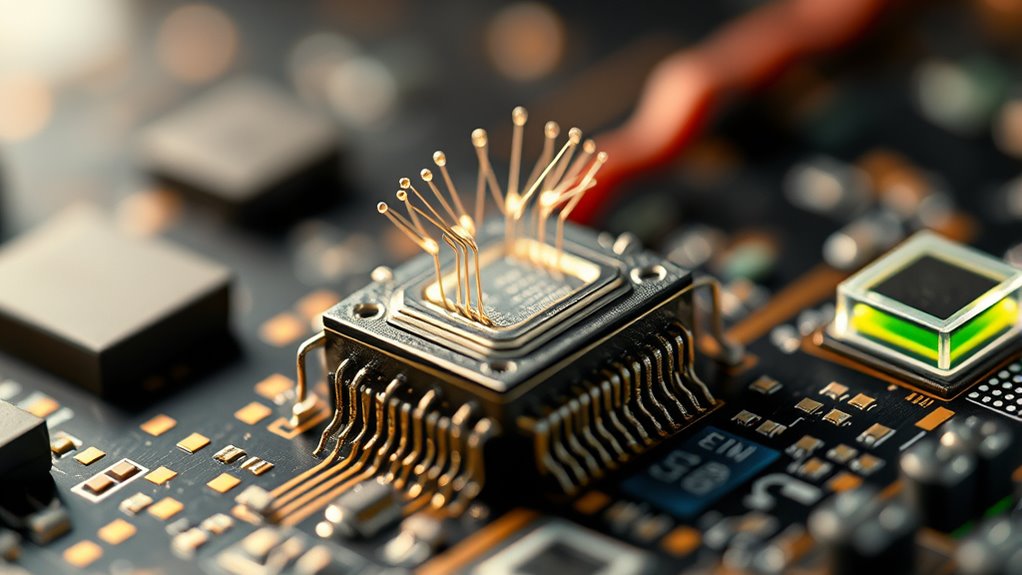
Nano-sensors are tiny devices that can detect and measure physical, chemical, or biological changes at the molecular level. Their small size allows them to access environments and detect signals that would be impossible for larger sensors. These devices leverage advanced technology like quantum detection, which enhances their sensitivity and accuracy. Quantum detection uses principles of quantum mechanics to observe minute changes in energy or particles, making nano-sensors incredibly precise. This capability enables applications in medical diagnostics, environmental monitoring, and industrial processes, where detecting subtle variations can be vital. Additionally, ongoing research into sensor calibration ensures the reliability and accuracy of nano-sensors in real-world conditions.
Material innovation plays a significant role in advancing nano-sensor technology. Researchers are constantly exploring new materials, such as graphene, carbon nanotubes, and nanowires, to improve sensor performance. These materials offer exceptional electrical, thermal, and mechanical properties, which translate into higher sensitivity, faster response times, and greater durability. For example, graphene’s remarkable conductivity and strength make it ideal for detecting trace chemicals or biomolecules at low concentrations. Material innovation also helps miniaturize sensors further, making them more versatile and easier to integrate into existing systems.
When you consider the potential of quantum detection combined with innovative materials, the possibilities expand exponentially. Imagine sensors that can detect cancer biomarkers at very early stages or monitor pollutants in the environment with unprecedented accuracy. These nano-devices can be embedded into wearable health monitors, smart packaging, or even embedded in the infrastructure itself to provide real-time data. The integration of cutting-edge materials ensures these sensors are not only highly sensitive but also robust enough to operate in challenging conditions. This combination of quantum detection and material innovation pushes the boundaries of what’s feasible with nano-sensors.
The development of nano-sensors also involves overcoming challenges related to manufacturing and stability. Advances in nanofabrication techniques, driven by material innovation, allow for scalable production while maintaining precision. Researchers focus on guaranteeing that these tiny devices remain stable over time and under different conditions, which is essential for their practical deployment. As you explore this field, you’ll see that continuous innovation in materials and quantum detection techniques is key to unlocking the full potential of nano-sensors across various industries.
In essence, nano-sensors are transforming how we monitor and understand the world around us. By harnessing the power of quantum detection and material innovation, these tiny devices deliver big results, opening new frontiers in science, healthcare, and environmental stewardship. Their ability to operate at the molecular level, combined with ongoing technological breakthroughs, means their impact will only grow, shaping a smarter, more responsive future.
Frequently Asked Questions
How Do Nano-Sensors Communicate Data Wirelessly?
You can imagine nano-sensors communicating data wirelessly through wireless transmission, where they send signals to a receiver. They use signal modulation to encode information onto electromagnetic waves, allowing data transfer over short or long distances. As you work with these tiny devices, you’ll notice they often employ techniques like radio frequency or infrared signals, enabling seamless, real-time data exchange even in challenging environments.
What Are the Main Challenges in Nano-Sensor Manufacturing?
Think of building nano-sensors as challenging as Daedalus’s labyrinth. You face scaling challenges, making it tough to produce these tiny devices consistently. Material limitations also hinder progress, as not all materials behave well at such a small scale. You must carefully select and manipulate materials, overcoming hurdles to guarantee functionality and durability. These obstacles demand innovative solutions, pushing the boundaries of current manufacturing capabilities in nano-technology.
Are Nano-Sensors Biodegradable or Environmentally Friendly?
You should know that nano-sensors aren’t inherently biodegradable or environmentally friendly. Biodegradability concerns arise because some nano-sensors contain materials that persist in the environment, potentially causing harm. Researchers are actively working on developing eco-friendly nano-sensors with minimal environmental impact, but it is crucial to evaluate each sensor’s composition. By prioritizing biodegradable materials, we can reduce environmental impact and ensure these tiny devices support sustainable development.
How Do Nano-Sensors Enhance Medical Diagnostics?
Nano-sensors enhance medical diagnostics by enabling precise, real-time monitoring of biological signals. In biomedical applications, they detect early signs of disease with high sensitivity, allowing for timely intervention. You benefit from faster, more accurate diagnoses, which can improve treatment outcomes. These tiny devices can track biomarkers and physiological changes at the cellular level, making early disease detection more effective and personalized, ultimately transforming healthcare and patient care.
What Is the Cost Comparison Between Nano-Sensors and Traditional Sensors?
You’ll find that nano-sensors generally have higher manufacturing costs compared to traditional sensors due to their complex fabrication processes. However, their precision and ability to detect minute changes often lead to cost savings in medical diagnostics and other applications. Over time, as production scales up, the cost comparison may favor nano-sensors, making them more affordable and accessible, especially given their enhanced performance and smaller size.
Conclusion
Imagine these tiny sensors as microscopic detectives patrolling your body and environment, quietly recording vital clues. Their small size hides their powerful impact, like silent guardians working behind the scenes. As they weave through cells or drift through air, they open new possibilities for health and safety. With each tiny device, you’re witnessing a future where innovation is as delicate as a whisper, yet as impactful as a giant leap forward. Tiny, but mighty—these nano-sensors are changing everything.