
When choosing a business structure in Germany, you need to contemplate your liability, tax situation, and growth plans. A sole proprietorship is simple and low-cost but offers no liability protection. GmbH provides limited liability and added credibility, while partnerships like OHG and KG offer flexible arrangements with varying liability levels. Carefully weigh your financial capacity and business goals, as the right choice can set a strong foundation for success. Keep exploring to find the perfect fit for your future.
Key Takeaways
- Assess your liability risk and choose between sole proprietorship, partnership, or GmbH for appropriate personal and legal protection.
- Consider your initial capital availability, as GmbH requires a minimum of €25,000 in share capital.
- Evaluate your tax implications; sole proprietorship profits are taxed as personal income, while GmbH profits face corporate taxes.
- Match your business goals and growth plans with the structure’s credibility, flexibility, and legal obligations.
- Consult legal and tax professionals to ensure the chosen structure aligns with long-term objectives and compliance requirements.
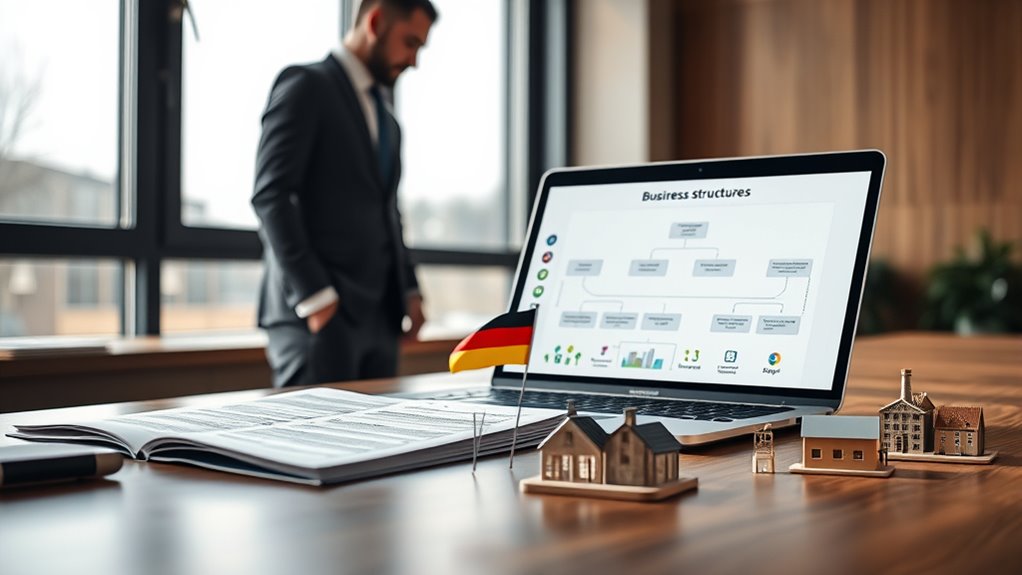
Selecting the right business structure in Germany is a crucial step that can considerably impact your company’s legal obligations, taxation, and growth potential. When choosing, you need to carefully consider how different structures will affect your tax implications and liability considerations. Your choice influences not only how much you pay in taxes but also how much personal risk you assume and how your business is perceived legally.
Choosing the right business structure in Germany impacts taxes, liability, and your company’s legal standing.
If you opt for a sole proprietorship, you’ll find that setting up is straightforward and costs are minimal. However, you should be aware that liability considerations are significant here. As a sole proprietor, you’re personally responsible for all debts and obligations, which means your personal assets are at risk if the business faces financial trouble. On the upside, tax implications are relatively simple since profits are taxed as personal income, but this can become a disadvantage if your income grows substantially because you’ll be taxed at higher personal rates.
In contrast, forming a GmbH (Gesellschaft mit beschränkter Haftung) offers limited liability protection, which can be a major advantage if you want to shield your personal assets. This structure requires a minimum share capital of €25,000, but it provides credibility and can make it easier to attract investors or partners. When it comes to tax implications, a GmbH is taxed separately from its owners, meaning corporate taxes apply, and profits are subject to corporate income tax and trade tax. While this might result in higher overall taxes compared to a sole proprietorship, the liability considerations are far more favorable, as your personal assets are generally protected from business liabilities. Additionally, choosing the appropriate business structure can influence business growth potential through legal and financial flexibility.
Another option, the partnership (OHG or KG), combines features of both sole proprietorships and corporations. Partnerships can be easier and less costly to establish than a GmbH, but liability considerations can vary. In an OHG, all partners are personally liable, which can expose your personal assets to business debts. Conversely, a KG can limit liability for certain partners, offering a balance between flexibility and protection. Tax implications for partnerships are also different; profits pass through to individual partners and are taxed as personal income, which might be advantageous depending on your income level and other factors.
Ultimately, your decision should balance tax implications and liability considerations carefully. Your business goals, financial capacity, and risk appetite all play a role. Consulting with a legal or tax professional familiar with German business law will ensure you choose a structure that aligns with your plans and offers the right mix of protection, tax efficiency, and growth potential.
Frequently Asked Questions
How Does Tax Liability Differ Between Gmbh and UG?
You’ll find that a GmbH offers more tax advantages, especially with its lower corporate tax rate, while the UG has higher tax liabilities due to its smaller profit threshold. Profit distribution in a GmbH can be more flexible, allowing you to reinvest or distribute profits efficiently. With a UG, you might face higher personal tax on retained earnings, making it less advantageous for long-term growth.
What Are the Ongoing Compliance Requirements for a Sole Proprietorship?
Are you ready for ongoing compliance? As a sole proprietor, you must obtain the necessary business licensing and make certain you keep thorough records of income, expenses, and transactions. You’ll need to regularly file taxes and submit financial statements. Do you want to avoid penalties? Staying organized with your record keeping and renewing your licenses on time keeps your business compliant and running smoothly.
Can I Switch Business Structures Later Without Penalties?
Yes, you can switch business structures later without penalties, but it involves structural changes that can be complex. Business flexibility allows you to adapt as your company grows or your needs change, but you’ll need to follow legal procedures, update registrations, and possibly face tax implications. Planning ahead and consulting with legal or financial experts guarantees a smooth transition and helps you avoid unexpected costs or compliance issues.
What Are the Initial Registration Costs for Each Structure?
The initial costs and registration fees vary depending on your chosen structure. For a sole proprietorship, expect to pay lower registration fees, often around a few hundred euros. A GmbH usually requires higher initial costs, including notary fees and a minimum share capital of €25,000. An AG has even steeper registration fees and capital requirements. Always budget for these initial costs to make certain of smooth registration and compliance.
How Does Business Liability Vary Across Different German Structures?
You might think personal liability is the same across all structures, but it varies. In a sole proprietorship, you’re personally liable for debts, risking your assets. A GmbH offers corporate protections, limiting your liability to your business investment, shielding your personal assets. An AG provides similar protections but is suited for larger companies. Understanding these differences helps you choose a structure that aligns with your risk and liability preferences.
Conclusion
Choosing the right business structure in Germany can set the foundation for your success. Remember, “A journey of a thousand miles begins with a single step,” so take the time to pick the option that aligns with your goals. Whether you opt for a GmbH, sole proprietorship, or partnership, making informed decisions now will pay off later. Trust your instincts, plan carefully, and you’ll be on your way to building a thriving business.