

Sustainability metrics and impact measurement help you evaluate how effectively your organization reduces its environmental footprint and promotes social responsibility. By applying a life cycle approach, you can identify impacts at each stage, from raw materials to disposal, and track progress using key indicators like waste diversion and carbon footprint. Incorporating circular economy principles encourages resource efficiency and waste minimization. Continuing will reveal how integrating these tools guides system-wide improvements and long-term sustainability success.
Key Takeaways
- Implement comprehensive life cycle assessments to evaluate environmental impacts across all product or service stages.
- Adopt circular economy metrics such as material reuse, recycling rates, and waste reduction to track resource efficiency.
- Set clear sustainability targets and monitor progress using quantifiable indicators like carbon footprint and waste diversion.
- Integrate impact measurement into reporting frameworks to ensure transparency and stakeholder accountability.
- Use continuous evaluation to identify improvement opportunities, fostering system-wide sustainable practices.
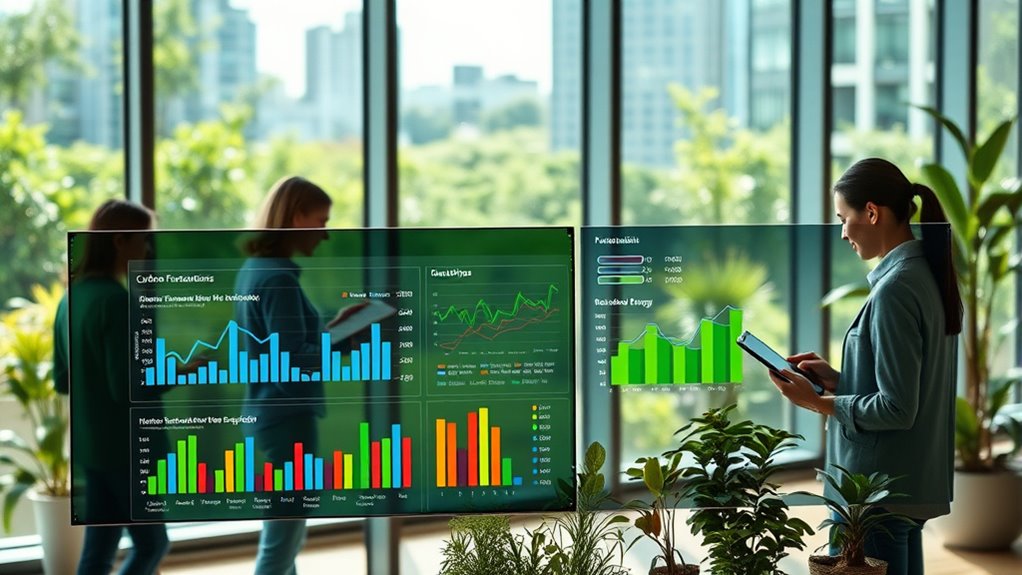
Sustainability metrics and impact measurement are essential tools for evaluating how effectively organizations are reducing their environmental footprint and promoting social responsibility. When you focus on these tools, you’re better equipped to understand the true impact of your operations and identify areas for improvement. One key aspect of impact measurement involves analyzing the entire life cycle of your products or services. By examining every stage—from raw material extraction to manufacturing, distribution, use, and disposal—you gain a thorough view of where environmental impacts occur and how they can be minimized. This life cycle approach helps you avoid shifting problems from one phase to another and ensures your sustainability efforts are holistic and effective.
In addition to life cycle assessment, adopting a circular economy mindset can considerably enhance your sustainability metrics. The circular economy emphasizes designing out waste, keeping products and materials in use longer, and regenerating natural systems. When you incorporate this approach into your impact measurement, you move beyond traditional linear models of take-make-dispose. Instead, you focus on creating closed-loop systems where materials are reused, repurposed, or recycled, reducing the need for virgin resources and lowering greenhouse gas emissions. Measuring your progress toward a circular economy can involve tracking material flows, recycling rates, and the durability of your products. This way, you not only improve environmental outcomes but also demonstrate social responsibility by minimizing waste and promoting resource efficiency.
Using these metrics, you can set clear targets and monitor progress over time, making your sustainability initiatives more transparent and accountable. For example, you might quantify how much waste you divert from landfills or how your supply chain reduces its carbon footprint through circular practices. These measurements serve as concrete evidence of your commitment and help you communicate your achievements to stakeholders, investors, and customers. Furthermore, by continuously evaluating the life cycle impacts and circular economy indicators, you can identify innovations that reduce costs and environmental risks while increasing resilience. Incorporating standardized metrics ensures consistency and comparability across different initiatives and organizations.
In the end, integrating life cycle analysis and circular economy principles into your impact measurement framework guarantees a more accurate and meaningful assessment of your sustainability performance. It allows you to focus on system-wide improvements rather than isolated actions, fostering a mindset that values long-term environmental health and social well-being. By doing so, you not only meet regulatory requirements and stakeholder expectations but also position your organization as a responsible leader in sustainability, capable of adapting to the evolving demands of a resource-constrained world.
Frequently Asked Questions
How Do Companies Choose the Right Sustainability Metrics?
You choose the right sustainability metrics by focusing on your supply chain and carbon footprint. First, identify the areas where your company has the most environmental impact, such as transportation or sourcing. Then, select metrics that accurately track these impacts, like emissions reduction or supply chain transparency. Make sure your chosen metrics align with your business goals and can be reliably measured over time to gauge progress effectively.
What Are the Challenges in Standardizing Impact Measurement?
Did you know that over 60% of organizations struggle with impact measurement? The main challenge is achieving data consistency across different sources, which makes comparison difficult. You also face hurdles in incorporating qualitative assessment alongside quantitative data, leading to incomplete pictures of true impact. Standardizing impact measurement requires aligning these diverse data types and ensuring reliability, so you can genuinely track progress and make informed decisions efficiently.
How Can Smaller Organizations Implement Effective Sustainability Metrics?
You can implement effective sustainability metrics by starting with your organization’s carbon footprint, tracking emissions, energy use, and waste. Engage stakeholders early to identify relevant goals and gather diverse insights. Use simple, measurable indicators to monitor progress regularly, adjusting strategies as needed. This approach keeps your efforts focused, transparent, and impactful, helping you demonstrate sustainability commitments and foster trust among stakeholders.
What Role Does Technology Play in Impact Measurement?
Technology plays a pivotal role in impact measurement by enabling you to leverage data analytics and digital tools to track and analyze your sustainability efforts. These tools help you gather real-time data, identify trends, and assess your progress more accurately. By using technology, you can make informed decisions, optimize your strategies, and demonstrate your impact effectively, making your sustainability initiatives more transparent and impactful.
How Do Sustainability Metrics Influence Investor Decisions?
You see, 78% of investors now prioritize sustainability metrics when making decisions, showing how crucial they are. These metrics influence your choices by highlighting green finance opportunities and eco labeling, making sustainable investments more appealing. They help you assess risks, identify environmentally responsible companies, and align your portfolio with your values. Ultimately, strong sustainability metrics guide you toward investments that are both profitable and environmentally conscious.
Conclusion
Think of sustainability metrics like a GPS guiding your journey—without them, you’re lost in the dark. When you measure impact accurately, it’s like planting seeds and watching a garden grow, each data point a bloom of progress. For example, companies tracking their carbon footprint saw a 20% reduction within a year. By embracing these metrics, you steer your efforts toward lasting change, turning small steps into a thriving, sustainable future.