
📊 Full opportunity report: How GLP-1 Pharmacy Data Can Clarify Access And Pricing on IdeaNavigator AI — validation score, market gap, and execution plan.

Get business pricing on office and shipping supplies
- Business-only prices and quantity discounts
- Tax-exempt purchasing
- Multiple users, one account, clear invoices
TL;DR
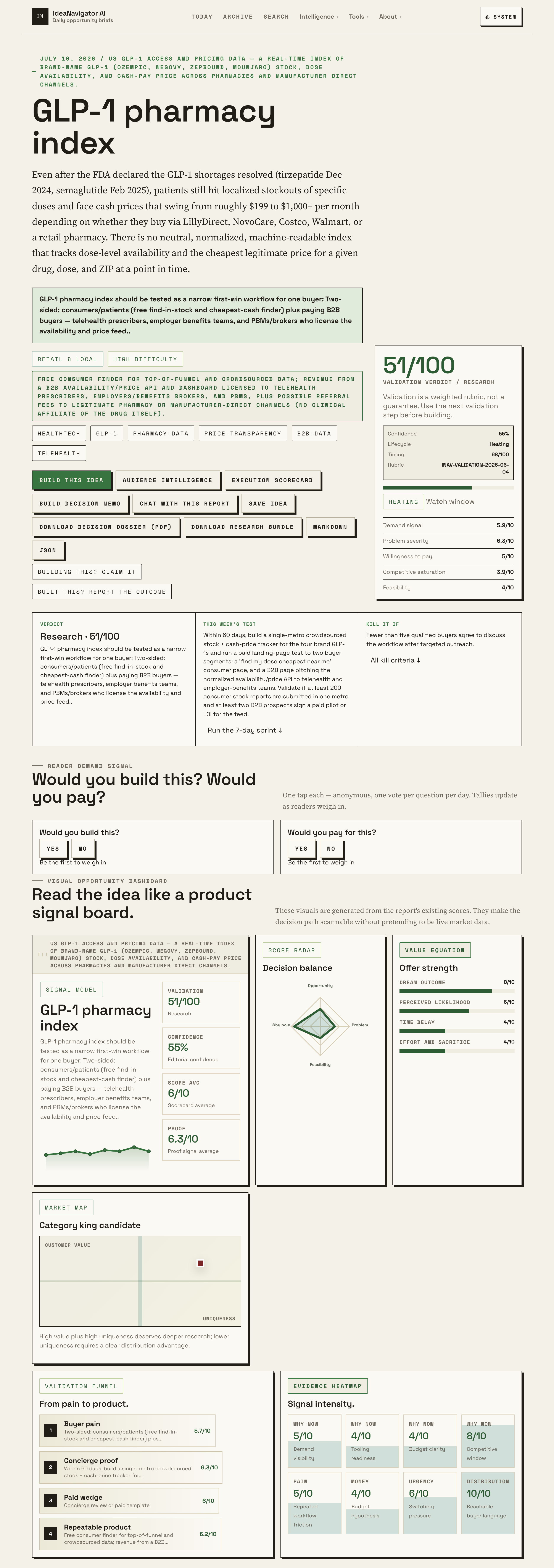
IdeaNavigator AI describes a proposed GLP-1 pharmacy index that would compare dose-level availability and cash prices by ZIP code. The concept is at the proposal stage; its suggested 60-day test would need to establish whether patients contribute useful reports and whether business buyers pay for the data.
GLP-1 pharmacy index that would track which doses of four branded drugs are available and compare legitimate cash prices by ZIP code. The concept pairs a free consumer search tool with paid data services for telehealth providers, employers and pharmacy benefit managers; it remains a proposal, with no operating product or demonstrated customer demand reported.
The proposed index would cover Ozempic, Wegovy, Zepbound and Mounjaro. Patients would be able to search by drug, dose and ZIP code for reported stock and cash prices, and could sign up for dose availability alerts. The proposed price data would draw on manufacturer direct programs, including LillyDirect and NovoCare, as well as Costco, Walmart and pharmacy discount listings. The proposal does not describe agreements with those companies or explain how often their prices and stock would be checked.
On the business side, the idea is to license a normalized availability and price feed or dashboard to telehealth prescribers, employer benefits teams, brokers and pharmacy benefit managers. IdeaNavigator AI also suggests possible referral fees from legitimate pharmacy or manufacturer-direct channels. It frames the consumer service as free and says revenue would come primarily from business subscriptions, rather than clinical referrals tied to the drugs.
The suggested initial test would cover a single metro area and run for 60 days. Its proposed benchmarks are at least 200 consumer stock reports and paid pilots or letters of intent from at least two business prospects. Those figures are validation targets in the proposal; no results, signed customers or pilot commitments are reported.
A Shift From Shortages to Price Gaps
In its proposal, IdeaNavigator AI says patients may need to check multiple pharmacies and direct-purchase programs to find a specific dose and cash price. The proposed search tool would bring reported availability and price information together. Its usefulness would depend on whether listings are current, accurate and clearly qualified.
IdeaNavigator AI proposes that employers and other health buyers could use the feed to compare local supply and cash prices when evaluating access and spending. The company says GLP-1 medicines account for roughly 20% of pharmacy spend in employer reporting, but its material does not identify the employers, time period or calculation behind that figure. The estimate is attributed to IdeaNavigator AI and is not established as a universal measure.
The proposal describes an index of price and reported supply. A listing would not establish that a medicine is clinically appropriate, covered by insurance or available to a particular patient. The material does not describe the index as a prescribing service or a replacement for pharmacy confirmation.
Why Pharmacy Data Is Fragmented
IdeaNavigator AI’s proposal says the FDA declared shortages of tirzepatide resolved in December 2024 and semaglutide in February 2025. The company argues that the end of those national shortage listings did not eliminate local gaps for particular doses. Its material also cites the end of compounding transition periods and the growth of manufacturer and retailer cash-pay channels as reasons prices and availability are spread across more sources.
IdeaNavigator AI cites monthly cash prices ranging from about $199 to more than $1,000, depending on the drug, dose and purchase channel. Its material gives no date, product-by-product breakdown or consistent comparison method for that range. Prices may depend on eligibility, dose, location and program terms, so the cited figures do not establish what an individual patient would pay.
The proposal names LillyDirect, NovoCare, Costco and Walmart as channels to monitor, and references a TrumpRx portal in February 2026. It provides no portal pricing or explanation of the portal’s relationship to pharmacy listings. IdeaNavigator AI says the market lacks a single neutral, machine-readable index combining dose-level availability and cash prices. The proposal provides no independent market survey to substantiate that claim.
Data Quality and Demand Remain Open
No product launch, live inventory feed, pharmacy partnership or completed test is described. It remains unclear whether consumers will submit enough reliable stock reports to make a single-metro index useful, and how the service would distinguish a recent confirmation from a report that has gone stale.
The proposal also leaves open how listed prices would be verified and compared. Cash offers may carry eligibility rules or other conditions, while prices and dose availability can change quickly. It does not specify how the index would handle insurance prices, shipping, pharmacy eligibility, geographic coverage, duplicate reports or corrections. Business buyers’ willingness to pay is likewise unconfirmed; the proposed pilot targets are tests, not evidence of sales.
A 60-Day Local Pilot
IdeaNavigator AI recommends starting with one metro, collecting crowdsourced reports for the four branded drugs and normalizing publicly available cash prices. The next stated milestones are the 200-report threshold and paid pilots or letters of intent from two business prospects within 60 days. The proposal gives no calendar start date, so it is not possible to identify when that period would end.
If a pilot proceeds, its results could indicate whether the data is fresh enough for consumers and whether a business buyer is willing to pay for it. IdeaNavigator AI provides no launch announcement, participating metro, named customer or subsequent milestone.
Source: IdeaNavigator AI
Key Questions
Has the GLP-1 pharmacy index launched?
No launch is reported. IdeaNavigator AI describes a proposal for a consumer finder and a paid data feed for business buyers.
Which medicines would it track?
The proposed index would cover Ozempic, Wegovy, Zepbound and Mounjaro, with searches organized by dose and ZIP code.
How would the service make money?
The proposal suggests licensing an availability and price feed or dashboard to telehealth providers, employers, brokers and pharmacy benefit managers. It also mentions possible referral fees from legitimate pharmacy or manufacturer-direct channels.
What would count as an initial test?
The suggested 60-day, single-metro test would seek at least 200 consumer stock reports and paid pilots or letters of intent from at least two business prospects. These are proposed targets, not reported results.
Source: IdeaNavigator AI
Halloween Picks
halloween
As an affiliate, we earn on qualifying purchases.