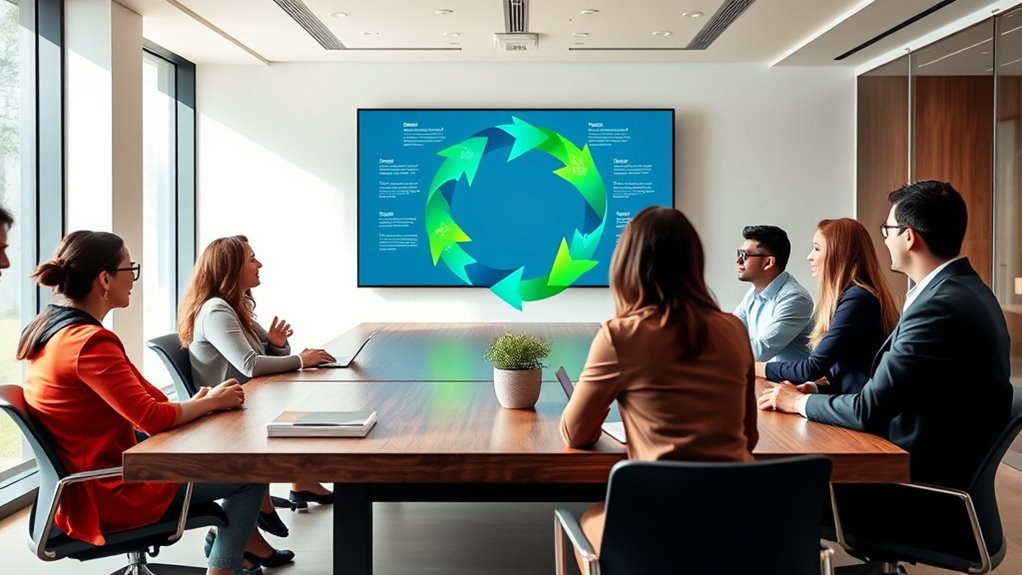

To integrate circular economy principles into your business strategy, focus on designing products that are repairable, upgradeable, and recyclable to extend their lifecycle and minimize waste. Emphasize resource efficiency at every stage, from sourcing to manufacturing and distribution, and adopt models like product-as-a-service. Communicate your commitment to sustainability to strengthen customer trust and gain a competitive edge. As you explore further, you’ll discover how these strategies can transform your business into a more resilient and eco-friendly enterprise.

Get business pricing on office and shipping supplies
- Business-only prices and quantity discounts
- Tax-exempt purchasing
- Multiple users, one account, clear invoices
Key Takeaways
- Embed circular principles into core business strategies to proactively adapt to sustainability trends and regulatory changes.
- Incorporate eco design innovation to enhance resource efficiency and reduce environmental impact across product lifecycles.
- Develop product-as-a-service models and leasing options to promote reuse, extend product lifespans, and foster customer loyalty.
- Establish closed-loop supply chains and sustainable sourcing to minimize waste and optimize resource utilization.
- Communicate sustainability commitments clearly to build brand trust, differentiate in the market, and attract eco-conscious consumers.

The circular economy is transforming the way businesses operate by emphasizing resource efficiency and sustainability. As you rethink your company’s approach, you realize that integrating circular principles isn’t just about waste reduction—it’s about designing smarter, more sustainable products from the ground up. Eco design innovation becomes a key strategy here, encouraging you to develop products that are easier to repair, upgrade, or recycle. This shift in mindset pushes you to consider every stage of a product’s lifecycle, ensuring that materials are kept in use longer and that waste is minimized from the outset.
By adopting eco design innovation, you create products that align with circular economy goals, reducing raw material consumption and energy use. You focus on selecting sustainable materials, designing for disassembly, and minimizing toxic components. This approach not only improves your environmental footprint but also offers a competitive edge, as customers increasingly value eco-friendly products. Moreover, prioritizing resource efficiency means you streamline your operations—reducing waste, optimizing supply chains, and lowering costs. When resources are used more efficiently, you can produce more with less, which benefits both your bottom line and the planet.
Eco design innovation reduces resource consumption, boosts competitiveness, and streamlines operations for a more sustainable business model.
Incorporating resource efficiency into your business strategy requires a mindset shift. You start examining your processes, from sourcing raw materials to manufacturing and distribution, identifying areas where waste can be reduced or materials reused. This might involve implementing closed-loop systems where waste products are recycled back into your production cycle, or choosing suppliers committed to sustainable practices. As you do this, you empower your team to innovate continuously, finding new ways to maximize resource use and minimize environmental impact. Developing a comprehensive understanding of your resource flows ensures you can identify the most effective opportunities for improvement.
Additionally, integrating circular economy principles encourages you to explore product-as-a-service models or leasing arrangements, which promote ongoing ownership and reuse rather than one-time sales. This approach fosters closer relationships with customers, who benefit from maintenance and upgrades, extending product lifespans. You’ll also need to communicate your commitment to resource efficiency and eco design innovation, building trust and loyalty among eco-conscious consumers.
Ultimately, embedding these principles into your business strategy requires a proactive mindset and a willingness to adapt. By focusing on resource efficiency and eco design innovation, you position your company as a leader in sustainability, prepared for future regulations and market shifts. As you embrace the circular economy, you turn environmental responsibility into a driver of innovation, growth, and resilience—ensuring your business thrives in a more sustainable world.
eco-friendly product design tools
As an affiliate, we earn on qualifying purchases.
As an affiliate, we earn on qualifying purchases.
Frequently Asked Questions
How Can Small Businesses Implement Circular Economy Strategies Effectively?
You can start by analyzing your product lifecycle to identify opportunities for reuse, recycling, or refurbishing. Engage your customers by promoting sustainable practices and encouraging return or recycling programs. Partner with local suppliers to reduce waste and improve resource efficiency. Educate your team about circular principles and integrate them into your daily operations. By actively involving customers and optimizing your product lifecycle, you’ll make your small business more sustainable and resilient.
What Are the Initial Costs Associated With Transitioning to Circular Economy Models?
The initial costs of shifting to circular economy models include an upfront investment in new equipment, technology, and training. You’ll also face change expenses like redesigning products and modifying supply chains. These costs might seem high at first, but they often lead to long-term savings through resource efficiency and waste reduction. Preparing for these expenses helps you smoothly adopt circular practices and reap environmental and financial benefits over time.
How Do Circular Economy Principles Impact Supply Chain Management?
Imagine redesigning your supply chain like Patagonia, focusing on waste reduction and resource optimization. Circular economy principles encourage you to reuse materials, extend product life, and source sustainably, which streamlines operations. You’ll reduce waste, lower costs, and improve efficiency. These principles also foster partnerships for closed-loop systems, making your supply chain more resilient and eco-friendly. Ultimately, adopting circular strategies transforms your supply chain into a sustainable, resource-efficient network.
What Metrics Are Best for Measuring Circular Economy Success?
You should focus on metrics like material flow efficiency and resource efficiency to measure circular economy success. Track how materials are reused, recycled, or repurposed to reduce waste. Measure resource efficiency by evaluating how well you minimize raw material consumption while maintaining output. These indicators give you clear insights into your progress toward sustainability goals and help optimize processes for a more circular, eco-friendly business model.
How Do Regulatory Policies Influence Circular Economy Adoption?
Think of regulatory policies as the traffic lights guiding your journey toward a circular economy. When regulatory incentives are clear, like tax breaks for recycling initiatives, you’re encouraged to adopt sustainable practices. However, policy barriers—such as complex compliance rules—can slow you down or derail progress. You must navigate these policies carefully, leveraging incentives and advocating for streamlined regulations to accelerate your shift to circularity.
Conclusion
By embracing circular economy principles, you’ll revolutionize your business—turning waste into wealth and scarcity into endless abundance. Think about it: your company could become so sustainable, it could single-handedly save the planet! With every product redesigned and every resource reused, you’re not just staying ahead; you’re rewriting the rules of business itself. So, jump in now—because the future belongs to those bold enough to make the impossible, possible!
Halloween Picks
halloween
As an affiliate, we earn on qualifying purchases.