📊 Full opportunity report: Backyard Home Reports: Exploring The ADU Landscape on IdeaNavigator AI — validation score, market gap, and execution plan.

Get business pricing on office and shipping supplies
- Business-only prices and quantity discounts
- Tax-exempt purchasing
- Multiple users, one account, clear invoices
TL;DR
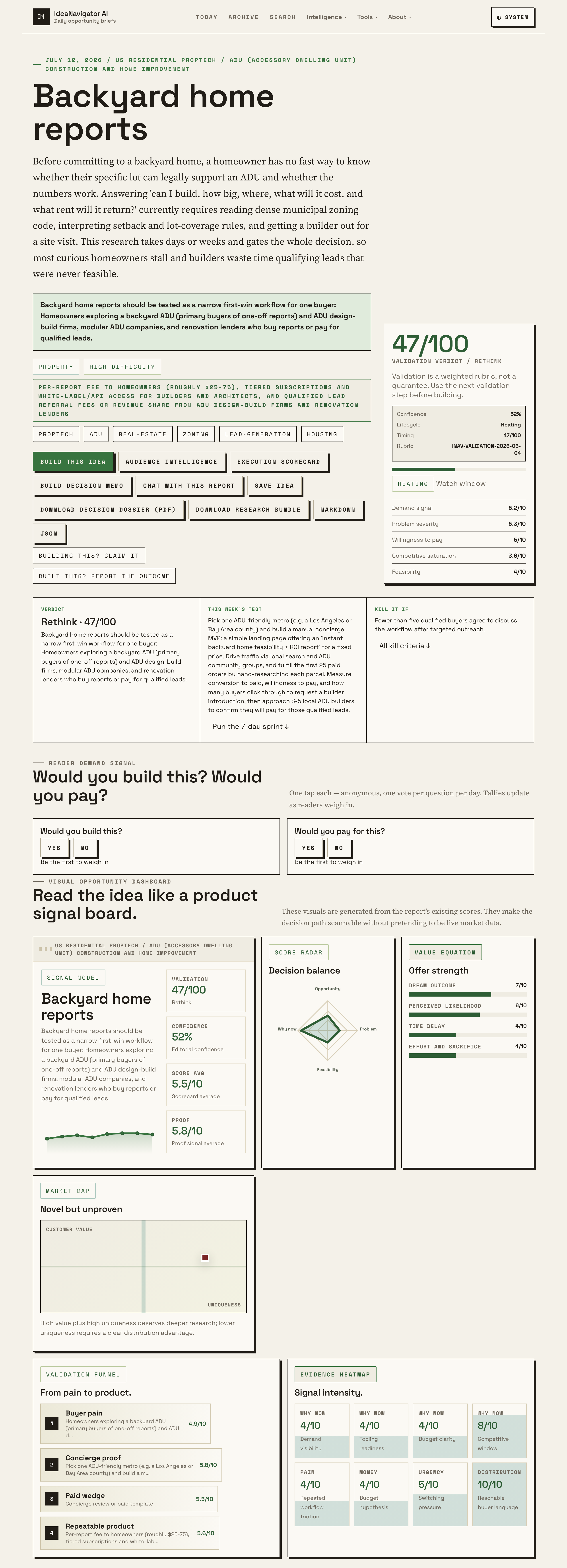
IdeaNavigator AI describes a proposed service that would assess whether a homeowner’s lot may support an accessory dwelling unit and estimate costs and rent. The concept has not been presented as a launched product; its suggested first step is to fulfill 25 paid reports by hand in one metro and test whether homeowners and local builders will pay.
IdeaNavigator AI has outlined a proposed service that would sell homeowners a report on whether their specific property may support an accessory dwelling unit, or ADU, and what construction costs and rental income could look like. The concept is at the validation stage: the proposal recommends manually fulfilling the first 25 paid orders in one metro before building a broader automated product.
The proposed report would use county parcel data, including lot boundaries, lot size and existing building footprints, alongside state ADU law and a manually maintained set of local zoning rules. For a selected market, it would estimate permitted ADU types and size, setback and lot-coverage limits, and the area that may be buildable. It would also provide a construction-cost range and projected rent based on local comparisons.
The proposal identifies homeowners considering a backyard unit as the main buyers for individual reports. It also names ADU design-build firms, modular home companies, architects and renovation lenders as potential business customers, either through subscriptions, branded reports, data access or fees for qualified referrals. A suggested homeowner price is $25 to $75 per report; that is a proposed range, not a tested price or reported revenue.
To test the idea, the plan calls for a simple landing page offering a fixed-price feasibility and return estimate, followed by hand research on each of the first 25 paid orders. The proposed measures are paid conversion, willingness to pay and how many customers request a builder introduction. The plan also recommends approaching three to five local builders to ask whether they would pay for those referrals.
The First Decision for ADU Buyers
A property-specific assessment addresses a practical hurdle for people deciding whether to pursue a backyard unit: they need to understand zoning, site limits and likely economics before committing time and money to design or a builder visit. The proposal argues that answering those questions can take days or weeks when owners must interpret local rules and arrange a site assessment. A faster report could help homeowners decide whether to investigate further and could help builders screen inquiries.
The potential value depends on local accuracy. A wrong interpretation of setbacks, lot coverage or other rules could give a homeowner an unrealistic picture of what may be permitted. Cost and rent estimates also depend on property conditions and local markets. The proposal does not provide accuracy results, customer research or evidence that buyers will rely on a paid report to make construction decisions.
The model could also connect homeowners with contractors and lenders, creating a second source of revenue through referrals. That makes the pilot’s builder conversations material: homeowner demand alone would not establish whether firms will pay for leads or subscriptions. The suggested test is designed to measure both sides before investment in a larger product.
California’s ADU Policy Backdrop
The IdeaNavigator AI proposal points to California’s statewide ADU legalization beginning in 2016 and says rules have loosened nearly every year since. It also cites supplied construction figures to explain why address-level feasibility might attract interest: Los Angeles County permitted more than 45,000 ADUs in 2023, and ADUs account for roughly one in five new housing units produced in California. The proposal provides no citations or underlying datasets for these figures, which it presents as context for the opportunity rather than evidence that a reporting service has been tested.
The proposal places ADUs within a broader US housing shortage it estimates in the millions of units, but does not cite a source for that estimate. It says parcel and zoning data, combined with language-model-based code parsing, could make per-address reports more practical. It proposes starting with one metro and curated rules, rather than assuming code can be interpreted reliably across jurisdictions from the outset. No specific launch county, data provider or technical implementation has been announced.
Demand and Accuracy Still Untested
No product launch, completed customer survey, paid order, builder agreement or operating result is reported in the IdeaNavigator AI proposal. The $25 to $75 fee and possible subscription and referral income are suggested business models, not established prices or earnings. The proposal does not specify which metro would be selected, how reports would handle conflicting or changing rules, or who would review estimates before customers receive them.
The proposal reports no measured error rate for its buildable-area, cost or rent estimates. Parcel records may not capture every relevant site condition, while local zoning rules can be detailed and subject to change. Its figure of more than 45,000 ADUs permitted in Los Angeles County in 2023 is a raw count; the proposal supplies no comparison period, baseline or supporting source. The proposed pilot would need to establish whether the report is useful and sufficiently reliable for homeowners and whether builders see value in the referrals.
A 25-Order Pilot Comes First
The next step outlined by IdeaNavigator AI is a manual concierge pilot in one ADU-friendly county or metro, potentially in the Los Angeles or Bay Area region. The operator would advertise a fixed-price report, research each property by hand and track purchases and requests for builder introductions. The proposal does not name a start date or say that the pilot is underway.
After the first 25 orders, the suggested next check is whether three to five local ADU firms would pay for qualified leads. Results from those tests could inform whether to automate parcel and rule analysis or expand coverage. Until those checks occur, the concept remains a business proposal with unverified demand, rather than an available service.
Source: IdeaNavigator AI
Key Questions
Is the backyard ADU report service available now?
The proposal does not say the service has launched. It recommends testing demand with a manual pilot before building an automated product.
What would a report include?
The proposed report would estimate allowed ADU types and size, site constraints, buildable area, construction costs and local rent using parcel information and curated local rules.
How much might a homeowner pay?
The suggested one-off price is $25 to $75. The proposal provides no sales data showing whether customers will pay within that range.
What would the pilot test?
The proposed first 25 paid orders would test conversion, willingness to pay and requests for builder introductions. The plan also calls for asking three to five local builders whether they would pay for qualified referrals.
Source: IdeaNavigator AI
Fall Picks
fall essentials
As an affiliate, we earn on qualifying purchases.