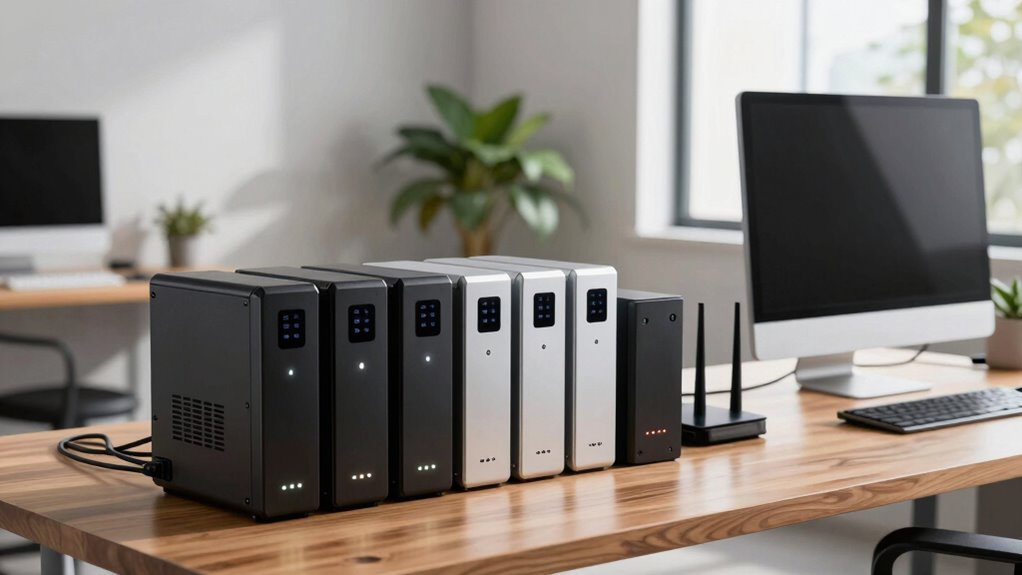

For most home offices, I would start with the GOLDENMATE 1000VA/800W LiFePO4 UPS, which pairs more output headroom with a lithium-iron-phosphate battery. The CyberPower CP1500PFCLCD is a standout for users who want a clearly specified 1000W PFC sinewave unit, while the GOLDENMATE 600VA/360W models suit lighter, compact setups. The main tradeoff is between output capacity for a desktop and multiple devices, and a smaller unit that may better fit a modest workstation. Battery chemistry, waveform, and the power draw of connected equipment also affect which model makes sense. Continue reading for the full breakdown and help matching a UPS to your home-office load.
Key Takeaways
- The 1000VA/800W GOLDENMATE models offer more wattage headroom than the 1000VA/600W versions, a meaningful distinction when a desktop, monitor, and networking gear share one UPS.
- The CyberPower CP1500PFCLCD stands apart on stated output and sinewave detail, making it a strong alternative for buyers prioritizing a 1000W rating and PFC-compatible output.
- The 600VA/360W GOLDENMATE units fit lighter loads; they are better matched to a router, modem, and modest workstation than a power-hungry desktop setup.
- Several listings repeat the same capacity and product family, so model naming and exact specifications matter more than assuming each listing brings a different capability.
- LiFePO4 models are the roundup’s battery-chemistry focus, but capacity and runtime still depend on the connected load; lithium chemistry alone does not tell you how long an office will stay powered.
| GOLDENMATE 1000VA/600W LiFePO4 UPS Battery Backup and Surge Protector |  | Best Overall for a Balanced Home Office | Capacity: 1000VA | Maximum output: 600W | Battery: 153.6Wh LiFePO4 | VIEW ON AMAZON | See Our Full Breakdown |
| GOLDENMATE 600VA/360W LiFePO4 UPS Battery Backup and Surge Protector |  | Best Compact Pick for a Router and Small Desk | Capacity: 600VA / 360W | Battery energy: 76.8Wh LiFePO4 | Outlets: 5 | VIEW ON AMAZON | See Our Full Breakdown |
| GOLDENMATE 1000VA/800W Lithium UPS Battery Backup and Surge Protector | | Best for a Higher-Power Workstation | Capacity: 1000VA / 800W | Battery type: LiFePO4 | Outlets: 8 | VIEW ON AMAZON | See Our Full Breakdown |
| CyberPower CP1500PFCLCD 1500VA/1000W PFC Sinewave UPS with Battery Backup and Surge Protection |  | Best for Active-PFC PCs and Broad Outlet Needs | Capacity: 1500VA / 1000W | Topology: Line-interactive | Output: PFC sinewave | VIEW ON AMAZON | See Our Full Breakdown |
| GOLDENMATE 1000VA/600W LiFePO4 Pure Sine Wave UPS Battery Backup and Surge Protector |  | Best for Automatic Computer Shutdown | Capacity: 1000VA / 600W | Battery type and life: LiFePO4; over 10 years listed | Charge cycles: More than 5,000 | VIEW ON AMAZON | See Our Full Breakdown |
| Goldenmate 1500VA/1000W LiFePO4 UPS Battery Backup and Surge Protector |  | Best Overall for a Full Home-Office Desk | Capacity: 1500VA / 1000W | Battery chemistry: LiFePO4 | Output waveform: Pure sine wave | VIEW ON AMAZON | See Our Full Breakdown |
| GOLDENMATE 1500VA/1000W LiFePO4 UPS Battery Backup and Surge Protector |  | Best for Wall-Mounted Setups | Capacity: 1500VA / 1000W | Battery type: LiFePO4 | Output waveform: Pure sine wave | VIEW ON AMAZON | See Our Full Breakdown |
| GOLDENMATE 1000VA/800W LiFePO4 UPS Battery Backup and Surge Protector | | Best for a Lean, Lower-Load Office | Capacity: 1000VA / 800W | Battery type: LiFePO4 | Output waveform: Pure sine wave | VIEW ON AMAZON | See Our Full Breakdown |
| GOLDENMATE 1500VA/1000W LiFePO4 UPS Battery Backup and Surge Protector |  | Best for Automatic Voltage Regulation | Capacity: 1500VA / 1000W | Battery type: LiFePO4 | Topology: Line-interactive with AVR | VIEW ON AMAZON | See Our Full Breakdown |
| GOLDENMATE 600VA/360W Lithium UPS Battery Backup and Surge Protector |  | Best Compact Desk Companion | Capacity: 600VA / 360W | Battery type: LiFePO4 | Battery capacity: 76.8Wh | VIEW ON AMAZON | See Our Full Breakdown |
| lithium ups backups for home office | Capacity | Outlets | Battery type | Output waveform |
|---|---|---|---|---|
| GOLDENMATE 1000VA/600W LiFePO4 | 1000VA | 8 NEMA 5-15P | — | — |
| GOLDENMATE 600VA/360W LiFePO4 | 600VA / 360W | 5 | — | — |
| GOLDENMATE 1000VA/800W Lithium | 1000VA / 800W | 8 | LiFePO4 | — |
| CyberPower CP1500PFCLCD 1500VA | 1500VA / 1000W | 12 total; 6 battery backup and surge protected, 6 surge protected | — | — |
| GOLDENMATE 1000VA/600W LiFePO4 | 1000VA / 600W | 8 NEMA 5-15P | — | — |
| Goldenmate 1500VA/1000W LiFePO | 1500VA / 1000W | 8 NEMA 5-15P | — | Pure sine wave |
| GOLDENMATE 1500VA/1000W LiFePO | 1500VA / 1000W | 8 NEMA 5-15P with surge protection and battery backup | LiFePO4 | Pure sine wave |
| GOLDENMATE 1000VA/800W LiFePO4 | 1000VA / 800W | 8 NEMA 5-15P | LiFePO4 | Pure sine wave |
| GOLDENMATE 1500VA/1000W LiFePO | 1500VA / 1000W | 8 NEMA 5-15P | LiFePO4 | Pure sine wave |
| GOLDENMATE 600VA/360W Lithium | 600VA / 360W | 6 surge-protected outlets with battery backup | LiFePO4 | Simulated sine wave |
More Details on Our Top Picks
GOLDENMATE 1000VA/600W LiFePO4 UPS Battery Backup and Surge Protector
For a home office that needs a dependable buffer for a desktop, monitor, and networking gear, this model balances eight backed-up outlets with a 153.6Wh LiFePO4 battery. Its pure sine wave output suits sensitive computer equipment, while the LCD makes it easier to check battery and power conditions at a glance. Compared with the GOLDENMATE 1000VA/600W model with USB shutdown support, this version lists battery energy and a 30-minute runtime, but not a communication port. Its 600W ceiling is the main constraint: it fits a modest workstation, not a high-draw setup with several demanding devices. The long-cycle battery rating favors buyers who want to avoid frequent battery replacement, though the cooling fan can be audible during heavier battery use.
Pros:- Pure sine wave output is suited to computers and network equipment.
- Eight outlets provide backup and surge protection for a small workstation.
- 153.6Wh LiFePO4 battery is rated for over 5,000 charge cycles.
- LCD displays battery and power conditions.
Cons:- Maximum output is limited to 600W.
- Cooling fan may activate during heavy battery use.
- No communication port is listed for automatic device shutdown.
Best for: Home-office users running a standard desktop, monitor, router, and modem who want lithium chemistry and eight protected outlets.
Not ideal for: Owners of high-power workstations or users who need automatic computer shutdown through a communication port; the 600W limit and listed features may not fit those needs.
- Capacity:1000VA
- Maximum output:600W
- Battery:153.6Wh LiFePO4
- Outlets:8 NEMA 5-15P
- Waveform:Pure sine wave
- Runtime:30 minutes
- Recharge time:6 hours
- Input and output voltage:90–140V AC input; 120V output
Our verdict“Choose this as a balanced lithium UPS for a typical home office that needs eight outlets and can keep its load below 600W.”
GOLDENMATE 600VA/360W LiFePO4 UPS Battery Backup and Surge Protector
This is the space-conscious choice for a home office built around a router, modem, laptop accessories, and a low-power computer rather than a full workstation. At 6.8 pounds, with a wall-mountable design, it is easier to place out of the way than the tower-style GOLDENMATE 1000VA/800W model. Five outlets and USB-A/USB-C ports cover basic desk gear, and a communication port can support automatic shutdown for connected equipment. The tradeoff is its 360W output and smaller 76.8Wh battery: it offers less headroom and backup energy than the 1000VA models. USB charging is limited to 10W total, so these ports are for modest accessories, not fast-charging a laptop. Its emergency light adds a useful touch during an outage, but this is a compact essentials backup, not a workstation power hub.
Pros:- Compact, wall-mountable design weighs 6.8 pounds.
- LiFePO4 battery is rated for 3,000 or more charge cycles.
- Communication port supports automatic device shutdown.
- USB-A, USB-C, and a built-in emergency light add convenience.
Cons:- 360W maximum output leaves little room for a high-draw workstation.
- 76.8Wh battery energy is lower than the listed 1000VA models.
- USB ports share just 10W total output.
Best for: Remote workers with a router, modem, small computer, and a few accessories who need a lightweight UPS that can be wall-mounted.
Not ideal for: Users powering a desktop workstation, multiple monitors, or equipment drawing close to 360W; the capacity and battery energy are limited.
- Capacity:600VA / 360W
- Battery energy:76.8Wh LiFePO4
- Outlets:5
- USB charging:USB-C and USB-A; 10W total
- Recharge time:3 hours
- Input and output voltage:90–140V AC input; 120V output
- Dimensions:11.69 × 5.67 × 3.43 inches
- Weight:6.8 pounds
Our verdict“Pick this compact model for a lightly equipped desk where small size and automatic shutdown matter more than long runtime or high output.”
GOLDENMATE 1000VA/800W Lithium UPS Battery Backup and Surge Protector
Among the listed GOLDENMATE 1000VA units, this tower gives a workstation more breathing room: its 800W output is 200W higher than the GOLDENMATE 1000VA/600W models, which can matter when a desktop and several peripherals draw power together. It also lists a 46-minute runtime, eight outlets, and pure sine wave output, making it a stronger fit for keeping a heavier office setup running through a short interruption. The LCD and buzzer-mute function help with status checks without forcing an audible alarm to remain on. There are compromises: the listed 10-hour recharge time is longer than the six hours specified for the 600W model, and its cooling fan may activate under heavy battery use. Choose it for added output headroom, not because 1000VA alone guarantees a particular runtime under your load.
Pros:- 800W maximum output offers more headroom than the 600W GOLDENMATE models.
- Pure sine wave output suits sensitive computer equipment.
- Eight outlets and an LCD support a multi-device workstation.
- Buzzer can be muted, and the listed runtime is 46 minutes.
Cons:- Listed recharge time is 10 hours.
- Cooling fan may activate during heavy battery use.
- Tower form takes more space than the compact 600VA model.
Best for: Home-office owners with a higher-draw desktop workstation and multiple peripherals who want more output headroom than a 600W UPS provides.
Not ideal for: Buyers with a quiet, low-power desk setup or limited floor space; its tower form and fan operation may be unnecessary, and the recharge time is long.
- Capacity:1000VA / 800W
- Battery type:LiFePO4
- Outlets:8
- Waveform:Pure sine wave
- Runtime:46 minutes
- Recharge time:10 hours
- Input and output voltage:90–140V AC input; 120V output
- Form and noise:Tower; below 50 dB
Our verdict“Choose this tower when your workstation needs more than 600W of available UPS output and you can accommodate its longer recharge time.”
CyberPower CP1500PFCLCD 1500VA/1000W PFC Sinewave UPS with Battery Backup and Surge Protection
For a home office built around an active-PFC desktop power supply, the CyberPower’s PFC sinewave output and automatic voltage regulation make it a different proposition from the lithium GOLDENMATE units. AVR can correct minor voltage changes without drawing on the battery, while its 1000W capacity exceeds the 800W GOLDENMATE 1000VA tower’s listed output. There are 12 outlets, but only six provide battery backup; the other six are surge protection only, so outlet count alone can overstate how much gear stays on during an outage. Its color LCD tilts for easier viewing, and two USB ports add charging options. The major tradeoff for this lithium-focused roundup is that its data lists two 12V batteries rather than a LiFePO4 pack. At 24.9 pounds, it is also far less convenient to move than the compact GOLDENMATE 600VA model.
Pros:- PFC sinewave output supports active-PFC and conventional power supplies.
- 1000W capacity is higher than the listed GOLDENMATE 1000VA models.
- AVR corrects minor power fluctuations without switching to battery.
- Tilting color LCD and two USB charging ports aid desk use.
Cons:- Only six of the 12 outlets provide battery backup.
- Uses two 12V batteries rather than the LiFePO4 chemistry featured by the other lithium picks.
- Weighs 24.9 pounds.
Best for: Home-office users with an active-PFC desktop, several plugged-in devices, and a need for AVR and a higher 1000W output ceiling.
Not ideal for: Buyers specifically seeking a LiFePO4 battery UPS or expecting all 12 outlets to provide battery backup.
- Capacity:1500VA / 1000W
- Topology:Line-interactive
- Output:PFC sinewave
- Outlets:12 total; 6 battery backup and surge protected, 6 surge protected
- Voltage regulation:Automatic Voltage Regulation (AVR)
- USB ports:1 Type-A and 1 Type-C
- Batteries:2 × 12V batteries required
- Dimensions and weight:14 × 3.9 × 11 inches; 24.9 pounds
Our verdict“Pick the CyberPower for active-PFC compatibility, AVR, and 1000W output, but skip it if LiFePO4 chemistry or backup power on every outlet is a requirement.”
GOLDENMATE 1000VA/600W LiFePO4 Pure Sine Wave UPS Battery Backup and Surge Protector
This 600W GOLDENMATE is the better match than the GOLDENMATE 1000VA/600W model without listed communications features when a home-office computer needs a USB shutdown connection. Its software communication port can support automatic device shutdown during an outage, helping protect open work and files if backup time runs out. The unit also combines eight backed-up outlets, pure sine wave output, an LCD, and a metal enclosure. Its LiFePO4 battery is rated for more than 5,000 cycles, aligning with buyers who want a long service-life design. The limitation is shared with other 600W picks: the output ceiling suits a typical desk, not a demanding workstation. A cooling fan may run during heavy battery use, and the listed input range is for standard household power. Compared with the GOLDENMATE 1000VA/800W tower, this model gives up output headroom but adds the specified shutdown connection.
Pros:- USB communication port supports automatic device shutdown.
- LiFePO4 battery is rated for more than 5,000 charge cycles.
- Eight outlets, pure sine wave output, and an LCD suit a typical home office.
- Metal enclosure and overload and overheating protections support monitored operation.
Cons:- 600W maximum output limits use with higher-draw workstations.
- Cooling fan may activate during heavy battery use.
- Designed for standard household voltage; outlet voltage should be checked.
Best for: Remote workers who want a LiFePO4 UPS with a USB communication link for automatic computer shutdown and a standard multi-device desk setup.
Not ideal for: Users with high-draw workstations or those who need output above 600W; the 1000VA/800W tower offers more power headroom.
- Capacity:1000VA / 600W
- Battery type and life:LiFePO4; over 10 years listed
- Charge cycles:More than 5,000
- Outlets:8 NEMA 5-15P
- Waveform:Pure sine wave
- Communication:USB port for automatic device shutdown
- Recharge time:6 hours
- Dimensions and weight:13 × 4.1 × 9.8 inches; 4.8 kg
- Input and output voltage:90–140V AC input; 120V output
Our verdict“Choose this 600W model if automatic shutdown support matters more than the extra output headroom of the GOLDENMATE 1000VA/800W tower.”
Goldenmate 1500VA/1000W LiFePO4 UPS Battery Backup and Surge Protector
I’d put this model near the top for a home office that needs to keep a desktop, monitor, router, and other essentials running through brief outages. Its 1500VA/1000W capacity and pure sine wave output offer more headroom than the 1000VA/800W GOLDENMATE, while eight backed-up outlets reduce the need to choose which desk devices stay protected. The LiFePO4 battery is rated for over 3,000 charge cycles, and the LCD plus computer-shutdown communication port help make power status and orderly shutdown easier to manage. USB-A and USB-C are useful for small devices, though their combined output is only 10W. The tradeoff is a cooling fan during heavy battery use, which may be noticeable in a quiet office; generator compatibility may also be limited.
Pros:- 1500VA/1000W capacity provides more load headroom than the 1000VA/800W GOLDENMATE.
- Pure sine wave output suits sensitive computer equipment.
- Eight battery-backed outlets accommodate a multi-device desk setup.
- LCD status display and communication port support monitoring and compatible automatic shutdown.
Cons:- Cooling fan may run during heavy battery use and add noise in a quiet workspace.
- May not recognize generator power.
- USB-A and USB-C charging share just 10W total.
Best for: Home-office users running a desktop PC, monitor, networking gear, and several peripherals who want a higher-capacity UPS with long-life battery chemistry.
Not ideal for: People using a generator as their primary backup source, or anyone who needs a silent UPS during extended battery operation.
- Capacity:1500VA / 1000W
- Battery chemistry:LiFePO4
- Output waveform:Pure sine wave
- Outlets:8 NEMA 5-15P
- Input range:90–140V AC
- Output voltage:120V
- USB charging:1 USB-C and 1 USB-A; 10W total
- Form factor:Tower
Our verdict“Choose this model for a multi-device home office that needs 1500VA-class backup and can accommodate fan noise during heavier battery use.”
GOLDENMATE 1500VA/1000W LiFePO4 UPS Battery Backup and Surge Protector
This 1500VA/1000W GOLDENMATE suits a home office where floor and desk space are tight: wall mounting gives it a placement option the tower-format B0GJ627K91 does not list. It matches that model’s capacity, pure sine wave output, eight backed-up outlets, and long-life LiFePO4 battery, then adds an emergency LED light and buzzer controls. Its transfer time is specified as under 10 ms, while USB communication can support automatic shutdown for compatible computers and NAS devices. Those additions make it a particularly flexible fit for a combined office and equipment area. The tradeoffs are that its USB charging output remains 10W total, and the 90–140V input range is aimed at household AC; generator power may not be recognized.
Pros:- Wall-mountable housing offers an alternative to placing a tower UPS on the floor.
- Under-10-ms transfer time and pure sine wave output suit computer and NAS backup.
- Eight battery-backed outlets and LiFePO4 chemistry support a multi-device setup.
- Emergency LED light, buzzer controls, and USB shutdown communication add practical control options.
Cons:- USB-A and USB-C charging provide only 10W total.
- Generator power may not be recognized.
- Its added mounting and light features may be unnecessary for a basic desk setup.
Best for: Home-office owners with limited floor space who want a 1500VA UPS that can be wall-mounted and can support automatic shutdown for compatible computers or NAS devices.
Not ideal for: Buyers who need stronger USB charging, generator compatibility, or a simpler UPS without mounting and emergency-light features.
- Capacity:1500VA / 1000W
- Battery type:LiFePO4
- Output waveform:Pure sine wave
- Transfer time:Under 10 ms
- Outlets:8 NEMA 5-15P with surge protection and battery backup
- Input voltage:90–140V AC
- USB charging:USB-C and USB-A; 10W total
- Housing:Metal; wall-mountable
Our verdict“Pick this 1500VA model if wall mounting and emergency-light features matter as much as keeping a computer and NAS backed up.”
GOLDENMATE 1000VA/800W LiFePO4 UPS Battery Backup and Surge Protector
For a home office built around a modest desktop or laptop setup, this 1000VA/800W tower provides a more restrained alternative to the 1500VA/1000W GOLDENMATE models. It still gives you eight battery-backed outlets, pure sine wave output, an LCD, and USB connectivity for compatible automatic shutdown, so the lower capacity does not mean giving up the basic tools for protecting a work setup. Its stated battery rating of over 5,000 charge cycles is higher than the 3,000-plus rating listed for the 1500VA options, a useful distinction for buyers focused on battery service life. The compromise is less load headroom, making it a poorer match for a powerful desktop plus multiple high-draw devices. Heavy battery use can also start the cooling fan.
Pros:- 1000VA/800W capacity fits a lower-load office without the 1500VA models’ higher capacity.
- Pure sine wave output supports sensitive computer equipment.
- Eight battery-backed outlets, LCD monitoring, and USB shutdown connectivity cover common office needs.
- Battery is rated for over 5,000 charge cycles.
Cons:- Offers less load capacity than the 1500VA/1000W GOLDENMATE models.
- Cooling fan can turn on during heavy battery use.
- Designed for North American household voltage.
Best for: People with a laptop or modest desktop, monitor, and networking gear who want eight backed-up outlets without stepping up to a 1500VA unit.
Not ideal for: Users with a high-power workstation or many connected devices whose combined load may approach 800W.
- Capacity:1000VA / 800W
- Battery type:LiFePO4
- Output waveform:Pure sine wave
- Outlets:8 NEMA 5-15P
- Input voltage:90–140V AC
- Output voltage:120V
- Dimensions:13 x 4.1 x 9.8 inches
- Weight:5.9 kg
Our verdict“Choose this model for a modest office load where eight backed-up outlets and long battery-cycle life matter more than 1500VA capacity.”
GOLDENMATE 1500VA/1000W LiFePO4 UPS Battery Backup and Surge Protector
This 1500VA/1000W GOLDENMATE stands apart from the other same-capacity option in this batch by specifying line-interactive topology with AVR. That makes it the more relevant choice for an office where input-voltage fluctuations are a concern, while its pure sine wave output and eight backed-up outlets cover a desktop, monitor, and network equipment. It also includes an LCD, USB-A and USB-C charging, and Windows PC shutdown support. Compared with the 1000VA/800W GOLDENMATE, this model offers more load headroom, but its battery rating is over 3,000 cycles rather than that smaller model’s stated 5,000-plus. The listed tradeoffs include a larger, heavier build and possible trouble recognizing generator power, so it fits a fixed household setup better than a generator-led backup plan.
Pros:- Line-interactive topology with AVR addresses input-voltage variation.
- 1500VA/1000W capacity provides more headroom than the 1000VA/800W GOLDENMATE.
- Pure sine wave output and eight battery-backed outlets suit a computer-centered office.
- LCD monitoring and Windows PC shutdown support help manage outages.
Cons:- Larger and heavier than comparable UPS models.
- Generator power may not be recognized, which can leave the unit on battery without recharging.
- Battery rating is over 3,000 cycles, below the 5,000-plus rating listed for the 1000VA/800W model.
Best for: Home-office users with a desktop and networking gear who want 1500VA capacity plus AVR for household input-voltage fluctuations.
Not ideal for: Buyers who need a lightweight unit, rely on generator power, or want the higher stated cycle rating of the 1000VA/800W GOLDENMATE.
- Capacity:1500VA / 1000W
- Battery type:LiFePO4
- Topology:Line-interactive with AVR
- Output waveform:Pure sine wave
- Outlets:8 NEMA 5-15P
- Input voltage:90–140V AC; designed for standard 110V household power
- Output voltage:120V
- USB charging:1 USB-C and 1 USB-A; 10W total
Our verdict“Choose this model if AVR and 1500VA capacity are priorities and the UPS will run from standard household AC.”
GOLDENMATE 600VA/360W Lithium UPS Battery Backup and Surge Protector
This compact 600VA/360W UPS is aimed at a lighter desk load, not at matching the runtime headroom of the 1500VA/1000W GOLDENMATE models. Its six backed-up outlets and LiFePO4 battery suit a router, monitor, and lower-power computer or other essentials, while the small footprint and desktop or wall-mount placement make it easier to fit beside a workstation. The unusual extra is a 15W wireless charging pad, alongside USB-A and USB-C ports; that’s handy for a phone, but the pad must be activated and the USB ports share just 10W. Unlike the larger pure sine wave options, this unit uses simulated sine wave output and has only 360W of capacity, so I would avoid it for a demanding workstation or equipment requiring pure sine output.
Pros:- Compact 2.1 kg design supports desktop placement or wall mounting.
- Six outlets provide battery backup and surge protection.
- 15W wireless charging pad plus USB-A and USB-C add convenient device charging.
- LiFePO4 battery is rated for over 10 years and 3,000+ charge cycles.
Cons:- 360W capacity is far below the 1000W 1500VA GOLDENMATE models.
- Simulated sine wave output differs from the pure sine wave offered by the larger options.
- Wireless charging requires activating the charging module.
Best for: Laptop-first home-office users who want a compact backup for a router, monitor, and other modest loads, with phone charging close at hand.
Not ideal for: Owners of high-power desktop workstations or equipment that calls for pure sine wave output, given the 360W capacity and simulated waveform.
- Capacity:600VA / 360W
- Battery type:LiFePO4
- Battery capacity:76.8Wh
- Battery pack:25.6V, 3Ah
- Outlets:6 surge-protected outlets with battery backup
- Output waveform:Simulated sine wave
- Wireless charging:15W
- Dimensions and weight:280 × 116 × 112 mm; 2.1 kg
Our verdict“Pick this compact unit for a low-power desk and phone-charging convenience, but choose a larger pure sine wave model for a demanding PC setup.”

How We Picked
I compared the ten listed models through the needs of a home office: keeping a computer and network connection powered through brief interruptions, providing enough output for connected equipment, and offering a practical setup for everyday use. The main ranking factors were stated wattage and VA capacity, battery chemistry, waveform information where provided, and how clearly each listing differentiates its configuration. I gave more weight to usable output and fit for common office loads than to a large VA number on its own.
The ranking favors models that present a stronger balance of capacity and office-relevant specifications, while smaller 600VA/360W units rank better for light loads than for full desktop systems. The CyberPower model earns a distinct place for its stated PFC sinewave output and 1000W rating; GOLDENMATE LiFePO4 models stand out for their stated battery chemistry and range of output options. Several entries share near-identical names and ratings, so I treat those as closely matched choices rather than inventing differences not established by the supplied product names.
| lithium ups backups for home office | Output waveform |
|---|---|
| GOLDENMATE 1000VA/600W LiFePO4 | — |
| GOLDENMATE 600VA/360W LiFePO4 | — |
| GOLDENMATE 1000VA/800W Lithium | — |
| CyberPower CP1500PFCLCD 1500VA | — |
| GOLDENMATE 1000VA/600W LiFePO4 | — |
| Goldenmate 1500VA/1000W LiFePO | Pure sine wave |
| GOLDENMATE 1500VA/1000W LiFePO | Pure sine wave |
| GOLDENMATE 1000VA/800W LiFePO4 | Pure sine wave |
| GOLDENMATE 1500VA/1000W LiFePO | Pure sine wave |
| GOLDENMATE 600VA/360W Lithium | Simulated sine wave |
Factors to Consider When Choosing Lithium Ups Backups For Home Offices
Choosing a UPS is less about buying the biggest number and more about matching the unit to your actual equipment and outage needs. These broader checks can help prevent overspending on unused capacity or buying a unit that cannot support your workstation.
Match Wattage to the Whole Workstation
List every device you expect to keep running during an outage, including the computer, monitor, router, modem, and any external storage. Check each device’s power draw rather than adding up only its adapter’s maximum rating, which may exceed typical use. Leave headroom for startup demand and future additions instead of selecting a UPS that sits at its output limit. A 600VA/360W model can suit a modest setup, but a desktop workstation may call for a higher-wattage option such as an 800W or 1000W unit. Avoid plugging in heaters, printers, or other high-draw equipment just because an outlet is available. The right capacity is the one that supports your essential load, not every device in the room.
Choose Runtime Around the Job You Need to Finish
A UPS can serve different goals: giving you time to save work and shut down, or keeping internet access available through a short interruption. Those goals can call for very different battery capacity, even when the devices are the same. Runtime falls as the connected load rises, so a model’s VA rating cannot tell you how many minutes your setup will run. Decide which devices need backup and which can lose power, then check manufacturer runtime information for a load close to yours. A smaller network-only load can run longer than a full workstation on the same unit. If your priority is extended work during outages, compare runtime data rather than relying on battery chemistry as a shortcut.
Check Waveform Compatibility for Your Computer
Some computers with active power-factor-correction power supplies may work best with a UPS that provides sinewave output. The CyberPower listing explicitly identifies PFC sinewave output, while several GOLDENMATE names distinguish pure sinewave or do not state waveform in the product name. Verify the exact listing and manufacturer documentation before choosing based on a broad family name. This is especially relevant when the computer’s power supply is sensitive to the output produced while the UPS runs on battery. A compatibility issue can show up as unexpected switching behavior or a device shutting down during an outage. If you are unsure, check the computer or power-supply documentation and favor a clearly specified compatible output.
Treat Battery Chemistry and Battery Life as Separate Questions
LiFePO4 describes the battery chemistry, not the runtime you will get from a particular UPS. Battery longevity also depends on operating temperature, charge cycles, storage, and the manufacturer’s service guidance. Before buying, check the stated battery warranty, replacement policy, and whether the battery is user-replaceable. A lithium model may appeal to buyers seeking a different maintenance profile from traditional UPS batteries, but the product listing should spell out what ownership and service involve. Do not assume that every model in a similarly named lineup shares the same battery details. Compare the precise model documentation, especially when multiple listings have overlapping names.
Plan Outlets, Connectivity, and Placement
Count the outlets you need for battery backup separately from surge-only outlets, since a UPS may not protect every socket the same way. Check whether the unit offers the connections or computer communication features you need for automatic shutdown, monitoring, or network management. Physical size, weight, cable reach, ventilation, and audible alerts can affect whether the UPS works well under a desk or near a shared workspace. Keep it in a ventilated area and avoid enclosing it in a cabinet that traps heat. A compact 600VA model may be easier to place, while larger-capacity units can better suit equipment-heavy desks but take up more room. Confirm the exact outlet layout and dimensions before deciding where it will live.
Compare Exact Model Numbers Before Buying
This roundup includes repeated or very similar GOLDENMATE descriptions, including 1000VA/800W and 1500VA/1000W variants. Similar naming does not prove that two listings are identical, nor does it establish a difference beyond the details shown. Check the complete model number, stated wattage, waveform, outlet layout, warranty, and included software or cables on the exact listing. Focus on specifications that affect your setup rather than treating a small wording change as a performance upgrade. If two options appear to match, use the manufacturer’s documentation to resolve the distinction. This extra check helps avoid ordering a lower-output variant when you intended to buy the higher-capacity model.
Frequently Asked Questions
Is a 600VA/360W UPS enough for a home-office computer?
It can be enough for a low-power computer, one monitor, or networking equipment, but the 360W ceiling is the key limit. Add up the load of everything you plan to keep on battery and leave room below that maximum. A gaming desktop or workstation with several peripherals may exceed what this size handles comfortably. For those setups, compare the 800W and 1000W choices in this roundup. Use actual device power figures and runtime information rather than assuming that a 600VA label alone determines fit.
Should I choose a 1000VA/800W model over a 1000VA/600W model?
The 800W version provides more stated wattage capacity at the same VA rating, which can matter when your equipment draws substantial power. It is not automatically a better buy for every desk: a router, modem, and light-use laptop may not benefit from the added headroom. Check the total load and consider whether you may add a monitor, storage device, or more demanding desktop later. Also compare exact model specifications, since similar product names may not identify every feature. Choose by wattage and runtime fit, not by VA alone.
Does LiFePO4 mean my computer will run longer during an outage?
No. LiFePO4 identifies battery chemistry, but runtime depends chiefly on the UPS’s available battery capacity and the load connected to it. A small load such as a modem and router may run much longer than a desktop and monitor on the same unit. Look for runtime charts or manufacturer estimates at a wattage close to your setup. Also check battery warranty and replacement details, which help explain the longer-term ownership picture. Do not use chemistry as a substitute for a runtime estimate.
Do I need a pure sinewave UPS for my home-office PC?
Some computers with active PFC power supplies are better suited to sinewave output, so the computer and power-supply specifications matter. The CyberPower CP1500PFCLCD listing explicitly states PFC sinewave output, and one GOLDENMATE listing names pure sinewave output. Other models in the roundup may have different output specifications, so check the exact product documentation. If your computer manufacturer recommends a sinewave UPS, follow that guidance. When compatibility is unclear, confirm it before relying on the UPS during an outage.
How should I choose between the GOLDENMATE 1500VA/1000W models and the CyberPower CP1500PFCLCD?
Both are listed at 1500VA/1000W, so capacity alone does not separate them. The CyberPower listing calls out PFC sinewave output, while the GOLDENMATE entries emphasize LiFePO4 battery chemistry. Decide which detail best matches your priority, then compare the exact model’s runtime information, outlet layout, shutdown or monitoring features, warranty, and battery-service terms. The GOLDENMATE names repeat across several entries, so verify the complete model number rather than relying on a shortened title. If sinewave compatibility is central to your setup, prioritize a listing with that specification clearly stated.
Conclusion
For a balanced home-office setup, my best overall pick is the GOLDENMATE 1000VA/800W LiFePO4 model, which offers more stated wattage headroom than the 1000VA/600W alternatives. The best value for a light setup is a GOLDENMATE 600VA/360W unit, provided your load stays comfortably below its limit. For buyers seeking a larger-capacity lithium option, a GOLDENMATE 1500VA/1000W model is my best premium fit among the LiFePO4 choices, while the CyberPower CP1500PFCLCD is the best choice when clearly stated PFC sinewave output is a priority. Beginners with a router, modem, and modest computer should start by measuring their load and matching it to the simpler 600VA/360W class. If you run a more demanding desktop, choose an 800W or 1000W unit only after checking runtime, waveform compatibility, and the exact model specifications.