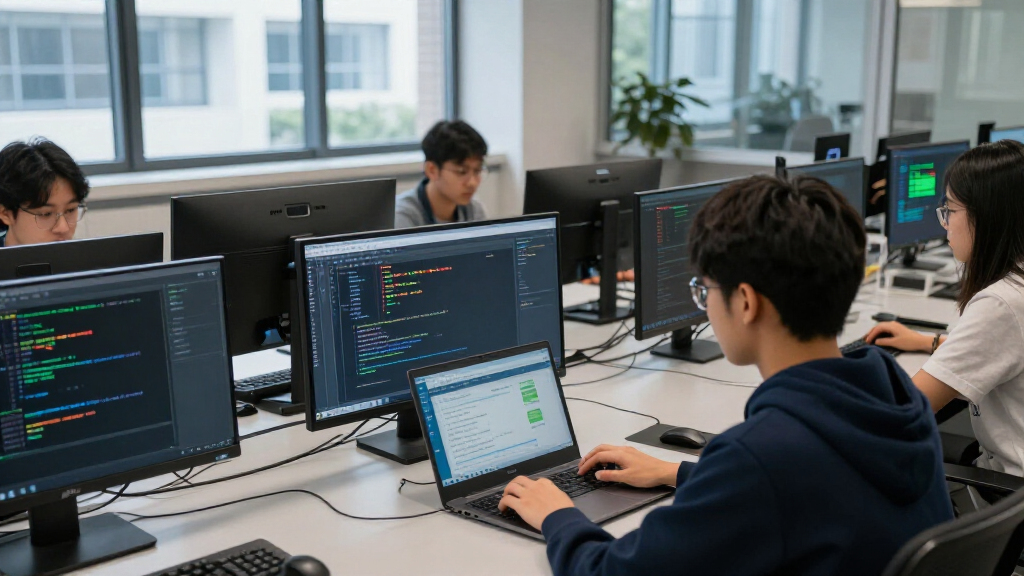

🔍 Read the full analysis: Computer Science Enrollment Is Down. How Much Does AI Have To Do With It? on ThorstenMeyerAI.com

Get business pricing on office and shipping supplies
- Business-only prices and quantity discounts
- Tax-exempt purchasing
- Multiple users, one account, clear invoices
TL;DR
Preliminary fall 2026 figures show computer and information science enrollment fell at four-year colleges, two-year colleges and graduate programs. A weak entry-level job market and AI-related job concerns may be contributing, but the data do not establish AI as the main cause; visa problems, post-boom correction and other factors also matter.
Computer and information science enrollment fell across U.S. colleges in preliminary fall 2026 data released October 29 by the National Student Clearinghouse Research Center, with declines of 12.4% at four-year colleges, 12.3% at two-year colleges and 10.4% in graduate programs compared with fall 2025. The figures arrive amid concern that artificial intelligence is shrinking entry-level coding work, but they do not show that AI caused the enrollment decline.
The Clearinghouse report compares the same participating institutions across years and covers the federal classification called Computer and Information Sciences and Support Services. The preliminary figures show declines at every level. Over two years, enrollment was down 18.4% among undergraduates at four-year colleges, 17.5% at two-year colleges and 27.1% in graduate programs.
The early release is based on 7.92 million enrollments reported by 46% of participating institutions as of September 24. The broader college picture was less severe: total enrollment rose 0.2%, undergraduate enrollment rose 0.6%, and graduate enrollment fell 1.6%. Final fall 2026 counts are due in January 2027 and may differ from the preliminary estimates.
Other fields did not show the same pattern. At four-year colleges, engineering enrollment increased 6.1% and health professions grew 6.2%, while business was flat. That suggests the reported decline is not simply a broad retreat from higher education or technical study.
Infographic 01 · The turn
Computer science is down at every level, while engineering and health grow
Early fall 2026 data from 46% of U.S. institutions. Percentage changes for the same panel of schools; final figures follow in January 2027.
Every level is down
Change in enrollment versus the prior fall. The undergraduate drop is speeding up, the graduate drop is slowing after a steep first year.
Undergraduate, 4-year
Undergraduate, 2-year
Graduate
Same 4-year colleges, other fields
Undergraduate enrollment change, fall 2026 vs. fall 2025. Students are leaving one field, not technical study.
- Computer & information science−12.4%
- Liberal arts & humanities−4.5%
- Visual & performing arts−4.2%
- Business+0.1%
- Biology+3.8%
- Engineering+6.1%
- Health professions+6.2%
Source: National Student Clearinghouse, Preliminary Fall Enrollment Trends, 29 Oct 2026 (dashboard Figure 3.5; prior-year values from the same panel). Unweighted, preliminary, subject to revision. Field names shortened. For scale: undergraduate computer science at 4-year colleges grew from about 499,000 (2020) to about 660,000 (2024), then fell 8.1% to about 606,000 in fall 2025 (NSC Final Fall Enrollment Trends 2025).
Powered by Thorsten Meyer AI
A Shrinking Pipeline Meets Hiring Changes
The enrollment figures matter to students weighing a major and to employers planning for future hiring. If the decline persists, colleges could produce smaller computer science graduating classes in coming years. The source estimates that the effect on the workforce may become more visible around 2029, though the final enrollment numbers and future student choices remain uncertain.
Students are also making decisions against a difficult entry-level hiring picture. The source reports that Indeed’s software development postings index stood at about 81, with February 2020 set to 100, and that entry-level roles made up 4.5% of software development postings in early 2026. It also cites a 7.0% unemployment rate for recent computer science graduates in the latest by-major data. These measures describe a weak market, but do not establish what drove each student’s decision.
For employers, a smaller pipeline could make it harder to recruit early-career technical workers if demand holds up. The source argues companies should redesign junior roles around work that combines coding with verification, judgment and subject-matter knowledge, rather than assume AI tools can replace entry-level development work. That is a recommendation, not a finding of the enrollment report.
Products Worth Considering

Dell XPS 13 9350 Laptop, 13.4 FHD+ Display, Intel Ultra 7 256V, 16GB DDR5, 1TB SSD
Apple iMac 2024 All-in-One Desktop with M4 Chip, 24‑inch Retina Display, 16GB Unified Memory, 256GB SSD, Silver

Apple MacBook Pro (14.2-inch, 2025) – M5 chip, 16GB Unified Memory, 1TB SSD, Space Black
As an affiliate, we earn on qualifying purchases.
A Post-Boom Decline, Not a Single Cause
The fall follows a rapid expansion in computer science study. According to final Clearinghouse data cited by the source, undergraduate enrollment in the field at four-year colleges rose from about 499,000 in fall 2020 to 660,000 in fall 2024, then fell 8.1% in fall 2025, to about 606,000. Graduate enrollment dropped 14.0% in fall 2025. The latest preliminary fall 2026 percentage cannot be used as a final headcount; the source’s rough estimate based on it is explicitly not a forecast.
The job market offers reasons for concern, but not a settled explanation for the enrollment numbers. A Stanford study cited in the source found employment among people aged 22 to 25 in AI-exposed jobs was 19% below an estimated counterfactual. That finding concerns employment in exposed jobs; it does not directly measure why students chose or left computer science.
Other possible influences include visa delays affecting international graduate students, a correction after the 2021-22 technology hiring boom, remote work and students choosing newer or adjacent programs. The source says about half of computer science master’s students at research universities are nonresidents and that 86% of computing departments in a spring 2026 survey reported visa delays and denials harmed their incoming graduate class. These factors may help explain why undergraduate and graduate trends differ.
“AI has made it harder for computer science graduates to find jobs “as companies eliminate many entry-level coding roles.””
— Bloomberg’s coverage of the enrollment data, as summarized by ThorstenMeyerAI.com
The preliminary enrollment report tracks changes in student numbers, not students’ reasons for enrolling or leaving. It cannot determine how much of the decline is linked to AI, hiring conditions, visa restrictions, remote work or the post-boom correction. The figures also cover institutions reporting by the September cutoff, so final totals may change.
The cited labor-market studies do not settle the question. The Stanford finding concerns employment among younger workers in AI-exposed jobs, while a New York Fed analysis cited by the source attributes much of the rise in unemployment among young graduates to remote work and notes that its timing predates generative AI. The relationship between those findings and college enrollment remains unproven.
It is also unclear whether students are leaving computing altogether or shifting to newer programs that may not be counted in the same category. The source’s two-year figures show a sharp decline, but they do not identify where those students went or what influenced their decisions.
Final Counts Will Test the Trend
The Clearinghouse is expected to publish final fall 2026 enrollment figures in January 2027. Those results will show whether the preliminary declines hold and may clarify the scale of the change across participating colleges. They will still not, on their own, identify AI as a cause.
Further evidence will come from enrollment trends in coming years, visa outcomes for international students, and job-posting and employment data as companies change their use of AI. For students considering the field, the available figures point to a difficult entry-level market, not proof that computer science has stopped offering strong career prospects. The source notes that the field still pays above average and recommends pairing coding ability with judgment, verification skills and knowledge of a specific domain.
Key Questions
How much did computer science enrollment fall?
Preliminary fall 2026 figures show enrollment down 12.4% at four-year colleges, 12.3% at two-year colleges and 10.4% in graduate programs compared with fall 2025. Final figures are expected in January 2027.
Does the report prove AI caused the decline?
No. The report measures enrollment changes, not students’ reasons for their choices. AI-related job concerns are one possible factor among several, and the report does not assign a share of the decline to any cause.
Are students moving away from technical fields generally?
The figures do not show a broad decline across all technical study. At four-year colleges, engineering enrollment rose 6.1% in fall 2026, while health professions grew 6.2%.
When will the enrollment numbers be final?
The National Student Clearinghouse Research Center expects to release final fall 2026 figures in January 2027. The current release is preliminary and based on reporting from 46% of participating institutions by September 24.
Source: ThorstenMeyerAI.com