
📊 Full opportunity report: Real-Time Business Liquidation Alerts: Simplify Asset Acquisition on IdeaNavigator AI — validation score, market gap, and execution plan.

Get business pricing on office and shipping supplies
- Business-only prices and quantity discounts
- Tax-exempt purchasing
- Multiple users, one account, clear invoices
TL;DR
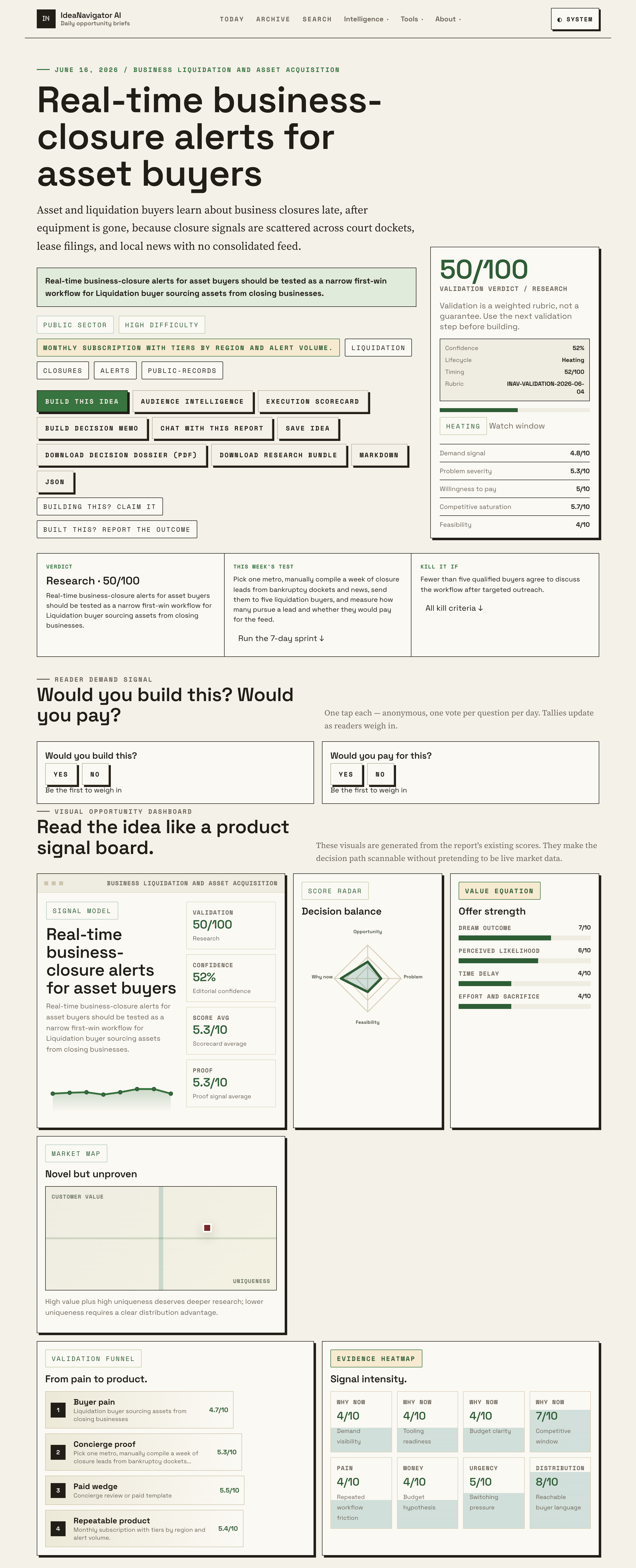
A pilot program introduces real-time alerts for liquidation buyers, notifying them immediately of business closures. This aims to streamline asset acquisition and reduce delays caused by scattered information sources.
Liquidation buyers are set to receive real-time alerts about business closures, aiming to streamline asset acquisition from closing companies. This development addresses longstanding delays caused by scattered closure signals across court dockets, lease filings, and local news, which often result in missed opportunities for buyers. The initiative is currently in a pilot testing phase, with plans to evaluate its effectiveness and potential market adoption.
The new system is designed to provide daily, manually curated alerts based on region and asset category, with human analysts scanning bankruptcy dockets and local news sources for relevant closure signals. These alerts will include details such as business type, estimated asset value, and closure timeline. The goal is to give liquidation buyers a timely advantage, allowing them to act before assets are removed or sold elsewhere.
According to an anonymous researcher involved in the pilot, the system is intended to be a cost-effective, subscription-based service with tiered pricing based on region and alert volume. The initial test involves selecting a metro area, compiling closure leads over a week, and distributing these leads to five liquidation buyers to measure engagement and willingness to pay. The project aims to validate whether real-time alerts can significantly improve asset acquisition efficiency.
Impact on Asset Acquisition Efficiency
This development could transform how liquidation buyers source assets by reducing the delay between business closure and asset acquisition. Currently, buyers often learn about closures too late, when assets are already gone or sold. The ability to receive immediate, consolidated signals may increase the speed and success rate of acquiring valuable equipment and inventory, potentially lowering costs and increasing profitability for buyers.
Market analysts suggest that if successful, this system could set a new standard in liquidation workflows, especially as the volume of small-business closures remains elevated post-pandemic. It may also encourage more systematic, data-driven approaches to asset procurement, reducing reliance on scattered, inconsistent information sources.
business liquidation asset scanner
As an affiliate, we earn on qualifying purchases.
As an affiliate, we earn on qualifying purchases.
Post-Pandemic Rise in Business Closures and Data Accessibility
The idea for real-time alerts arises amid a backdrop of increased small-business closures and bankruptcies following the COVID-19 pandemic. Despite the higher volume of closures, current information flows are fragmented, with signals scattered across court records, lease filings, and local news outlets. The recent shift toward electronic filing of bankruptcy and legal records has made it feasible to aggregate this data more efficiently, enabling the development of real-time alert systems.
Previous efforts to track business closures relied on manual or delayed data collection, limiting timely asset acquisition. The pilot project builds on recent technological advances and the growing need for more immediate information in the liquidation market, which continues to recover from pandemic-related disruptions.
“The goal is to provide liquidation buyers with timely, consolidated alerts that can significantly improve their asset sourcing process.”
— an anonymous researcher
Uncertain Effectiveness and Market Adoption
It is not yet clear how many liquidation buyers will adopt the system or whether the alerts will lead to a measurable increase in successful asset acquisitions. The pilot is limited in scope, and broader market validation is still pending. Additionally, the accuracy and timeliness of manually curated alerts may vary, and operational challenges could affect scalability.
Next Steps for Pilot Evaluation and Expansion
The project team plans to complete the initial testing phase by collecting data on alert engagement and buyer feedback over the coming weeks. Success metrics include the number of leads pursued, conversion rates, and willingness to subscribe at different tiers. Pending positive results, the system could expand to additional regions and asset categories, with automation and AI integration considered for future iterations.
Key Questions
How will the alerts be delivered to buyers?
The alerts will be sent via email or a dedicated platform, depending on buyer preferences, with daily updates based on the curated data.
What types of assets will the system focus on?
The initial focus is on equipment and inventory from small businesses, with potential expansion to real estate and other assets in future phases.
How much will the subscription service cost?
Pricing is still being finalized but will be tiered based on region and alert volume, aiming to be accessible for small and large buyers alike.
When will the system be available more broadly?
If the pilot proves successful, a broader rollout could occur within the next 6-12 months, depending on feedback and operational adjustments.
Are there privacy or legal concerns with data collection?
The system relies on publicly available records and news sources, complying with legal standards for data use and privacy.
Source: IdeaNavigator AI
Columbus Day / Indigenous Peoples' Day Picks
long weekend sales
As an affiliate, we earn on qualifying purchases.