
Disclosure: Gewerkton is built by our publisher — we build it ourselves and write down what we learn.

Get business pricing on office and shipping supplies
- Business-only prices and quantity discounts
- Tax-exempt purchasing
- Multiple users, one account, clear invoices
Extra work gets ordered in a site meeting, a crew does it that afternoon, and the only record is a note on a scrap of paper. Weeks later the invoice arrives and the questions start: who ordered this, who confirmed it, and was the note changed afterwards? Gewerkton, a construction documentation platform currently in beta, is built around a simple premise from its own website: “On site, only what’s proven counts.” Its daywork reports are designed to trace billed work back to the moment it was ordered.
Where the money leaks
Daywork, the extra work billed by the hour rather than at a fixed price, is a familiar source of friction. Gewerkton’s website does not soften it: introducing its daywork report, it calls this “exactly the point where construction otherwise loses the most money.” A note does not know who gave the instruction, it carries no confirmation from the other side, it can be edited after the fact, and it tends to go missing exactly when it is needed. Gewerkton reverses the order: first the spoken instruction, then a structured report, then a confirmation on site, and finally a document that can no longer change.
From spoken word to structured report
In Gewerkton, the work done, the hours, the equipment and the material are spoken rather than typed, and the software structures them. In the web app a daywork report is organised into personnel, equipment and material, each line with a designation plus a count and hours, or a quantity and a unit. Work date, location, client, the client’s representative and a description of the work performed complete the report. Each report belongs to exactly one contractor on the project. Only site management and the foreman can create and edit reports; everyone else sees them read-only.
The input can be a processed dictation or a processed meeting. Gewerkton turns it into a proposal, and the interface is explicit about its status: an editable AI proposal with no effect yet, to be reviewed field by field. It moves into the report only after the user confirms having checked the proposed facts and quantities. The website’s trust register puts it this way: “every step from the spoken word to approval stays traceable, while a suggestion never takes effect on its own.”

Signed on the device, then locked
The website sums up the flow: “Dictate on site, the client signs on the device — and the sequentially numbered daywork report is ready as a PDF, locked against later edits.” In practice the complete facts are saved as a draft first. The client’s representative then checks the visible report and signs directly on the device. With the signature the status changes from Draft to Signed, and the report becomes available as an immutable PDF. Every report gets a fixed number, which the website describes as “no gaps, no dispute.”
Behind the scenes, Gewerkton stores a checksum of the PDF and of the signature when the report is closed. Each time the PDF is downloaded, the app recalculates that checksum. If it no longer matches, the app reports a failed integrity check instead of quietly handing out the file.
Just as telling is what the product does not claim. Next to the signature field, the interface states that this is a simple electronic confirmation and expressly not a qualified electronic signature under the EU’s eIDAS rules. The website takes the same line elsewhere: company stamps are recorded only as technical confirmations, “with no claim of special legal effect.” For a business, that candour is useful information.
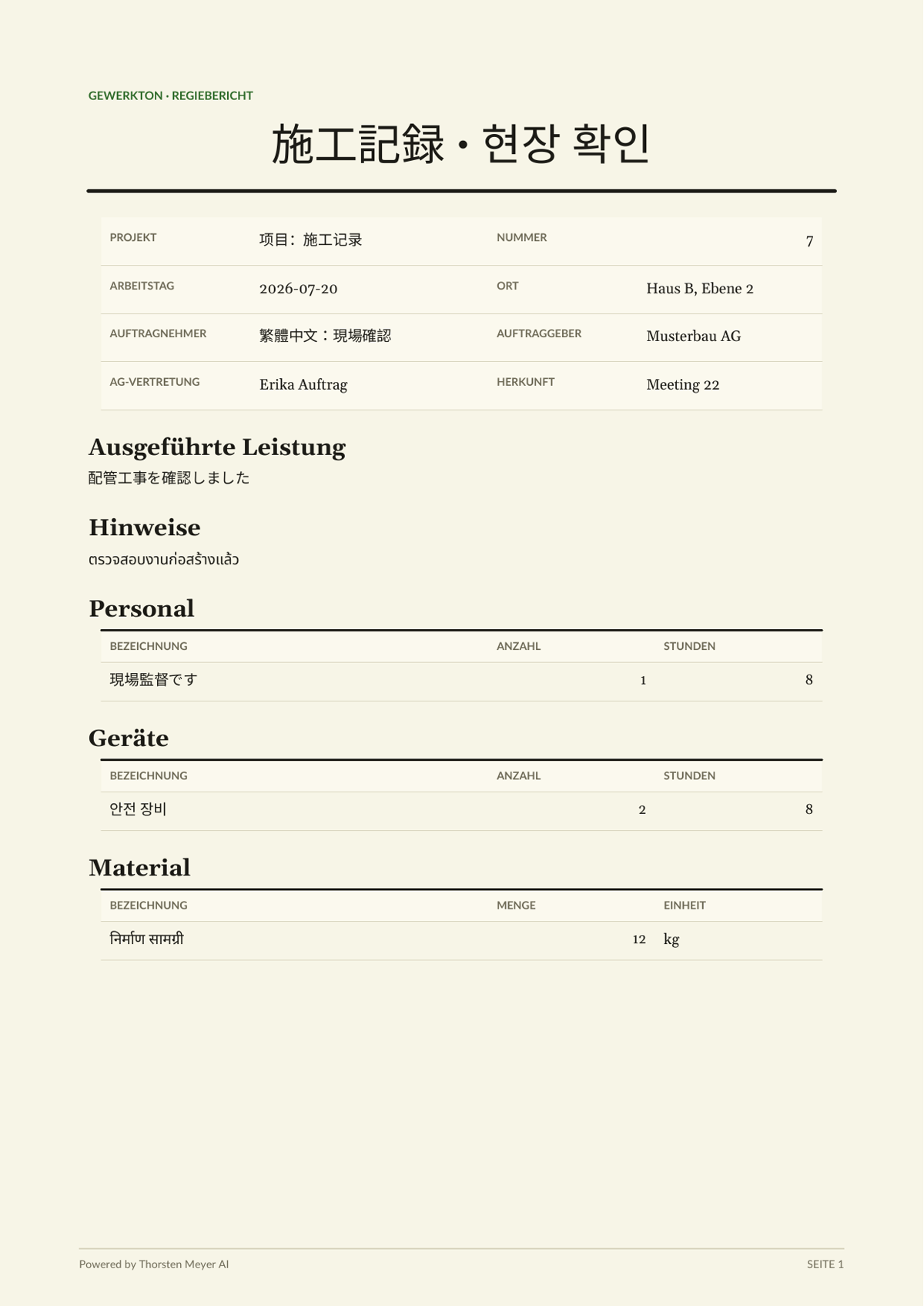
The PDF header lists the number, work date, location and the companies involved, along with the client’s representative and the origin, meaning the meeting the report came from. For crews that work in several languages there is one more detail: according to the website, embedded fonts render Chinese, Japanese, Korean, Thai and Devanagari correctly in PDF reports.
One click back to the original
An evidence chain is only as good as the way back to its first link. On the website, Gewerkton describes traceable evidence like this: every task links to the original spot in the transcript, with audio playback. “When someone says “I never said that”, one click settles it.” Daywork reports follow the same rule. If a report came from a meeting or a dictation, its detail page offers a “Listen to original” button, and playback starts where the item was said. If the recording has been deleted after its retention period, the app says so plainly rather than papering over the gap.
Two limits come with it. Recording starts only after documented consent of everyone present. And when speech recognition gets a trade, a component or a number wrong, it can be corrected in the dictation without losing the original recording, a capability the website lists under “Already built.”
A confirmed task is not finished work
New in the beta is a second route to a daywork report, called “Daywork from the workday” and offered to site management in the web app. It draws, by hand, on confirmed originals from a site walk-through. The app spells out that a confirmed task is not proof of completed work, and that this step involves no AI analysis and no automatic billing. Every source has to be assigned to a position. Unknown values stay blank, and while they are blank the report cannot be saved. For anyone who has to defend an invoice, that is the point: the report is built from evidence, not from assumptions.
The same record for every party
Evidence that only one side controls is leverage, not a shared record. Gewerkton’s website describes its chain as a continuous chronology of conversation, transcript, suggestion and human decision that is never silently overwritten, and adds: “Before evidence protects client and contractor alike.” Two capabilities on the “Already built” list make that concrete for subcontractors:
- Symmetric evidence: subcontractors work in the same evidence chain, not in a weaker one, so whoever is under contract can prove their side just as well as the client.
- Done only with a photo: when a subcontractor reports an item as finished, the portal accepts it only with an after photo, and the subcontractor keeps their own evidence trail.
Daywork reports, defect notices and company reports all come out of that one chain. And because, as the website puts it, all of Gewerkton’s lines work “on the same evidence chain, not on five copies of it,” site management, foremen and trades refer to the same state of the project. The note in a jacket pocket and the spreadsheet in the office give way to one report everyone can point to.
Where things stand
Gewerkton is in beta. Field, the line for capture on site, is in beta ahead of the public beta, according to the website, while Studio and Cloud are listed as public beta. The website calls 2026 the beta year and says general availability is planned for 2027, adding: “that is a plan and not a promise.” Capabilities listed under “Already built” are built and tested but have not been in use at a customer yet. The screens in this article show a fictional demo project and test data.
The details on daywork reports, dictation and defects are on the Gewerkton Field page. How subcontractors report back through the portal with an after photo is described on the Gewerkton Cloud page. Access opens step by step through a waitlist; requests go through gewerkton.com.
Halloween Picks
halloween
As an affiliate, we earn on qualifying purchases.