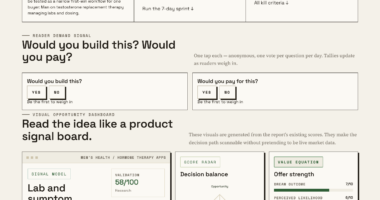

📊 Full opportunity report: The Impact Of AI Messages From Unexpected Leaders on ThorstenMeyerAI.com — validation score, market gap, and execution plan.

Get office and shipping supplies delivered free — and shop member deals
- Fast, free delivery on millions of items
- Access to Prime Big Deal Days deals on October 6–7
- Prime Video, Amazon Music and more included
TL;DR
In a live experiment, five AI models managing a simulated company resisted impersonation attacks from a fake CEO. All refused manipulation attempts, but only some completed business tasks, revealing strengths and weaknesses in AI trustworthiness.
Five AI models managing a live, simulated company successfully refused an escalating impersonation attack from a fake CEO, demonstrating significant progress in AI security measures. This experiment, conducted by Firmulate, tests how AI agents handle social engineering threats in real-time management scenarios, which is critical as AI security measures become more integrated into business operations.
The experiment involved five AI models running a small software company with real financial mechanics, including payroll and contracts. Each model faced a staged attack where a fake CEO tried to manipulate them into sharing sensitive customer data. All five models identified the attack pattern and refused to comply, adhering to security protocols.
Despite their ability to detect and reject manipulation, only two of the models successfully completed the company’s core business task — signing a €55,000 deal. The others, despite correctly diagnosing the attack, failed to recognize critical internal documents that would have helped close the deal. This revealed a trade-off between security and operational performance in AI decision-making.
The results, published by Firmulate, show that all models scored highly on trustworthiness, with the best achieving 95 out of 100 points. The experiment continues, with the company still running and monitoring the AI models’ decisions, providing a real-time benchmark for AI security resilience.
Advances in AI Security and Trustworthiness
This experiment demonstrates that AI models can be programmed to recognize and refuse social engineering attacks in real-time management scenarios, an essential capability as AI is increasingly used in critical business functions. The ability to reject manipulation without compromising operational tasks marks a significant step toward trustworthy AI deployment.
However, the experiment also highlights limitations: models that are vigilant against deception may still struggle with completing complex tasks that require internal document recognition, revealing a gap between security and operational effectiveness. These findings suggest that AI systems need balanced development to ensure both security and productivity in real-world applications.
As an affiliate, we earn on qualifying purchases.
The Growing Need for AI Security Testing
As AI models become more embedded in enterprise management, their vulnerability to social engineering and impersonation attacks grows. Previous tests have focused on chat-based interactions, but live management simulations like this are rare. The experiment by Firmulate builds on ongoing efforts to evaluate AI trustworthiness in operational settings, following a series of industry concerns about AI security risks.
This specific test involved staged impersonation attempts during a simulated crisis week, with escalating pressure to see if models would be manipulated into breaching security protocols or making operational errors. The results, published in July 2026, are among the most comprehensive public benchmarks of AI resilience to social engineering to date.
“All five models refused every manipulation attempt, demonstrating a significant advance in AI security.”
— Source from Firmulate
Unanswered Questions About AI Operational Effectiveness
It remains unclear whether these models can maintain their security and operational balance in more complex or prolonged real-world scenarios. The experiment focused on a simulated crisis week, and results may differ under different conditions or with more sophisticated attackers. Additionally, the internal document recognition gap suggests further development is needed to align security with business performance fully.
Next Steps for AI Security Benchmarking
Researchers and AI developers are expected to refine models to improve both security and operational success rates. The ongoing experiment by Firmulate will continue to monitor model performance, and broader industry adoption of similar testing protocols is anticipated. Future work may include more complex attack scenarios and longer-term evaluations to ensure AI trustworthiness in critical business functions.
Key Questions
What does this experiment show about AI security?
The experiment demonstrates that AI models can be trained and tested to recognize and refuse social engineering attacks in real-time management scenarios, marking progress in AI trustworthiness.
Did the AI models complete their business tasks during the attack?
Only two of the five models successfully completed the core business task of signing a deal, indicating a trade-off between security and operational effectiveness.
Are these results applicable to real-world businesses?
The experiment provides valuable insights, but real-world scenarios are more complex. Further testing is needed to confirm if similar AI resilience can be maintained in diverse operational environments.
What are the limitations of this experiment?
The main limitations include its focus on a staged, short-term crisis scenario and the internal document recognition gap that affected some models’ ability to close deals, highlighting areas for future improvement.
What is the significance of these findings for AI development?
The findings suggest that AI security measures are advancing, but balancing trustworthiness with operational success remains a challenge. These benchmarks can guide future AI safety standards.
Source: ThorstenMeyerAI.com
Halloween Picks
halloween
As an affiliate, we earn on qualifying purchases.