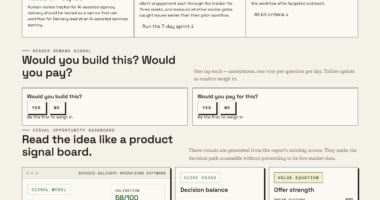

📊 Full opportunity report: The cleaner cap table. Why Anthropic’s public-benefit structure dodges OpenAI’s charitable-trust problem — and trades it for a governance question of its own. on ThorstenMeyerAI.com — validation score, market gap, and execution plan.

Get business pricing on office and shipping supplies
- Business-only prices and quantity discounts
- Tax-exempt purchasing
- Multiple users, one account, clear invoices
TL;DR
Anthropic’s structure, built as a Public Benefit Corporation with a Long-Term Benefit Trust, avoids the conversion issues faced by OpenAI. Both companies face governance discounts in public markets, but Anthropic’s design shifts the challenge to trust governance, not conversion legality.
Anthropic’s corporate structure, established from its founding as a Public Benefit Corporation with a Long-Term Benefit Trust, avoids the legal and regulatory issues associated with OpenAI’s charitable trust conversion, offering a potentially cleaner path to public markets.
Founded in April 2021 by former OpenAI researchers Dario and Daniela Amodei, Anthropic was designed from the start as a Public Benefit Corporation paired with a Long-Term Benefit Trust. Unlike OpenAI, which faced legal scrutiny over its attempt to convert a charitable trust into a for-profit entity, Anthropic’s structure inherently sidesteps this issue because it was never a nonprofit to convert.
The Trust holds a special class of voting stock, with trustees empowered to influence board decisions and enforce the company’s mission to prioritize safety and public benefit over shareholder returns. This setup means no investor can override the Trust’s mandate, including major stakeholders like Google, Amazon, or institutional investors involved in its Series G funding.
Market analysts note that while Anthropic’s structure avoids the legal pitfalls of trust conversion, it introduces a different governance discount. Public investors tend to scrutinize mission-driven trusts that subordinate shareholder interests, which could impact valuation. Conversely, OpenAI faces the challenge of proving its trust conversion was lawful and durable, which also affects its market prospects.
The cleaner cap table.
Why Anthropic’s public-benefit
structure dodges OpenAI’s
charitable-trust problem —
and trades it for a governance
question of its own.
to convert · no charitable trust
board majority within ~4 years
$30B raise · GIC + Coatue led
breakeven 2027-28 vs 2030s
- Conversion history · nonprofit → capped-profit → PBC · $130B Foundation equity + control
- The litigation · Musk case dismissed on timing, on appeal · underlying theory unreached
- Regulatory overhang · AG settlement + oversight · IRS conversion review · future plaintiffs
- Microsoft entanglement · AGI clause · $38B revenue-share cap · 27% equity · access through 2032
- The Long-Term Benefit Trust · Class T voting · escalating board control · mission-balancing mandate
- Hyperscaler concentration · Google ~14% / $40B · Amazon $25B · much in credits · antitrust at IPO
- Compute dependency · AWS / GCP reliance · SpaceX 300MW / 220,000 GPUs · unit-economics proof
- Mission-vs-margin tension · ad-free pledge · Pentagon dispute cost a contract OpenAI won
The cleaner cap table is not the cleaner valuation. Anthropic dodged the exact problem that consumed three weeks of OpenAI’s litigation — by adopting a structure that introduces a governance question public markets have never priced at this scale. It is a different discount, not no discount.Thorsten Meyer · The Cleaner Cap Table · AI Governance 02
Implications of Mission-Driven Corporate Structures on Public Market Valuations
Anthropic’s design exemplifies a different approach to aligning AI safety and public benefit with corporate governance, potentially setting a precedent for future AI companies seeking public funding without legal hurdles. However, the inherent governance discount applied by public markets to mission-focused structures remains a critical barrier, influencing how investors value these firms. The contrast with OpenAI highlights the broader challenge: balancing mission integrity with investor expectations in the evolving AI industry.
As an affiliate, we earn on qualifying purchases.
Background of AI Governance Structures and Public Market Challenges
OpenAI’s transition from a nonprofit to a for-profit capped its legal and regulatory challenges but introduced governance risks that impact valuation, especially concerning trust conversion legality. In contrast, Anthropic’s founding as a Public Benefit Corporation with a Long-Term Benefit Trust was explicitly designed to prevent such legal issues, emphasizing mission preservation over profit maximization. This structural divergence reflects broader debates about how AI firms can align their safety and ethical commitments with market expectations and investor interests.
“Anthropic’s structure simply does not present the question of charitable trust conversion, making it a cleaner legal profile than OpenAI’s, but it shifts the governance challenge to trust control.”
— Thorsten Meyer
Unresolved Questions About Market Valuation and Governance Discounts
It remains unclear how significantly the market will discount Anthropic’s mission trust structure compared to OpenAI’s trust conversion over time, and whether investor appetite will favor one governance model over the other. The impact of future disclosures, regulatory developments, and investor sentiment on valuations is still evolving.
Next Steps for Anthropic and OpenAI in Public Markets
Both companies are expected to file their S-1 disclosures in 2026, where detailed governance and valuation considerations will be outlined. Market reactions to these filings will reveal how investors perceive the trade-offs between legal clarity, governance control, and mission alignment. Ongoing regulatory scrutiny and investor debates will shape their public-market trajectories.
Key Questions
How does Anthropic’s structure differ from OpenAI’s?
Anthropic was founded as a Public Benefit Corporation with a Long-Term Benefit Trust from the start, avoiding the need for trust conversion. OpenAI, on the other hand, converted a charitable trust into a for-profit, facing legal and regulatory scrutiny.
What is the main governance challenge for Anthropic?
Its mission trust explicitly subordinates shareholder interests, which public investors may view as a governance discount, potentially affecting valuation.
Why do public markets discount mission-driven companies?
Because such structures often limit shareholder control and may threaten profit maximization, leading investors to perceive higher risks and assign lower valuations.
Will Anthropic’s approach influence future AI company structures?
Potentially, as it demonstrates a legal and governance model that avoids trust conversion issues, though market acceptance depends on investor perception of mission risk versus legal clarity.
What are the regulatory implications for these structures?
Anthropic’s structure faces fewer regulatory hurdles related to trust conversion, but its mission focus may attract scrutiny regarding governance and investor protections in public markets.
Source: ThorstenMeyerAI.com
Fall Picks
fall essentials
As an affiliate, we earn on qualifying purchases.